Aircraft
The Spruce Goose: the plane that flew once, then disappeared for 30 years
The Hughes H-4 Hercules was the biggest aeroplane ever built, and it was made of wood. It flew for about a mile in 1947. Then Howard Hughes hid it.
Radu BalasReviewed by Adrian Man
Published 6 min read

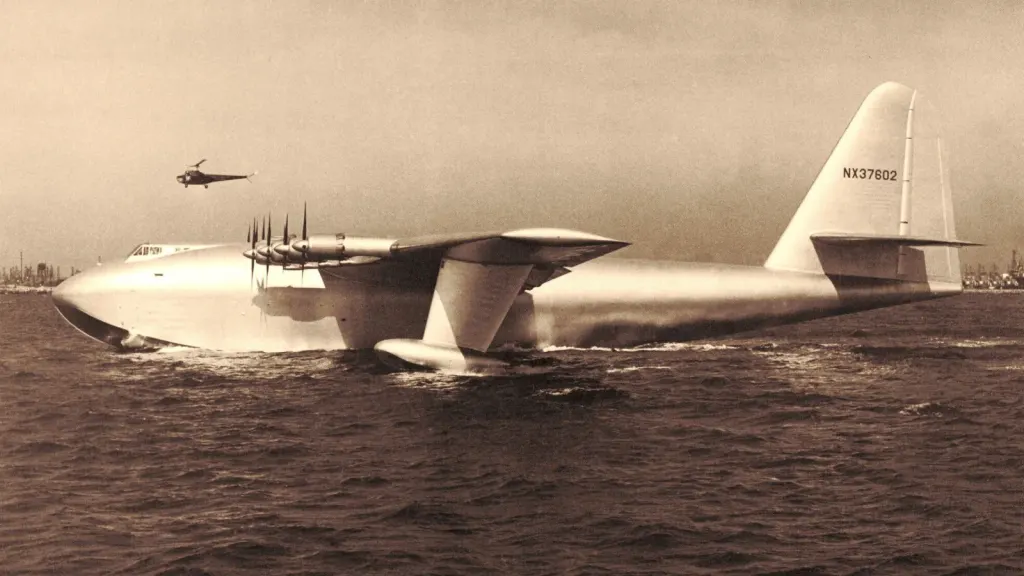
On a windy Sunday in November 1947, thousands of people lined the shore at Long Beach, California, to look at a monster. The biggest aeroplane anyone had ever built sat on the water. It had eight engines, a wing you could play a football match on, and a hull made of wood.
The plan for the day was taxi tests. Drive it up and down the harbour, show the press it worked, go home. Nobody was supposed to fly. A few reporters were even on board, notebooks out. On the third run, Howard Hughes pushed the throttles forward, the spray turned into a wall, and the water let go. The Hercules flew about a mile, perhaps 70 feet up, and came gently back down.
That was it. It never flew again. And Hughes didn't scrap it or sell it. He locked it away, kept a crew paid to look after it, and kept it ready to fly for the rest of his life.
A war that was being lost at sea
To understand the plane, go back to 1942. German U-boats were sinking American cargo ships faster than the yards could build them, some of them within sight of the US coast. Troops, tanks and fuel had to cross the Atlantic, and the sea was where they were dying.
Henry Kaiser had an answer. Kaiser was the man whose yards were building Liberty ships in days instead of months, and he thought the same could be done with aircraft. Fly the cargo over the submarines. Build giant flying boats, hundreds of them, out of whatever material the war effort could spare.
Kaiser knew ships, not planes. So he went to Howard Hughes, who had the aircraft company, the record-breaking H-1 racer and a reputation for doing things nobody else would try. The government gave the pair a contract for three flying boats, and a rule that came with it: no metal. Aluminium was for bombers and fighters.
Built of wood
The answer was birch, not spruce. Thin sheets of it, glued in layers and shaped like a boat hull, a process the Hughes team had to invent as they went. Getting the glue right alone took years. The press christened it the Spruce Goose, a name Hughes hated for the rest of his life.
The numbers are still hard to take in. A wingspan of about 320 feet, wider than a Boeing 747 and wider than anything that flew for the next 70 years. A hull longer than a basketball court and taller than a five-storey building. Eight Pratt & Whitney R-4360 Wasp Major engines, the biggest piston engines ever put into production, each one close to 3,000 horsepower.
And it was late. Badly late. Kaiser lost patience and walked away. The contract was cut from three aircraft to one. In 1946 Hughes nearly died test-flying another of his projects, the XF-11 spy plane, which crashed into houses in Beverly Hills. By the time the hull was ready to be moved to Long Beach, the war it was built for had been over for a year.
The Senate
In August 1947 a Senate committee investigating war contracts called Hughes to Washington. The question was simple: millions of dollars of public money, and what had America got for it? Senators called the flying boat a flying lumberyard.
The hearing was supposed to destroy him. It did the opposite. Hughes, shy, half deaf and still recovering from the crash, fought back. He accused the senator leading the attack, Owen Brewster of Maine, of offering to make the inquiry go away if Hughes merged his airline, TWA, with its biggest rival. Brewster denied it. The room gasped anyway.
Then Hughes said the line the film is built around. He had put the sweat of his life into the plane, he said, and his reputation was rolled up in it. If it was a failure, he would probably leave the country and never come back. The hearings fizzled out. Hughes went home to Long Beach to prove it.
Why it never flew again
People have argued about this for almost 80 years. The simple answer is that nobody needed it. The war was over, jets were arriving, and big metal planes with wheels could land on runways all over the world. A wooden flying boat the size of a ship looked like a dinosaur the day it flew.
Some engineers say it only got airborne because it was flying so close to the water, where a wing picks up extra lift from the air trapped underneath. Others say one short, stable flight and a clean landing prove the design worked. Nobody ever found out, because Hughes never tried again.
There's a third answer, and it's the one the film argues for. Hughes had told the Senate it would fly, and it flew. Every flight after that risked the win. The plane wasn't fully his to sell either, since much of it belonged to the government on paper. And the man himself was changing, pulling away from people and towards the strange, private life he became famous for.
The hidden years
So he hid it. Hughes built a climate-controlled hangar around the aircraft to protect the wood from the sea air, and he kept a crew on the payroll whose whole job was to keep it clean, keep the engines turning over, and keep it ready. For almost 30 years, while jets crossed the Atlantic and men walked on the moon, it was still 1947 inside that hangar.
Hughes died in April 1976, aged 70, on a plane flying to a hospital in Texas. For the first time since the war, nobody was paying to look after the giant. For a while there was a real chance it would be cut up.
Where it is today
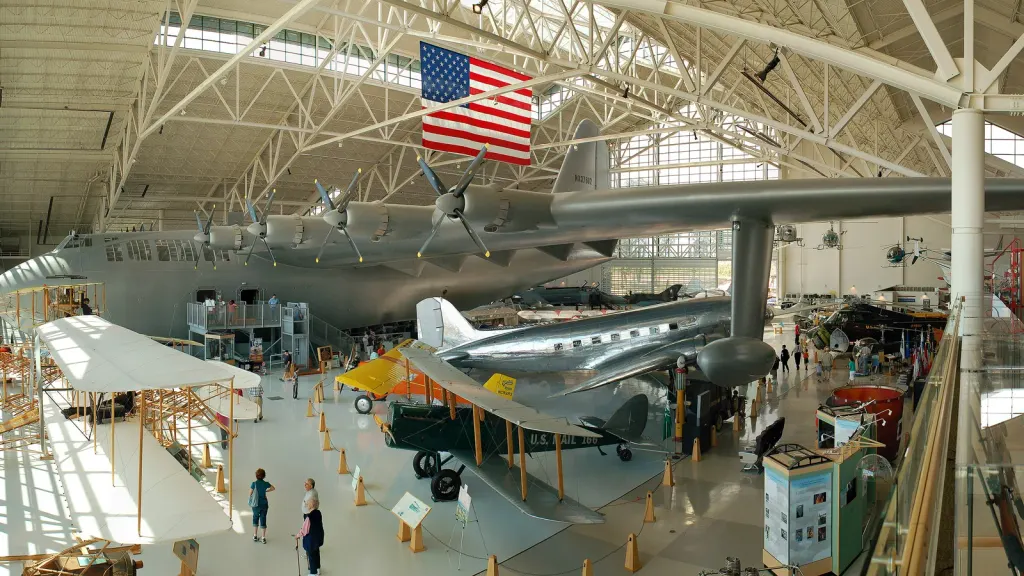
It was saved. In the early 1980s it went on show in Long Beach inside a dome next to the Queen Mary, and for the first time ordinary people could stand under that wing and look up. In the early 1990s it was taken apart again, floated up the Pacific coast and the Columbia River on a barge, and trucked piece by piece to McMinnville, Oregon.
The Evergreen Aviation and Space Museum was built around it. Smaller aircraft sit under its wing. Its wingspan stayed the widest of any aeroplane until Stratolaunch, a twin-bodied rocket carrier, flew in 2019. A Boeing 747 would fit beneath it with room to spare.
Was it a failure?
It never carried a soldier or crossed an ocean. It flew once, for about a mile, and spent the rest of its life indoors. But a man was told it couldn't be done, was laughed at, investigated and nearly killed, put his name on the line in front of the whole country, and then climbed into the cockpit and proved it. The plane was never really about the war. It was about a stubborn man who refused to be told no.
The film
Our 32 minute film tells the whole story in twelve chapters, from the U-boat war to the museum floor, using US National Archives newsreels, 1947 colour footage from the Internet Archive and photographs from Wikimedia Commons. Full credits are at the end of the film and in the pinned comment on YouTube.
If this is your kind of story, our film on the Antonov An-225 Mriya and our Boeing history are on the same channel.
Sources: the film's narration and credits; Evergreen Aviation and Space Museum; Smithsonian National Air and Space Museum; US Senate War Investigating Committee hearings, August 1947.

About the author
Radu Balas
Founder, Flying Engineer
View author profile Editorial policy and correctionsExplore Aircraft Sales
Browse 773 companiesNeed a charter, a part or a service?
Tell us what you need and we share it with up to 3 relevant companies, who reply to you directly.