Bombardier Global 7500 Explained: The Private Jet Built for Ultra-Long-Range Luxury
 Marius StefanTechnology ManagerPublished 14 min read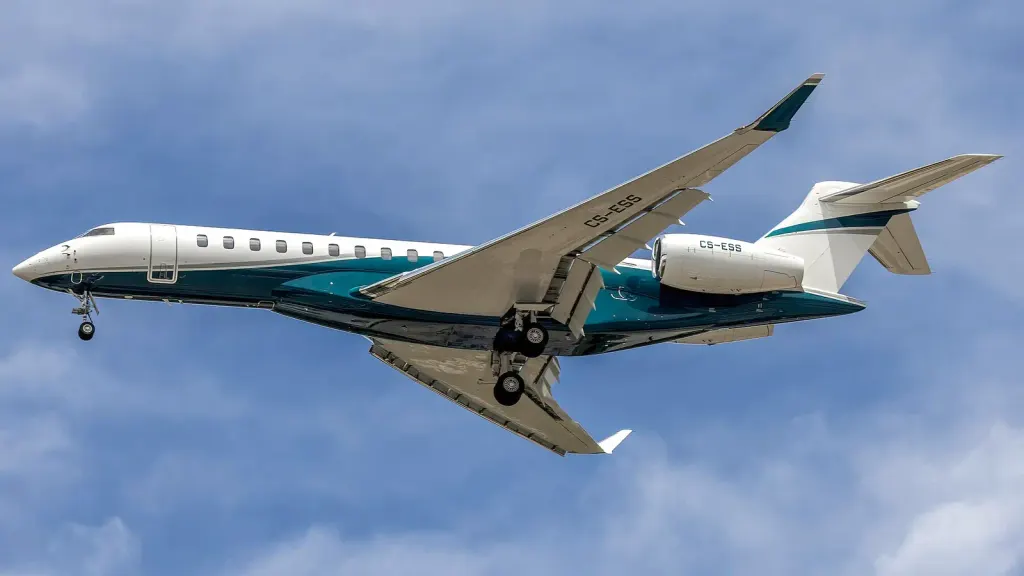
When Bombardier unveiled the Bombardier Global 7500, the aerospace industry recognized something rare: an aircraft that didn't simply compete with existing business jets but fundamentally redefined what ultra-long-range private aviation could deliver. The Global 7500 combined record-breaking range with a cabin layout revolutionary enough to transform how the ultra-wealthy experience transcontinental travel.
The Global 7500 holds the range record for purpose-built business jets at 7,700 nautical miles, proved through a Singapore-to-Arizona nonstop demonstration flight covering 8,152 nautical miles under optimal conditions. This capability enables true global connectivity without compromise, appealing to buyers who refuse to accept refueling stops on any route.
Understanding why this aircraft became one of the most desired private jets in history requires looking beyond published specifications to the design philosophy that created cabin experiences, performance capabilities, and engineering innovations competitors continue struggling to match.
What Is The Bombardier Global 7500?
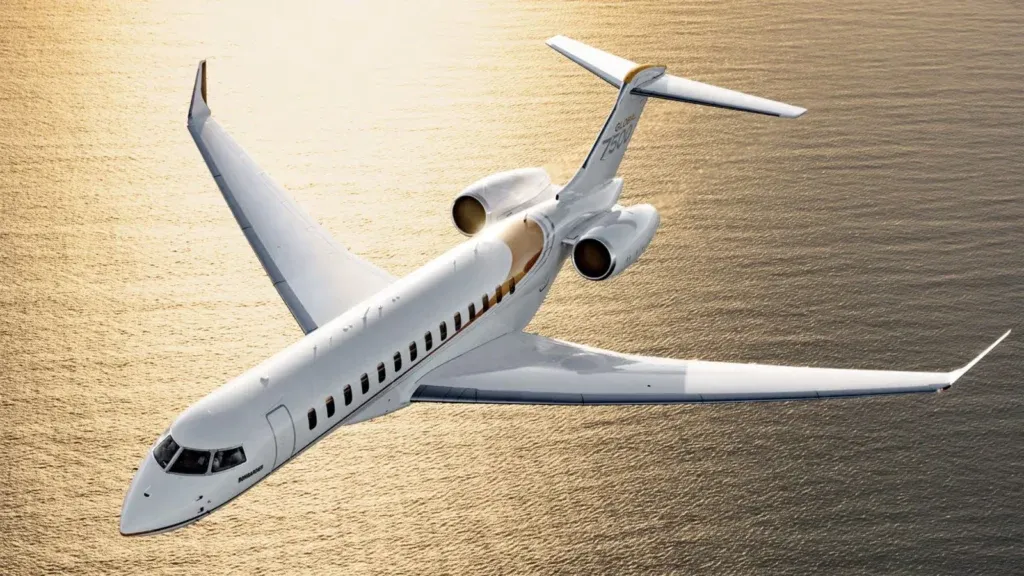
The Bombardier Global 7500 represents Canadian aerospace giant Bombardier's flagship business jet, designed to compete directly with the Gulfstream G650ER and position the company as leader in ultra-long-range private aviation. The aircraft evolved from Bombardier's Global Express family, incorporating revolutionary cabin design and next-generation engineering.
Bombardier developed the Global 7500 with a singular ambition: creating the most capable and innovative business jet ever built. This goal demanded not just incremental improvements over existing Bombardier models but fundamental rethinking of how passengers experience ultra-long flights lasting 12-15 hours.
The aircraft entered service in 2018, immediately establishing itself as the range leader in business aviation. Bombardier positioned the Global 7500 against both the established Gulfstream G650ER and the then-upcoming Gulfstream G700, arguing that range leadership and cabin innovation justified the significant investment required.
The gamble s쳮ded. The Global 7500 attracted high-profile buyers including royal families, multinational corporations, and ultra-high-net-worth individuals who recognized capabilities impossible in any competing aircraft. The four-zone cabin layout in particular created demand from buyers who had never previously considered Bombardier products.
Why The Global 7500 Became So Popular
The Global 7500's market success stems from multiple advantages that individually impress and collectively create an aircraft experience unmatched in business aviation.
Range Leadership: At 7,700 nautical miles, the Global 7500 flies farther than any purpose-built business jet, enabling specific mission profiles impossible for competitors. Singapore to Los Angeles (7,614 nm) nonstop, New York to Hong Kong with favorable winds, Dubai to any major Asian capital without refueling — routes that separate the Global 7500 from aircraft falling even 200 nm short.
Revolutionary Cabin: The four-zone cabin introduced genuine privacy through solid doors separating living spaces, a concept no competitor had attempted in a business jet. This innovation resonated with buyers accustomed to private suites on superyachts and in luxury residences who found traditional open-cabin jets inadequate.
Smooth Ride Technology: Active wing control surfaces detect and counter turbulence before passengers feel it, creating the smoothest ride in business aviation. Sensors measure atmospheric disturbances and command rapid control surface movements that dampen turbulence effects, a technology derived from military flight control systems.
Brand Positioning: Bombardier successfully repositioned from "alternative to Gulfstream" to "category leader in innovation," attracting buyers who previously defaulted to Gulfstream based on reputation alone. The Global 7500 gave these buyers a compelling reason to reconsider.
Cabin Luxury And Passenger Experience
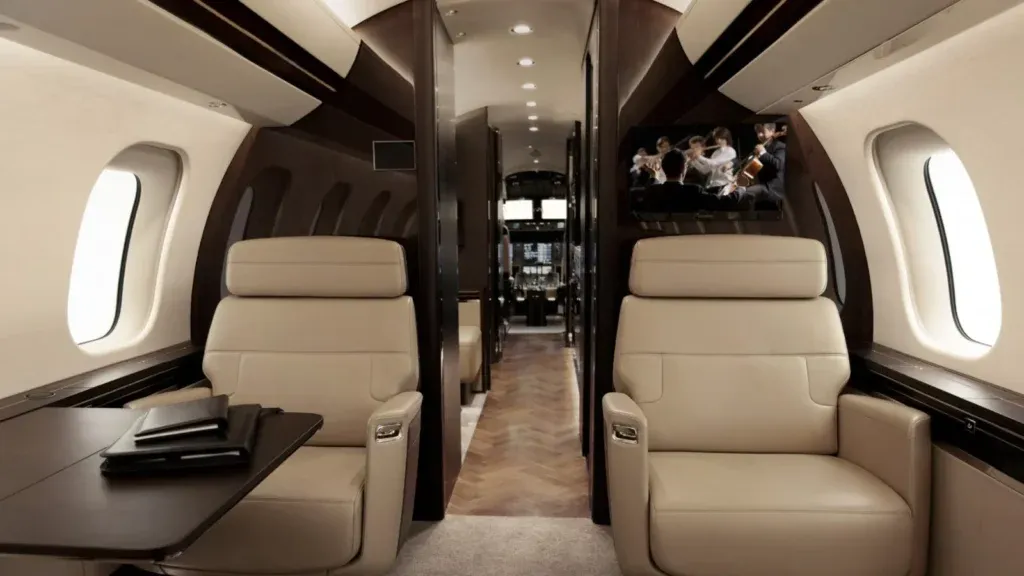
The Global 7500's four-zone cabin layout represents the single most significant innovation in business jet interior design in decades. Solid doors between zones create genuine privacy impossible in conventional open-cabin designs, transforming how passengers utilize space during ultra-long flights.
The four zones typically configure as:
- Zone 1 — Conference/Dining: Full-size table seating six to eight, convertible between meeting space and formal dining. Solid door separates this zone from the rest of the cabin.
- Zone 2 — Entertainment Lounge: Theater-style seating with large display screens, entertainment systems, and comfortable recliners designed for relaxation during long flights.
- Zone 3 — Master Suite: Permanent king-size bed (not a converted divan), ensuite bathroom with full-standing shower, private dressing area. Solid door ensures complete privacy.
- Zone 4 — Dedicated Crew Suite: Separate rest area with private lavatory ensuring crew remains fresh during ultra-long missions without intruding on passenger space.
The cabin measures 54.4 feet long, 8.2 feet wide, and 6.2 feet high, providing approximately 2,637 square feet of usable space. While not the largest dimensions in its class, the compartmentalized layout creates a feeling of spaciousness through variety, each zone offering distinct atmospheres and purposes.
Nuage Seating: Bombardier's proprietary seating system features a floating base mechanism enabling deep recline without the seat physically tilting backward. The zero-gravity position distributes body weight evenly, reducing pressure points and improving comfort during flights exceeding 12 hours. Many owners report Nuage seats surpass first-class airline seating in sustained comfort.
Large windows positioned throughout the cabin flood the interior with natural light, while Bombardier's Nice HD cabin management system controls entertainment, lighting, temperature, and window shading through tablet interfaces. High-speed Ka-band connectivity enables video conferencing and streaming throughout the flight.
The full-sized galley enables gourmet meal preparation, critical for flights lasting 12-15 hours where catering quality directly impacts passenger satisfaction and energy levels. Professional flight attendants can prepare multi-course meals rivaling fine dining rather than reheating pre-packaged options.
How Far Can The Global 7500 Fly?
Range defines the Global 7500's core competitive advantage. Maximum published range of 7,700 nautical miles exceeds all purpose-built business jet competitors, though the aircraft demonstrated capabilities beyond this figure under optimal conditions.
The record-setting Singapore-to-Arizona flight covered 8,152 nautical miles nonstop, proving real-world performance exceeds published specifications when wind conditions cooperate. This demonstration established credibility that marketing claims alone cannot create.
Representative Global 7500 missions include:
- New York to Hong Kong: 7,990 nm — achievable with favorable winds (competitors typically require fuel stops)
- Singapore to Los Angeles: 7,614 nm — nonstop capability unique in class
- Singapore to San Francisco: 7,300 nm — comfortable nonstop with reserves
- Dubai to New York: 6,850 nm — easily accomplished with significant reserves
- London to Sydney: 9,000 nm — beyond all current business jet capabilities
The 200-nautical-mile range advantage over the Gulfstream G700 proves critical on specific trans-Pacific routes where every nautical mile determines whether nonstop operation s쳮ds or a costly refueling stop becomes necessary.
For operators whose missions regularly approach 7,000+ nm, the Global 7500's range advantage eliminates uncertainty that competitors cannot. Knowing the aircraft will complete the mission without fuel stops provides operational confidence that directly impacts scheduling, passenger experience, and operational costs.
Speed And Performance Explained
The Global 7500 achieves maximum cruise speed of Mach 0.925, matching the fastest business jets in production. Typical long-range cruise operates at Mach 0.85, balancing speed with fuel efficiency to maximize the aircraft's range advantage.
At Mach 0.85 cruise, the Global 7500 completes a New York to Dubai flight (6,850 nm) in approximately 13 hours 45 minutes. At higher Mach numbers approaching 0.90, the same route reduces to roughly 13 hours but consumes additional fuel, reducing range below the published maximum.
This speed flexibility enables operators to choose mission-specific profiles: maximum range for routes near the aircraft's capability limit, or faster cruise when range permits and time matters most.
Runway performance enables Global 7500 operations from airports requiring approximately 5,800 feet for departure at typical weights. While not matching the Falcon 8X's exceptional short-field capability, this performance provides access to most major business aviation airports globally.
Maximum altitude certification reaches 51,000 feet, enabling cruise above most weather and commercial traffic. This altitude capability improves ride quality, enables more direct routing, and reduces ATC delays common at lower altitudes where airspace congestion impacts operations.
Engineering Behind The Global 7500
The Global 7500's engineering integrates advanced propulsion, aerodynamics, and flight control systems creating genuine operational advantages beyond specification numbers.
GE Passport Engines: Two GE Passport engines, the first all-new business jet engine in over a decade when introduced, produce approximately 18,920 pounds of thrust each. Key advantages include:
- Higher thrust output enabling superior climb performance
- Advanced materials reducing weight and improving durability
- Optimized fuel efficiency at Mach 0.85 long-range cruise
- Quiet operation contributing to low cabin noise levels
- Modern architecture enabling extended maintenance intervals
The Passport engines provide power reserves enabling the Global 7500's class-leading range despite carrying substantial fuel loads for intercontinental missions. Single-engine climb performance exceeds regulatory requirements, providing significant safety margins during critical flight phases.
Advanced Wing Design: The Global 7500 wing incorporates transonic aerodynamics optimized for efficient high-speed cruise while maintaining acceptable low-speed handling. The wing shape enables the aircraft's remarkable range by reducing drag at cruise speeds where most fuel is consumed.
Fly-By-Wire Flight Controls: Electronic flight controls reduce pilot workload through automated trim management, envelope protection, and optimized control responses. The system derives from Bombardier's extensive experience with certified digital flight controls across multiple business jet platforms.
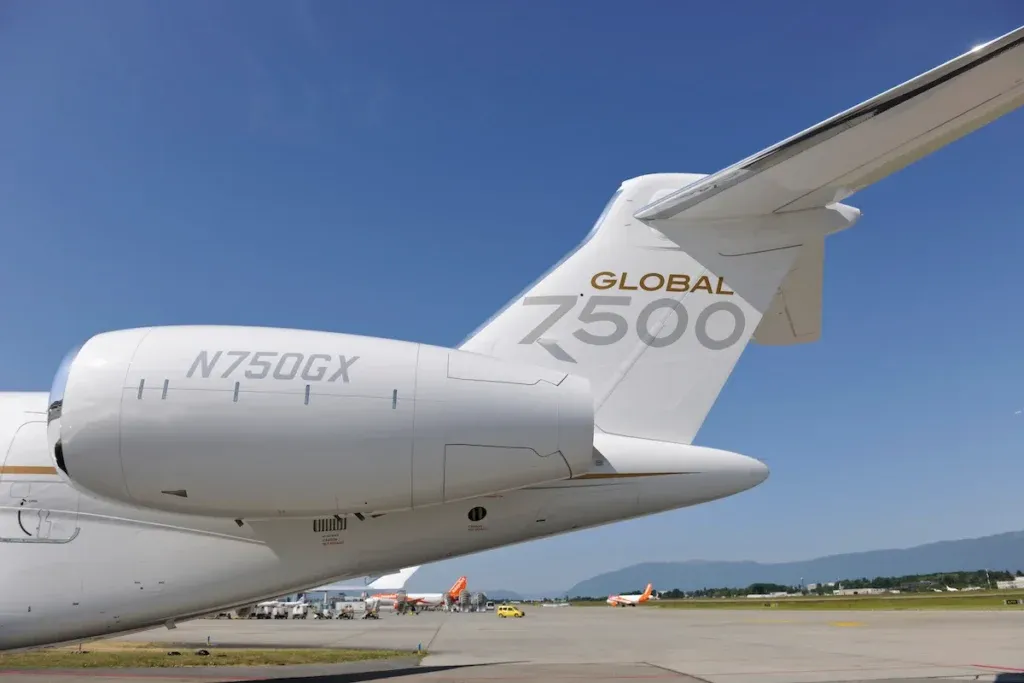
Smooth Ride Technology: Active turbulence dampening using wing control surfaces represents one of the Global 7500's most distinctive engineering achievements. Accelerometers detect atmospheric disturbances and command rapid control surface movements counteracting turbulence before passengers experience it, creating noticeably smoother rides in conditions that buffet competing aircraft.
Why Passengers Love Flying On The Global 7500
Passenger comfort on ultra-long flights depends on factors extending beyond cabin dimensions. The Global 7500 excels through engineering that reduces the cumulative fatigue affecting travelers during 12-15 hour missions.
Reduced Fatigue: The combination of smooth ride technology, Nuage seating, and the four-zone layout enables passengers to move between different environments during long flights. Rather than remaining in a single seat for hours, occupants transition between conference zones, lounges, and private suites, maintaining physical comfort and mental freshness.
Quiet Cabin: Bombardier's acoustic engineering creates one of the quietest cabins in the ultra-long-range segment. Engine noise insulation, structural dampening, and careful attention to aerodynamic noise sources enable comfortable conversation at normal voice levels throughout the cabin.
Sleeping Comfort: The permanent bed in Zone 3 eliminates the awkward divan-to-bed conversions common in competing aircraft. The dedicated bedroom provides hotel-quality sleeping arrangements with proper mattress, quality bedding, and privacy through solid doors ensuring undisturbed rest.
Cabin Altitude: The Global 7500 maintains cabin altitude of approximately 4,850 feet at 41,000 feet cruise altitude. While not matching Gulfstream's industry-leading numbers, this remains comfortable for extended flights. Bombardier compensates through superior cabin layout flexibility and humidity control maintaining comfortable moisture levels.
Corporate travelers report arriving at destinations markedly fresher after Global 7500 flights compared to comparable journeys on competing aircraft. The combination of smooth ride, dedicated sleeping space, and cabin variety creates cumulative comfort advantages that specifications alone cannot capture.
How Much Does A Bombardier Global 7500 Cost?
The Global 7500 occupies the premium tier of business jet pricing, though total ownership costs remain competitive when accounting for the aircraft's operational advantages.
New aircraft pricing starts around $75 million before customization. Interior completion adds $7-15 million depending on materials, design complexity, and technology integration. Total acquisition for fully configured aircraft ranges $82-92 million.
Operating economics include:
- Hourly variable cost: $3,800-4,500
- Annual fixed costs: $400,000-600,000
- Fuel burn: Competitive at Mach 0.85 cruise
- Maintenance reserves: Typical for ultra-long-range category
Pre-owned Global 7500 aircraft command $50-68 million depending on age, total time, and configuration. Strong residual values reflect sustained demand from buyers recognizing the aircraft's capabilities and the limited availability of competing alternatives matching its range.
The charter market values the Global 7500 highly, as its range enables nonstop missions that generate premium pricing from clients willing to pay substantially more for direct connectivity. Charter operators report strong demand for Global 7500 aircraft on trans-Pacific and intercontinental routes where the range advantage translates directly to higher revenue.
Buyers evaluating ownership structures should note the Global 7500 qualifies for various tax advantages depending on business use, potentially reducing effective acquisition costs through depreciation benefits and operational deductions.
Global 7500 Specifications
| Specification | Bombardier Global 7500 |
|---|---|
| Maximum Range | 7,700 nautical miles (record holder) |
| Max Cruise Speed | Mach 0.925 (710 mph) |
| Typical Cruise Speed | Mach 0.85 (652 mph) |
| Passenger Capacity | Up to 19 (typically 12-17) |
| Cabin Length | 54.4 feet |
| Cabin Width | 8.2 feet |
| Cabin Height | 6.2 feet |
| Cabin Zones | Four (with solid doors) |
| Engines | GE Passport (2x, 18,920 lbs thrust each) |
| Maximum Altitude | 51,000 feet |
| Cabin Altitude at 41,000 ft | ~4,850 feet |
| Takeoff Distance | 5,800 feet |
| Base Price (New) | ~$75M |
| Hourly Operating Cost | $3,800-4,500 |
| Distance Record | 8,152 nm (Singapore to Arizona) |
Global 7500 vs Competitors
| Aircraft | Range (nm) | Max Speed | Cabin Focus | Base Price |
|---|---|---|---|---|
| Global 7500 | 7,700 | Mach 0.925 | Four-zone layout, Nuage seats, range record | ~$75M |
| Gulfstream G700 | 7,500 | Mach 0.925 | Lowest cabin altitude, panoramic windows | ~$78M |
| Dassault Falcon 10X | 7,500 | Mach 0.85 | Widest cabin (9.1 ft), quietest, fighter-jet tech | ~$75M |
| Gulfstream G650ER | 7,500 | Mach 0.925 | Iconic prestige, proven reliability, strong resale | ~$70M |
The Global 7500 maintains clear range leadership while matching or exceeding competitors on speed and innovation. The four-zone cabin layout remains unique in business aviation, with no competitor offering equivalent compartmentalized privacy.
Gulfstream counters with industry-leading cabin altitude (2,840 feet versus 4,850 feet) and established brand prestige that continues attracting buyers who prioritize proven excellence. The Falcon 10X will offer the widest cabin in business aviation when it enters service, creating additional competitive pressure.
Buyers increasingly evaluate these aircraft as different expressions of ultra-long-range excellence rather than strictly better or worse alternatives. The Global 7500 appeals most to those prioritizing maximum range, cabin privacy, and Bombardier's innovative approach. Competitors attract buyers valuing cabin altitude, speed flexibility, or established brand loyalty.
Why The Global 7500 Changed Business Aviation
The Global 7500's influence extends beyond its sales numbers to how it reshaped industry expectations and competitive dynamics across the ultra-long-range segment.
Before the Global 7500, business jet cabins defaulted to open layouts maximizing flexibility over privacy. The four-zone concept with solid doors proved that buyers wanted genuine separation between living spaces, forcing competitors to reconsider their interior design philosophies for future models.
The Nuage seating system demonstrated that business jet seats could innovate beyond traditional recline mechanisms, introducing comfort technology previously confined to automotive and furniture industries. Several competitors have since developed enhanced seating systems influenced by Bombardier's approach.
Smooth ride technology established turbulence dampening as an expected feature in ultra-long-range jets, with competing manufacturers developing similar active systems for next-generation models.
The Global 7500 proved Bombardier could compete with and even lead against Gulfstream in the ultra-long-range segment. This competitive pressure benefits all buyers through accelerated innovation and improved capabilities across the category. Without the Global 7500's success, the Gulfstream G700 might have evolved more conservatively.
For buyers considering aircraft beyond the business jet segment entirely, the Global 7500 represents the practical limit before transitioning to VIP airliners like the BBJ 777X, which serve fundamentally different mission profiles at dramatically higher acquisition and operating costs.
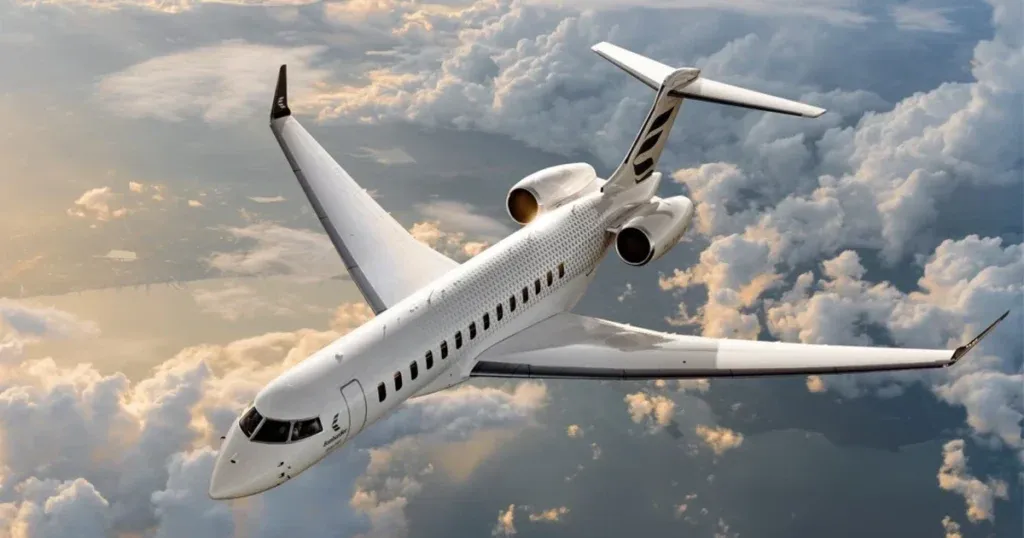
Bombardier Global 7500 aircraft on tarmac
Frequently Asked Questions
How Much Does A Bombardier Global 7500 Cost?
The Bombardier Global 7500 base price starts around $75 million for new aircraft before interior customization. Completion costs add $7-15 million depending on materials selection, technology integration, and design complexity. Total acquisition for fully configured aircraft typically ranges $82-92 million. Pre-owned Global 7500 aircraft command $50-68 million depending on age, total time, and equipment specification. Annual operating costs including fuel, crew salaries, maintenance, insurance, and hangar reach approximately $3.5-4.5 million for typical 400-500 hour yearly utilization. Hourly variable costs run $3,800-4,500. Charter and fractional alternatives exist for buyers not ready for full ownership commitment.
How Far Can The Bombardier Global 7500 Fly?
The Global 7500 achieves maximum published range of 7,700 nautical miles at Mach 0.85, the longest range of any purpose-built business jet. The aircraft demonstrated real-world capability exceeding published specifications through its record-setting Singapore-to-Arizona nonstop flight covering 8,152 nautical miles under favorable conditions. Representative missions include Singapore to Los Angeles (7,614 nm) nonstop, New York to Hong Kong (7,990 nm with favorable winds), Dubai to New York (6,850 nm with significant reserves), and Singapore to San Francisco (7,300 nm comfortably). The 200 nm range advantage over the nearest competitor proves critical on extreme trans-Pacific routes where the difference determines nonstop capability versus costly refueling stops.
Who Owns Bombardier Global 7500 Aircraft?
Global 7500 ownership includes ultra-high-net-worth individuals, multinational corporations, governments, and royal families requiring maximum range and cabin innovation. The aircraft appeals particularly to buyers with frequent trans-Pacific travel requirements where its range advantage enables specific nonstop missions impossible in competing jets. Corporate operators value the four-zone cabin enabling productive meeting spaces separated from rest areas during ultra-long flights. Government operators appreciate the aircraft's range for diplomatic missions requiring nonstop intercontinental connectivity. Fractional ownership providers operate Global 7500 fleets serving affluent clientele willing to pay premium rates for the aircraft's capabilities. Celebrity and entertainment industry ownership also exists, attracted by privacy features and ultra-long-range capability.
Is The Global 7500 Better Than Gulfstream?
Neither the Global 7500 nor competing Gulfstream models represent universally superior choices, as each aircraft serves different operational priorities. The Global 7500 excels with longest range in class (7,700 nm versus 7,500 nm), revolutionary four-zone cabin layout with solid doors providing genuine privacy, Nuage seating comfort innovation, and smooth ride technology reducing turbulence effects. Gulfstream models counter with industry-leading cabin altitude (2,840 feet versus 4,850 feet at cruise), established brand prestige built over decades, stronger historical resale values, and extensive global support networks. Buyers prioritizing maximum range and cabin innovation favor the Global 7500; those valuing cabin altitude, brand prestige, and proven reliability favor Gulfstream. Both manufacturers produce exceptional aircraft, with the choice depending on specific operational priorities rather than clear superiority.
Redefining What Business Jets Can Achieve
The Bombardier Global 7500 earned its reputation through genuine innovation rather than incremental refinement of existing designs. The four-zone cabin, record-breaking range, Nuage seating, and smooth ride technology collectively created an aircraft that changed industry expectations and forced every competitor to raise their standards.
For buyers demanding maximum range and cabin privacy unavailable in any other business jet, the Global 7500 remains the definitive choice. Its 7,700-nautical-mile capability enables specific missions impossible for competitors, while the compartmentalized cabin creates living spaces that rival luxury residences rather than merely improving upon airplane interiors.
The aircraft's influence on business aviation extends beyond its own commercial success. The innovations Bombardier introduced with the Global 7500 reshaped how the entire industry approaches cabin design, passenger comfort, and operational capability. This transformative impact ensures the Global 7500's legacy endures regardless of what future aircraft eventually surpass its specifications.
In the rarefied world of ultra-long-range business aviation, the Global 7500 proved that innovation and ambition can challenge established dominance. For private aviation buyers seeking the absolute maximum in range and cabin innovation, the Bombardier Global 7500 remains the aircraft against which all others measure themselves.
Explore Aircraft Charter
Browse 1,108 companiesGet private jet charter quotes
Tell us your trip and we will pass it to operators that fly it.