Guides
What Is an ATC Simulator? A Plain Guide
An air traffic control simulator lets controllers practise on made up traffic. This guide explains the types, who uses them and what a good one can do.
Published 2 min read
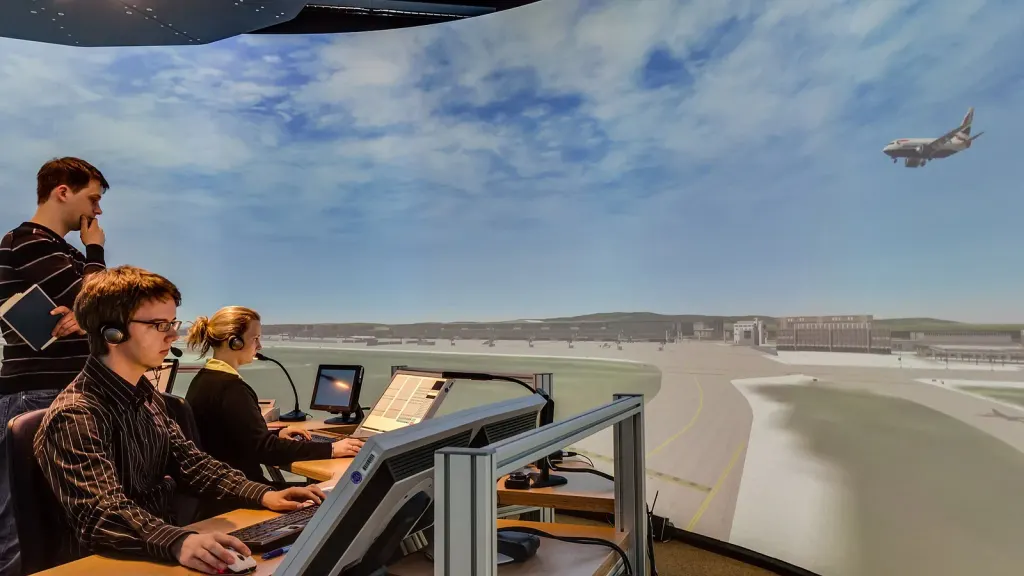
An air traffic control simulator lets controllers practise on made up traffic. There are no real planes and no real risk. It is software, and often a whole room, that looks and sounds like a tower, a radar room or a control centre.
What is in a simulator
A simulator has three parts that work together. The first is the picture of the airport or the airspace. The second is the simulated aircraft that move, climb, turn and land. The third is the voice side: someone or something answers the controller by radio, like a pilot would.
The controller sits at a working position with screens, a radio and a keyboard. An instructor sits at a separate station. The instructor sets the weather, the traffic and any problems, such as a runway closing or a radio failure.
The three main types
- Tower simulators. These show the view from the tower: runways, taxiways and the apron. Some use a few large screens. Others use projectors to wrap a 360 degree view around the room. Controllers practise take offs, landings and aircraft moving on the ground.
- Radar simulators. These show the radar screen, where aircraft are symbols with their flight details next to them. They cover approach control near an airport, and control of flights over a larger area.
- Integrated systems. These link the tower, the radar and the flight plan data in one exercise. Training centres use them to practise the whole chain, from the first call to the handover.
EUROCONTROL, the European air traffic body, uses this split. It describes a real time platform for en route and approach work, and a lighter tool for tower work (EUROCONTROL).
Who plays the pilots
Many training centres use pseudo pilots. These are people who answer the controller by radio and make the simulated aircraft do what they are told. It takes skilled staff, so it costs money. Some newer systems try to replace pseudo pilots with speech recognition, but this is still being developed.
Who uses simulators, and for what
- Controller schools and universities, to teach the first skills
- Air navigation service providers and airports, for refresher training and to practise rare events
- Armed forces, which train their own controllers
- Airports and authorities, to test a new runway, a new procedure or a new airspace layout before it goes live
What a good simulator can do
- Model the airport and the airspace you really use
- Let the instructor change flight plans and traffic
- Add weather and failures
- Record an exercise and play it back for the debrief
A simulator does not replace training on live traffic. Controllers still need supervised practice and the approvals of their own authority.
On the Flying Engineer
Looking for a simulator supplier? See the companies on our air traffic control systems page. To prepare for supplier calls, read how to choose ATC simulator software. For the people behind the screens, see the highest paying countries for air traffic controllers.
Source: EUROCONTROL

About the author
Cristina Gabriela
Marketing Strategy Manager
View author profile Editorial policy and correctionsExplore Aircraft Charter
Browse 1,782 companiesNeed a charter, a part or a service?
Tell us what you need and we share it with up to 3 relevant companies, who reply to you directly.