Aviation SEO and GEO: What We Learned Checking 16,000 Aviation Websites
We checked 16,058 aviation company websites. Half of maintenance shops and parts suppliers score under 20. Here is what aviation SEO and GEO mean, and what to fix first.
 Radu BalasFounder, The Flying Engineer
 Reviewed by Adrian ManPublished 4 min read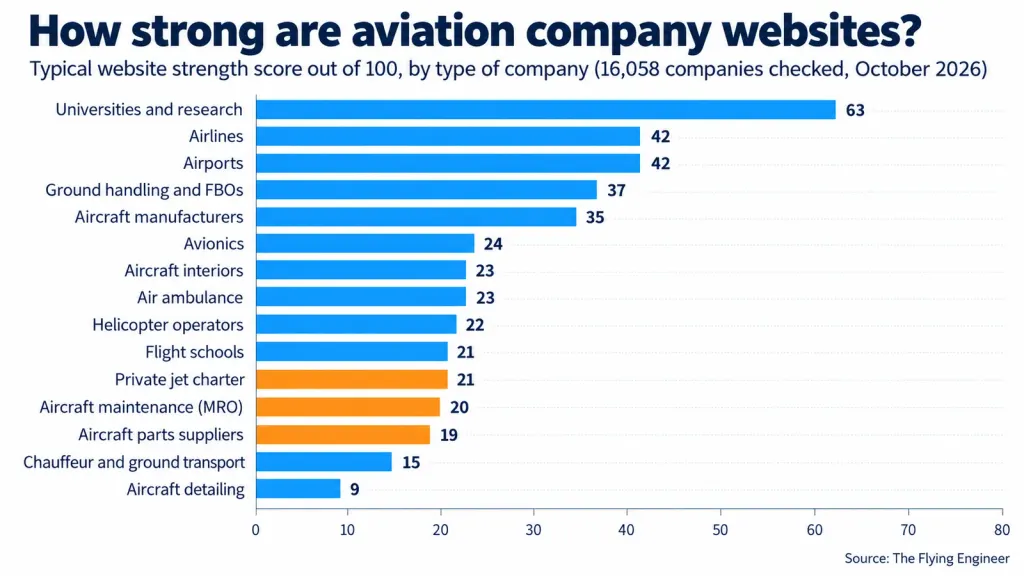
When a buyer needs an aircraft part, a flight school or a charter quote, more and more of them now ask ChatGPT, Copilot or Google's AI first. The AI answers with a few names. If your company is not one of them, the buyer never sees you.
That is what aviation SEO and aviation GEO are about. SEO (search engine optimization) gets you found on Google. GEO (generative engine optimization) gets you named in AI answers. In aviation, both now decide who gets the enquiry.
We checked the websites of 16,058 aviation companies in our directory to see where the industry stands. Here is what we found, and what to fix first.
What we found: most aviation websites are weak
We gave each website a strength score from 0 to 100, based on how much the rest of the web trusts and links to it. It is not the only thing that matters, and a good page can still rank with a modest score. But it is a fair sign of how easily search engines and AI tools will pick a site.
- The typical aviation company website has a strength score of 24 out of 100.
- 38% score under 20.
- Only 10% reach 50 or more.
The gap is not random. The companies buyers contact every day have the weakest websites.
Aviation SEO by sector
Airlines, airports and universities have strong websites. The companies that do the hands-on work, such as maintenance shops, parts suppliers, charter operators and flight schools, are far behind.
| Type of company | Companies checked | Typical strength score | Score under 20 |
|---|---|---|---|
| Universities and research | 159 | 63 | 5% |
| Airlines | 227 | 42 | 12% |
| Airports | 226 | 42 | 13% |
| Ground handling and FBOs | 738 | 37 | 23% |
| Aircraft manufacturers | 206 | 35 | 22% |
| Avionics | 771 | 24 | 33% |
| Aircraft interiors | 292 | 23 | 38% |
| Air ambulance | 672 | 23 | 43% |
| Helicopter operators | 880 | 22 | 43% |
| Flight schools | 1,507 | 21 | 43% |
| Private jet charter | 1,060 | 21 | 46% |
| Aircraft maintenance (MRO) | 1,533 | 20 | 50% |
| Aircraft parts suppliers | 1,577 | 19 | 50% |
| Chauffeur and ground transport | 357 | 15 | 64% |
| Aircraft detailing | 61 | 9 | 72% |
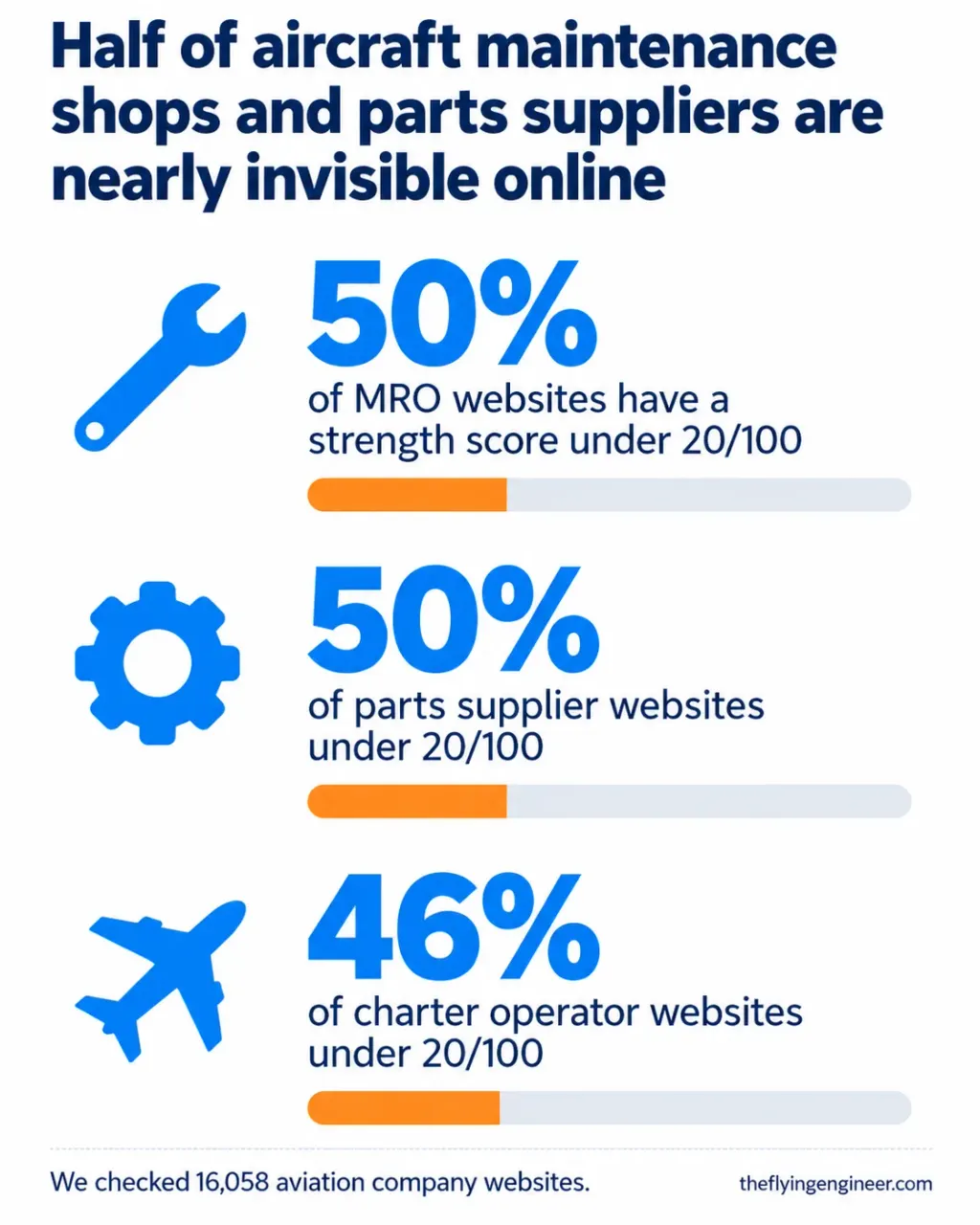
Half of all maintenance shops and parts suppliers score under 20. So do 46% of charter operators. These are exactly the businesses whose buyers now ask AI for a recommendation.
Aviation SEO by country
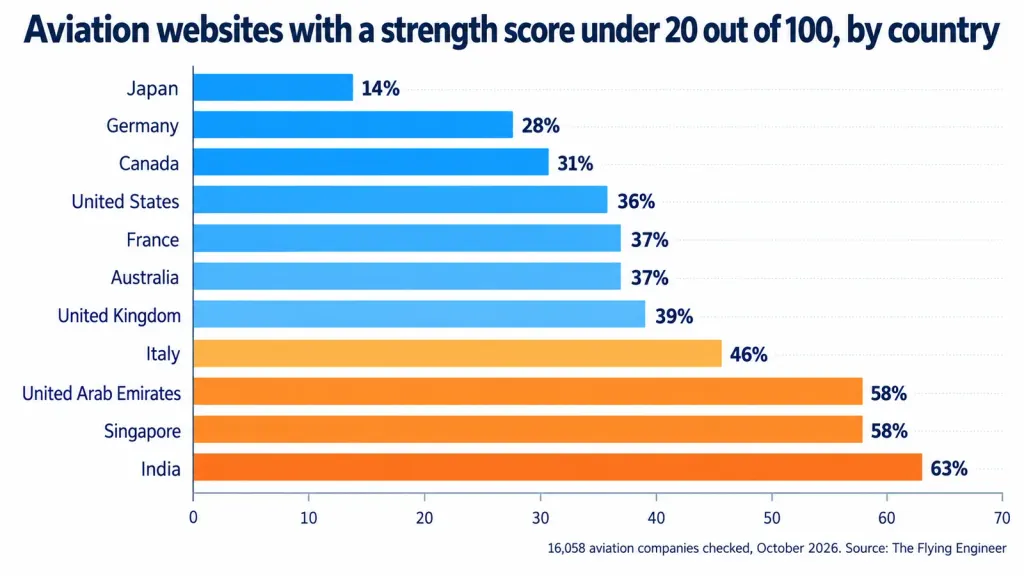
| Country | Companies checked | Typical strength score | Score under 20 |
|---|---|---|---|
| Japan | 163 | 33 | 14% |
| Germany | 759 | 26 | 28% |
| Canada | 424 | 26 | 31% |
| United States | 5,727 | 24 | 36% |
| France | 1,054 | 24 | 37% |
| Australia | 293 | 24 | 37% |
| United Kingdom | 913 | 24 | 39% |
| Italy | 343 | 21 | 46% |
| United Arab Emirates | 186 | 17 | 58% |
| Singapore | 119 | 16 | 58% |
| India | 227 | 15 | 63% |
Japan and Germany lead. In the UAE, Singapore and India, more than half of aviation companies score under 20. For a fast-growing market like Dubai, that is a real opening: the first local companies to fix their websites will be the ones AI names.
What GEO changes for aviation companies
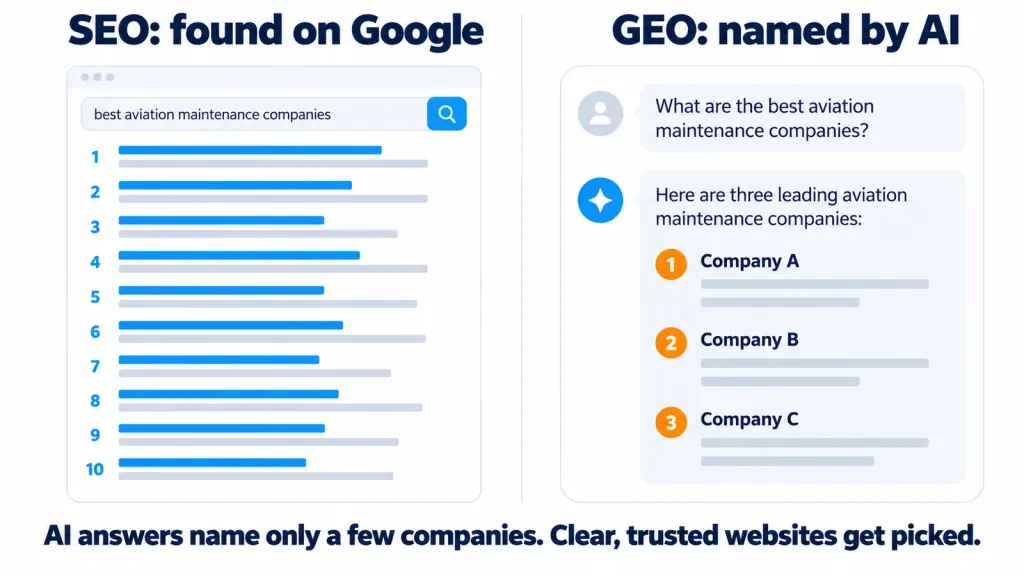
Google shows a list of links. An AI assistant gives one answer with a few names. There is less room, so the AI leans on sources it already trusts: strong company websites, well-known directories and trade press.
We see this on our own site. AI assistants cited The Flying Engineer up to 15,167 times on our best day (Microsoft Bing Webmaster Tools and Google Search Console, 3 June 2026), and Google's AI features have shown our pages 262,000 times since May 2026. Companies that are clearly described on trusted pages get picked up. Companies that are hard to read get skipped.
Aviation SEO and GEO checklist: what to fix first
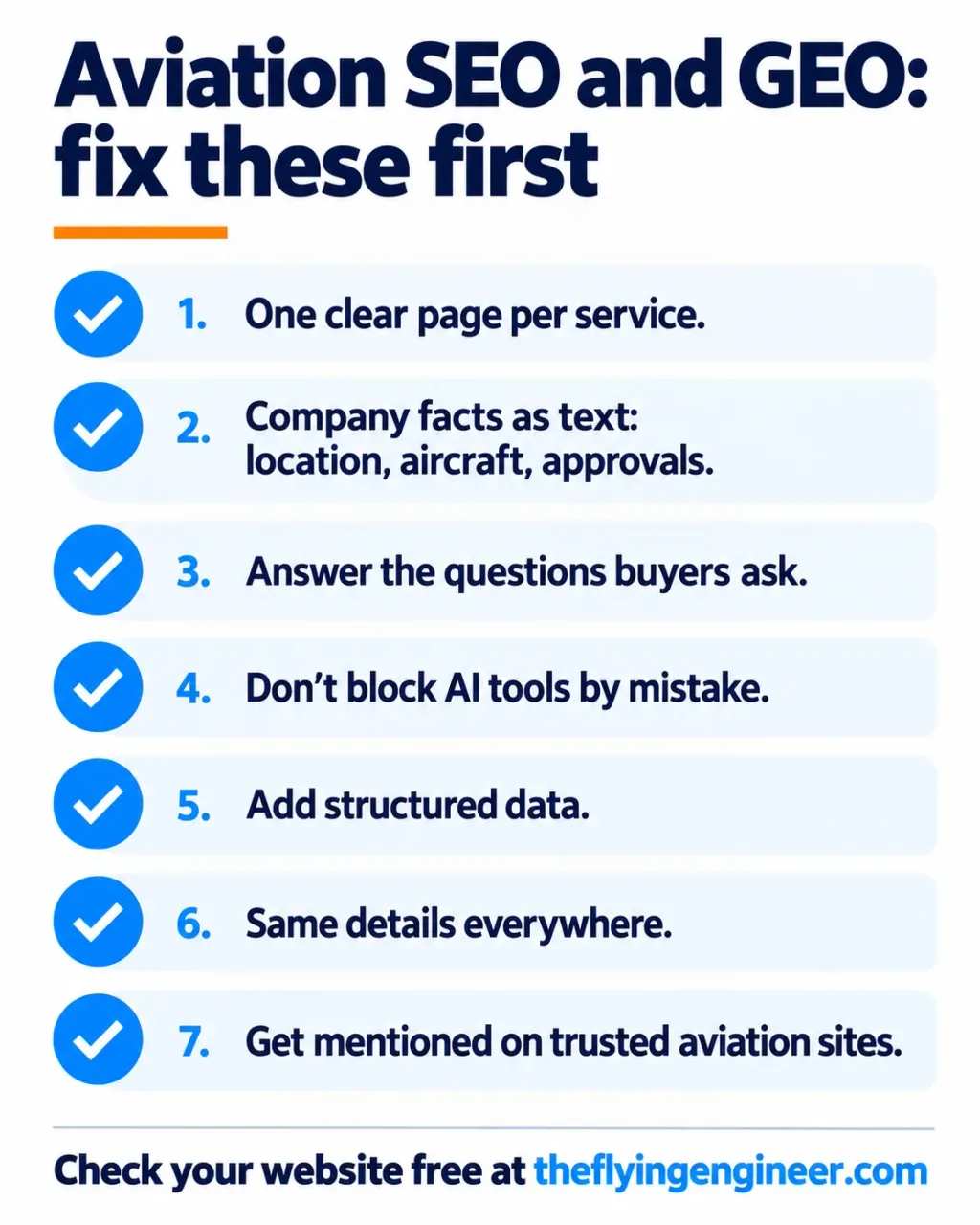
- One clear page per service. "Part 145 maintenance for King Air", not "Solutions". AI matches questions to pages.
- Company facts on the site. Where you are, which aircraft you work on, your approvals (FAA, EASA, AS9120) and how to contact you. Written as text, not only in images.
- Answer the questions buyers ask. Prices, lead times, coverage, how to book. A short FAQ works well for both Google and AI.
- Do not block AI tools by mistake. Some website settings (robots.txt, security plugins) stop AI crawlers. Check yours.
- Add structured data. Organization or LocalBusiness markup tells machines your name, address and services.
- Keep your details the same everywhere. Your website, Google Business Profile, LinkedIn and directory listings should match. AI trusts what it sees repeated.
- Get mentioned on trusted aviation sites. Directories, associations, trade press and events. This is what lifts authority over time.
Even fixing one or two of these can move a company ahead of most of its competitors, because the bar in aviation is still low.
Check your own website
We built a free check that reads your website the way AI tools do and compares it with the rest of the aviation industry. It takes about 20 seconds: check your aviation website.
If you want every issue explained with the fixes in order, our full audit is US$100 once.
How we got these numbers
The strength score is the domain authority of each company website in The Flying Engineer directory, checked in October 2026, matched to the company's category and country. A company can sit in more than one category. Typical score means the median. Countries with fewer than 40 companies are not shown.
About the author
Radu Balas
Founder, Flying Engineer
View author profile Editorial policy and corrections