What Is Involved in an Aircraft Appraisal? A Step-by-Step Guide
Most owners, buyers and lenders only see the finished report. Here is the work behind the number: the field visit, the logbooks, damage history, market research and the final opinion of value.
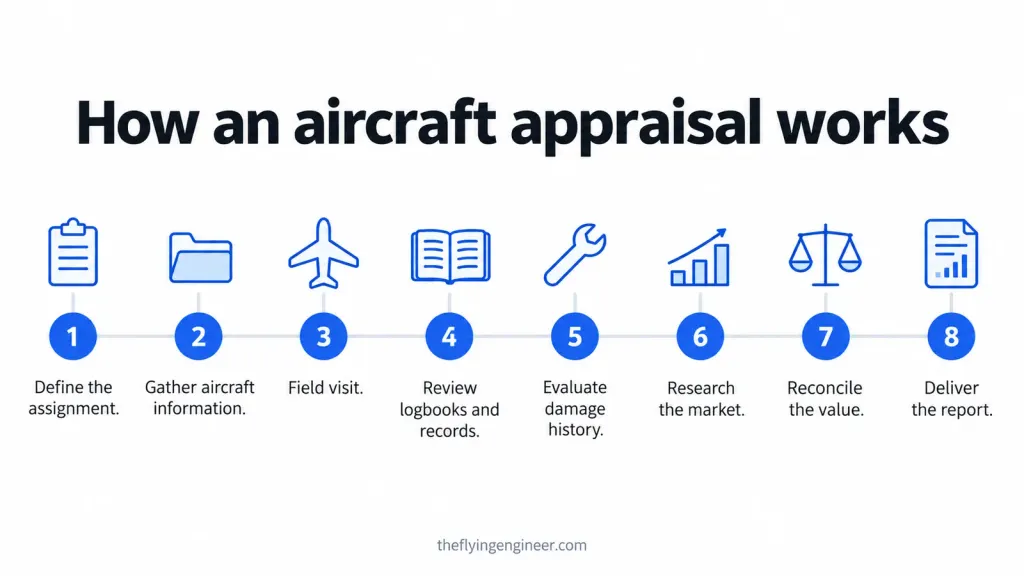
Most aircraft owners, buyers, and lenders only ever see the finished appraisal report: photographs, a records summary, a list of comparable aircraft, and an opinion of value. What they don't see is the work behind that number. A credible aircraft appraisal is not a database lookup or a figure pulled from a price guide. It is a structured process of defining the assignment, examining the aircraft in person, reading its maintenance history, studying the market, and applying professional judgment to reach a conclusion that a lender, attorney, insurer, or court can rely on.
Whether you're financing a purchase, settling an estate, resolving a dispute, or simply want to know what your airplane is worth, understanding that process will help you ask the right questions, prepare the right documents, and recognize the difference between an appraisal that holds up to scrutiny and one that just produces a number.
Step 1: Defining the Assignment
Every appraisal starts with questions about purpose, not about the airplane. Before any work begins, the appraiser needs to know:
- Who the client is and who else will rely on the report
- How the report will be used, such as financing, purchase, divorce, estate, tax, insurance, or litigation
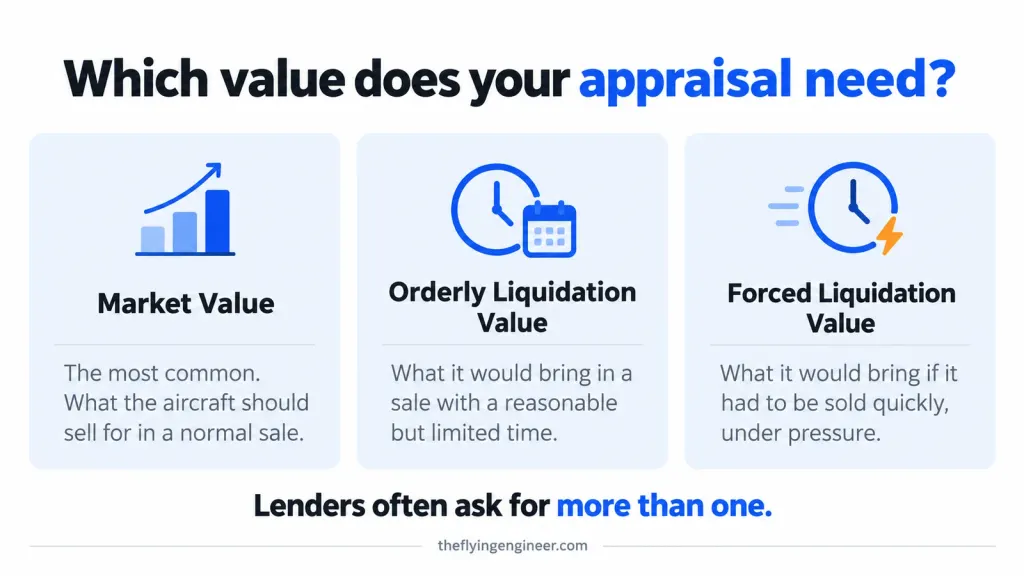
- What type of value is needed.
- The effective date of value, which may be today or, in estate and litigation matters, a date in the past
The value type matters more than most people realize. Market Value is the most common, but a lender may also need Orderly Liquidation Value or Forced Liquidation Value to understand what the collateral might bring if it had to be sold under less favorable conditions.
From these answers the appraiser develops the scope of work. Under the Uniform Standards of Professional Appraisal Practice (USPAP), aircraft are treated as personal property, and the scope of work must be sufficient to produce credible results for the intended use. This is also when the client decides between a certified appraisal and a more limited valuation. A limited or non-certified report can be useful for early screening, but it is not a substitute for a certified appraisal when financing, tax, estate, or litigation decisions depend on the result.
Step 2: Gathering Aircraft Information
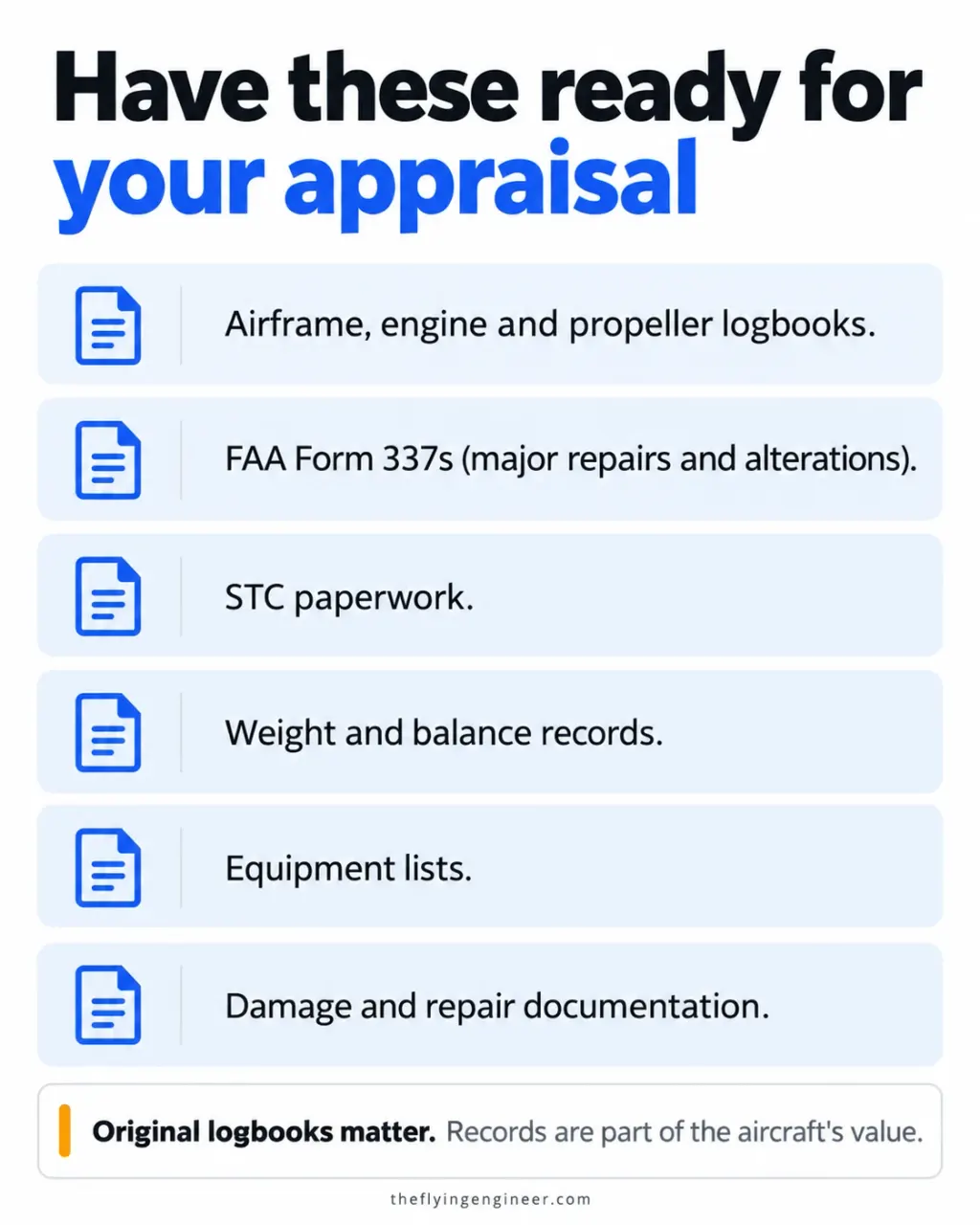
Before the field visit, the appraiser collects the aircraft's identifying details (make, model, serial number, registration, and year of manufacture) along with the owner's description of its equipment and history. The owner is also asked to have the complete records available, including:
- Airframe, engine, and propeller logbooks
- FAA Form 337s (Major Repair and Alteration)
- Supplemental Type Certificate (STC) paperwork
- Weight and balance records and equipment lists
- Documentation of any past damage or repairs
Collecting this information in advance lets the appraiser arrive prepared, know which records should be present, and recognize quickly when something is missing.
Step 3: The Field Visit
The field visit is where a professional appraisal separates itself from a “desktop” estimate and/or a non-certified report. The Professional Aircraft Appraisal Organization (PAAO) Best Practices requires an in-person field visit for the credibility and reliability of the reporting. That step goes above and beyond what USPAP itself requires. Seeing the aircraft lets the appraiser confirm that the airplane in the paperwork is the airplane on the ramp, and observe its condition firsthand instead of relying on an owner's description or listing photos that may be biased or incomplete in some manner.
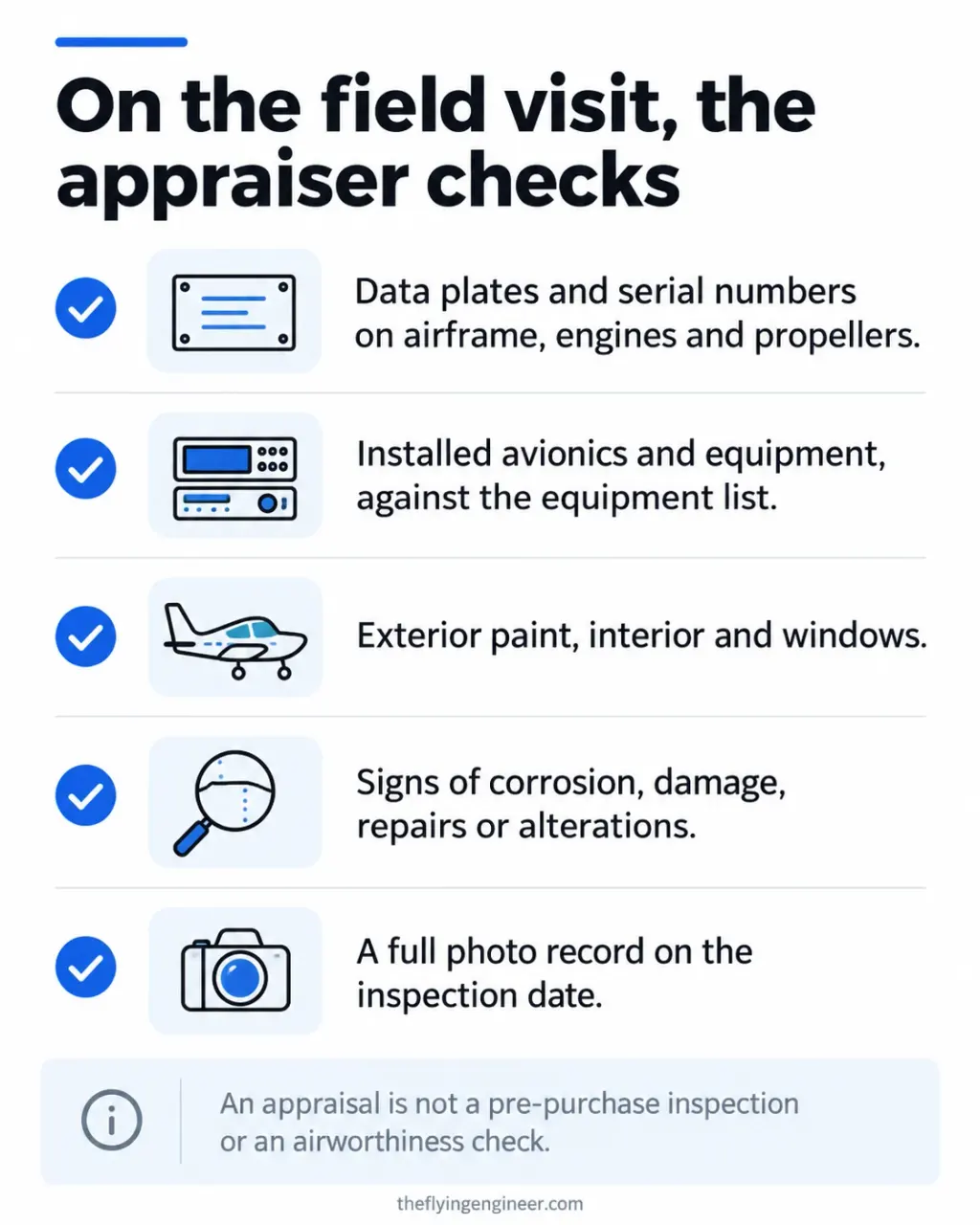
What the Appraiser Looks At
- Data plates and serial numbers on the airframe, engines, and propellers
- Installed avionics and equipment, verified against the equipment list
- Exterior paint, interior, and windows
- Visible evidence of corrosion, prior damage, repairs, or alterations that should be reflected in the records
- A thorough photographic record of the aircraft on the inspection date
What the Field Visit Is Not
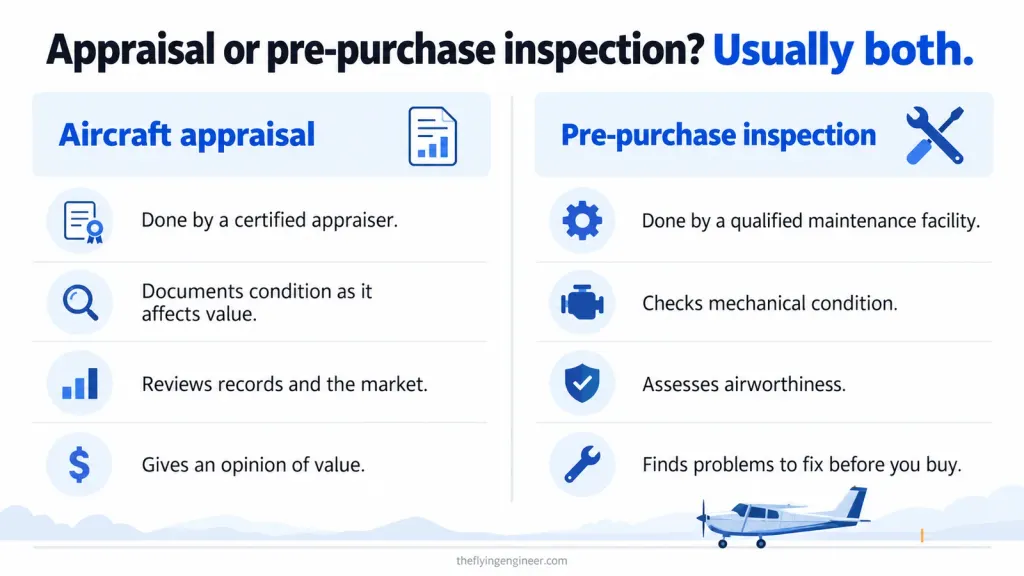
An appraisal inspection is not a pre-purchase inspection, an annual inspection, or a determination of airworthiness. The appraiser observes and documents condition as it bears on value. Mechanical evaluation remains the job of a qualified maintenance facility, and a buyer should still arrange a proper pre-purchase inspection.
Step 4: Reviewing the Logbooks and Records
An aircraft's records are part of its value. Two airplanes that look identical on the ramp can differ significantly in value because one has complete, continuous logbooks and the other has gaps, missing entries, or undocumented repairs. That's why the records review is often the most time-consuming part of the job.
The appraiser reads the logbooks to establish and/or validate:
- Total time on the airframe
- Time since new or since overhaul on the engines and propellers
- Continuity of annual or other required inspections
- Airworthiness Directive (AD) compliance
- Major repairs and alterations documented on Form 337s and STCs
In my own practice, I digitize the logs and records after the field visit, which preserves a contemporaneous record of exactly what was reviewed and these become part of the project’s workfile. An appraiser cannot validate records that someone else assembled or digitized, which is one more reason the original documents matter.
Step 5: Evaluating Damage History
Damage history can affect value long after a repair is complete. When the records or the inspection show evidence of an accident, incident, or significant structural repair, the appraiser documents what happened, when it happened, how it was repaired, and whether the repair paperwork is complete.
PAAO Aircraft Appraisal Methodology has six categories of damage and these are based on “what” was actually damaged and repaired, what replacement parts or corrective action was taken, and is evidence of repair visible during the field visit. The assessment goes beyond a flat percentage approach that applies to the airframe, engines, avionics and so forth which most likely were not part of the damage event. Instead, the assessment focuses on the airframe related repairs which no other methodology is able to do.
A well-documented repair performed to an approved standard is treated very differently in the market from an undisclosed or poorly documented one. Buyers and lenders want to know about these events, and a credible report identifies them plainly instead of leaving them for someone else to discover later.
Step 6: Researching the Market
Once the appraiser knows what the aircraft is and what condition it's in, the next step is understanding the market for that model. That means studying current and recent listings for comparable aircraft, how long similar aircraft have stayed on the market, and how the market for the model has been moving over time.
Comparables are selected for similarity in model, year, total time, engine and propeller status, equipment, and history. Differences between each comparable and the subject aircraft are then identified and adjusted.
Why Price Guides Aren't Enough
Value guides are a convenient starting point, but they cannot reliably account for aircraft-specific condition, damage history, or configuration, and the result depends heavily on the knowledge and judgment of whoever enters the adjustments. A defensible appraisal is built from current market research combined with the appraiser's direct knowledge of the specific aircraft gained during the field visit and records review.
Step 7: Reconciling an Opinion of Value
Market research doesn't produce the answer on its own. The appraiser weighs the comparable evidence, considers how reliable each data point is, and accounts for factors such as engine time remaining, avionics, interior and paint condition, records quality, and damage history. The final opinion is stated for the value type and effective date defined at the start of the assignment.
This is where experience matters most. Two analysts can look at the same listings, but the credibility of the conclusion depends on the appraiser's knowledge of the aircraft type, the market, and the standards that govern the work.
Step 8: The Appraisal Report
The report communicates the results in a form the intended user can understand and rely on. A complete report includes:
- A description of the assignment and the scope of work performed
- The aircraft, its equipment, and photographs from the field visit
- Findings from the records review and any damage history
- The market analysis and comparable aircraft
- The reasoning that supports the opinion of value
- The appraiser's certification and the assumptions and limiting conditions that apply
Keep in mind that an opinion of value applies to its effective date. Aircraft markets change, and as a report ages its main usefulness becomes documentation of what the aircraft and its records showed at that time and, for a lender, of what the bank lent against.
How to Prepare for Your Aircraft Appraisal
- Have the aircraft available and accessible for the field visit
- Organize the original logbooks and have them on hand, along with Form 337s, STC paperwork, equipment lists, and repair documentation
- Disclose known damage history up front rather than leaving it to be found in the records
- Tell the appraiser the intended use, the intended users, and the value type you need when you request a quote, since those answers determine the scope of work and the type of report
Frequently Asked Questions
Does an aircraft appraiser need to see the airplane in person?
USPAP does not require it, but PAAO Best Practices do. An in-person field visit is the only way to confirm the aircraft's identity, equipment, and condition firsthand, and it is what makes the report credible to lenders, attorneys, and courts.
Is an appraisal the same as a pre-purchase inspection?
No. An appraisal documents condition as it affects value. A pre-purchase inspection, performed by a qualified maintenance facility, evaluates the aircraft's mechanical condition and airworthiness. Buyers typically need both.
How long does an aircraft appraisal take?
It depends on the aircraft and its records. The field visit itself may take a few hours for a piston single and longer for a turbine aircraft, and the records review and market research follow afterward. Complex records, damage history, or rare models take more time.
What documents should I have ready?
Have the original airframe, engine, and propeller logbooks, Form 337s, STC paperwork, weight and balance records, equipment lists, and any repair documentation available. A professional aircraft appraiser will also provide a list of items they expect to see when they arrive for the field visit.
Does damage history always reduce value?
Damage history generally matters to buyers and lenders, but how much it matters depends on the nature of the damage, the quality of the repair, and how completely it is documented. Undisclosed or poorly documented damage usually has the greatest effect.
How long is an appraisal good for?
An appraisal states value as of a specific effective date. There is no fixed expiration, but because markets change, lenders and other users often require a current appraisal for a new transaction.
What does an aircraft appraisal cost?
Costs vary with the type of appraisal, the aircraft, and travel. Ask Plane Data for a quote.
Conclusion
A professional aircraft appraisal report is far more than a number or opinion of value. It is a documented process covering the assignment, the field visit, the records, the damage history, and the market, all brought together through the appraiser's judgment. When the stakes involve financing, an estate, a dispute, or a major purchase, insist on an appraiser who sees the aircraft, reads the records, and follows recognized professional standards.
For a field-verified aircraft appraisal from a PAAO Senior Certified Aircraft Appraiser, visit www.planedata.com to get started.
About the author
Mike Simmons
President, Plane Data, Inc.
View author profile Editorial policy and correctionsExplore Aircraft Financing
Browse 273 companiesNeed a charter, a part or a service?
Tell us what you need and we share it with up to 3 relevant companies, who reply to you directly.