The Economics of Sustainable Aviation Fuel: Costs, Mandates and Incentives
Why sustainable aviation fuel costs two to five times as much as jet fuel, how much is produced, and how EU, UK, US and Brazilian policy shapes the market.
 Marius StefanTechnology ManagerPublished Updated 4 min read
Sustainable aviation fuel (SAF) is the main tool the airline industry is counting on to cut its carbon emissions over the next three decades. It is also expensive and scarce. This guide sets out what SAF costs, why, how much is being produced, and how governments are trying to close the gap, as of late 2026.
What SAF is
SAF is jet fuel made from non-fossil sources that meets the same specification as conventional Jet A or Jet A-1, so it can be blended with fossil fuel and used in existing aircraft and airport infrastructure without modification. Fuel standards currently allow a blend of up to 50% SAF. The main production routes are:
- HEFA (hydroprocessed esters and fatty acids), made from used cooking oil, animal fats and other waste oils. This is the most mature route and supplies most SAF today, but suitable waste feedstock is limited.
- Alcohol-to-jet, which converts ethanol or isobutanol into jet fuel.
- Gasification and Fischer-Tropsch synthesis, using municipal waste, forestry and agricultural residues.
- Power-to-liquid or e-SAF, made from green hydrogen and captured CO2. It needs large amounts of renewable electricity and is at an early stage.
Emissions savings are measured over the fuel's full life cycle. Depending on feedstock and process, SAF can cut life-cycle CO2 emissions by up to about 80% compared with fossil jet fuel, and e-SAF potentially by more.
Why SAF costs more
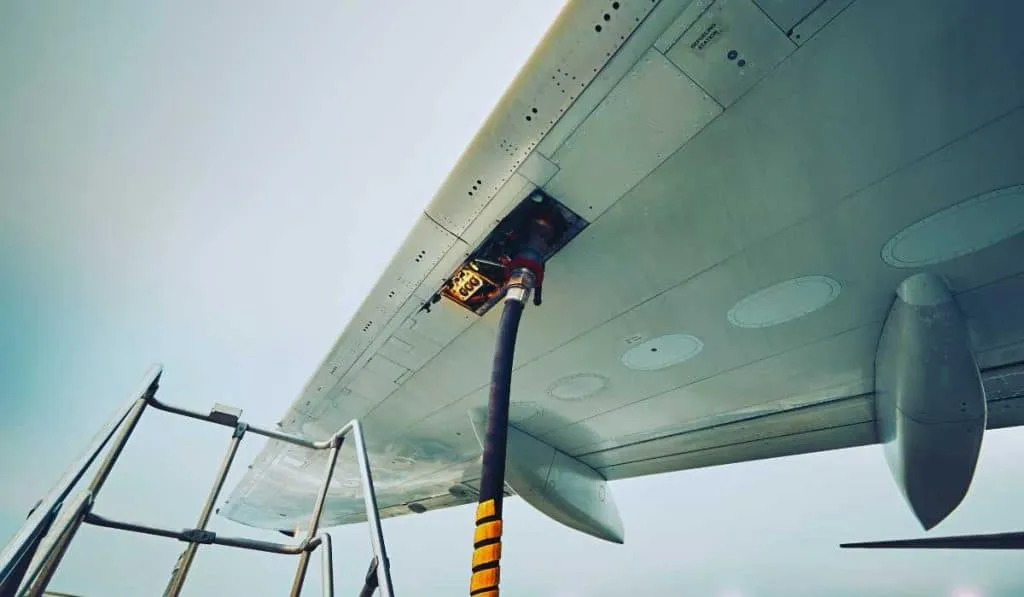
According to the International Air Transport Association (IATA), SAF typically costs two to five times as much as conventional jet fuel, with the highest multiples in markets with mandates. IATA estimates that e-SAF could cost up to 12 times as much. The main reasons are:
- Feedstock. For HEFA, the waste oils and fats make up most of the production cost, and competition for them from road biodiesel and renewable diesel keeps prices high.
- Capital costs. New plants cost hundreds of millions of dollars, and investors see risk in unproven technologies and uncertain policy.
- Scale. Production is a tiny fraction of the jet fuel market, so economies of scale have not yet arrived.
- Compliance fees. Where mandates apply, suppliers add charges for meeting their obligations, which IATA argues have pushed prices above production costs.
Because fuel is roughly a quarter of an airline's operating costs, even a small SAF share has a noticeable effect. IATA calculated that airlines paid a premium of about $2.9 billion for the 1.9 million tonnes of SAF available in 2025, of which about $1.4 billion reflected the basic price gap with fossil fuel and the rest compliance fees.
Production and demand
IATA estimates global SAF output doubled from about 1 million tonnes in 2024 to 1.9 million tonnes in 2025, equal to around 0.6% of airline fuel use. It expects growth to slow, with about 2.4 million tonnes, or 0.8% of fuel, in 2026. That is below the industry's earlier forecasts, and IATA has blamed poorly designed mandates for slowing investment.
Demand is being driven by airline climate commitments, corporate customers buying SAF to cover business travel emissions, and above all by government mandates. The airline industry has committed to net zero CO2 by 2050, and IATA expects SAF to deliver around 65% of the reduction needed. At the global level, the International Civil Aviation Organization agreed in 2023 to aim for a 5% cut in the carbon intensity of international aviation fuel by 2030.
Government mandates and incentives
Governments have used two broad approaches: mandates that require fuel suppliers to blend a rising share of SAF, and subsidies or tax credits that lower its cost to producers.
| Region | Main measure | Key requirements |
|---|---|---|
| European Union | ReFuelEU Aviation mandate | 2% SAF from 2025, 6% in 2030, 20% in 2035, 34% in 2040 and 70% in 2050, with a synthetic fuel sub-target from 1.2% in 2030 |
| United Kingdom | SAF Mandate and Sustainable Aviation Fuel Act 2026 | 2% in 2025, rising to 10% in 2030 and 22% in 2040; price guarantees for producers through a revenue certainty mechanism |
| United States | Section 45Z clean fuel production credit | Up to $1.00 per gallon from 2026, available to the end of 2029 |
| Brazil | ProBioQAV under the Fuel of the Future Law | Domestic airlines must cut greenhouse gas emissions by 1% from 2027, rising to 10% by 2037, through SAF use |
In the EU, fuel suppliers can meet the ReFuelEU obligation as an average across all the fuel they supply to EU airports until 2034, after which it applies at each airport. The EU also set aside 20 million emissions trading allowances to help airlines cover part of the price gap. The European Commission is due to review the regulation by January 2027.
The UK mandate began on 1 January 2025. The Sustainable Aviation Fuel Act, which received Royal Assent in March 2026, adds a guaranteed strike price for UK producers: if the market price falls below it, the producer receives the difference, funded by a levy on fuel suppliers. The aim is to make UK plants easier to finance.
The United States has relied on tax credits rather than a mandate. The blenders' credit introduced under the Inflation Reduction Act gave SAF up to $1.75 per gallon. From 2025 this was replaced by the 45Z production credit, and legislation passed in July 2025 removed SAF's extra premium, capping its credit at $1.00 per gallon from 2026 while extending the scheme to 2029. That narrowed SAF's advantage over renewable diesel, which competes for the same feedstock.
Who pays
The extra cost ultimately reaches passengers and shippers. Several European airline groups, including Air France-KLM and Lufthansa Group, have added SAF or environmental surcharges to fares. Airlines argue that if costs rise too fast, regional routes and price-sensitive leisure demand will suffer, and that carriers based outside mandate regions gain a cost advantage.
Outlook
Most forecasts assume SAF costs will fall as plants grow larger, new production routes mature and feedstock supply widens, but the timing is uncertain. In the near term, the price gap and the policy settings will be decided largely in Europe and the United States, with the EU review in 2027 and the operation of the UK's price guarantee likely to shape where new production is built.