We asked five AI assistants for the best MRO software. Here is what they said.
We asked ChatGPT, Gemini, Copilot, Claude and Grok for the best MRO software for a mid-size operator. See who they named, and where they agree.
 Radu BalasFounder, The Flying Engineer
 Reviewed by Adrian ManPublished 6 min read
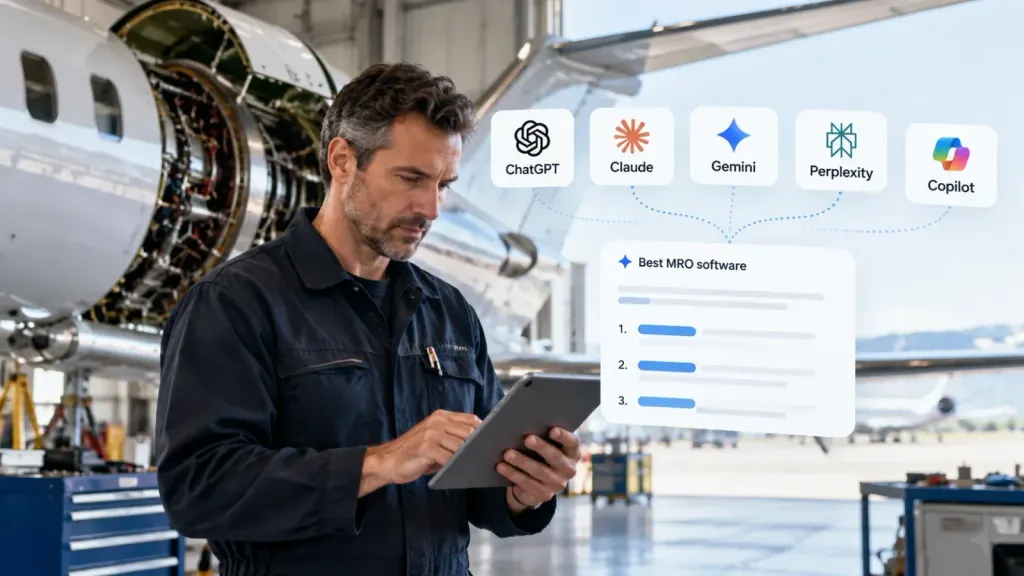
A buyer has a simple question. What is the best MRO software for a mid-size aviation operator? More and more buyers now type that question into an AI assistant instead of a search engine.
So we did the same. We asked five assistants one question, word for word: "What is the best MRO software for a mid-size aviation operator? Name the top companies and your sources." We asked ChatGPT, Gemini, Microsoft Copilot, Claude and Grok.
This article sums up what each one said. We did not add anything they did not say, and we do not rank the products ourselves.
Why buyers ask AI first
MRO software is a big choice. It holds your maintenance records, your parts and your compliance work. Buyers often start with a long list of vendors and little time.
An AI assistant gives a short list in seconds. It also names sources. That makes it a quick first step. It also means the answer a buyer sees may shape who gets a demo.
ChatGPT
ChatGPT put Veryon Tracking+ first. It noted that Tracking+ was formerly Rusada ENVISION. Next came OASES, then AMOS from Swiss AviationSoftware.
It also named TRAX eMRO, IFS Aviation Maintenance (Maintenix), Veryon Tracking and Ramco. For business jets, it named CAMP Systems.
ChatGPT said its list is a shortlist based on fit. It said it is not a measured ranking. Its sources were vendor product pages, a Rankite comparison and a Joker Aviation guide.
Gemini
Gemini sorted its answer by type of operator.
- Veryon, formerly Flightdocs and ATP, for business aviation and charter.
- TRAX for growing regional airlines.
- AMOS for upper mid-size airlines.
- CAMP Systems and Traxxall for corporate flight departments.
- CORRIDOR and Quantum Control for operators with repair stations.
Its sources were Guideflow, FL3XX, Mitti, ACMI World, Capterra and G2.
Microsoft Copilot
Copilot gave a numbered ranking.
- 1. AMOS, used by more than 270 organisations, according to Swiss-AS.
- 2. OASES, with more than 130 organisations.
- 3. Ramco, with 4,000 aircraft and 24,000 users, according to Ramco.
- 4. TRAX, with 100+ customers and 6,000+ aircraft, according to TRAX.
- 5. CAMP Systems.
Look at where those numbers come from. Copilot's sources were the vendors' own sites. The figures are the vendors' claims.
Claude
Claude said there is no single best product. It listed AMOS, Ramco, IFS Cloud, TRAX, Veryon Tracking, CORRIDOR, Impresa MRO and TCS MRO FlightOps.
It also gave two warnings. It found no independent head-to-head test of these products. And it noted that Capterra rankings include sponsored profiles. Its sources were Guideflow, AlphaApex Group, G2, Capterra and Gitnux.
Grok
Grok gave the longest list. It said Ramco is often named best overall. It named Veryon for business aviation and OASES for CAMOs. It named WinAir for mid-size operators, and CAMP and Traxxall for business jets.
It also listed TRAX, Impresa, Corridor, Pentagon 2000SQL, Avexus, Component Control and Quantum Control. Grok said it drew on 35 sources, including SoftwareConnect, Guideflow and Gitnux.
Which software each AI named
| Software | ChatGPT | Gemini | Copilot | Claude | Grok |
|---|---|---|---|---|---|
| AMOS (Swiss AviationSoftware) | Yes | Yes | Yes | Yes | |
| TRAX | Yes | Yes | Yes | Yes | Yes |
| Veryon | Yes | Yes | Yes | Yes | |
| Ramco | Yes | Yes | Yes | Yes | |
| CAMP Systems | Yes | Yes | Yes | Yes | |
| OASES | Yes | Yes | Yes | ||
| CORRIDOR | Yes | Yes | Yes | ||
| IFS (Maintenix / IFS Cloud) | Yes | Yes | |||
| Impresa MRO | Yes | Yes | |||
| Quantum Control / Component Control | Yes | Yes | |||
| WinAir | Yes | ||||
| Pentagon 2000SQL | Yes | ||||
| Avexus | Yes | ||||
| TCS MRO FlightOps | Yes |
What they agree on
The overlap is real, but smaller than you might expect.
- TRAX was named by all five assistants.
- AMOS, Veryon, Ramco and CAMP Systems were each named by four.
- OASES and CORRIDOR were each named by three.
Past that, the lists split. Only one assistant named WinAir, Pentagon 2000SQL, Avexus or TCS MRO FlightOps.
The top picks also differ. ChatGPT led with Veryon Tracking+. Copilot led with AMOS. Grok said Ramco is often named best overall. Claude said no single product wins.
What sources AI leans on
Two kinds of source show up again and again.
- Comparison guides. Guideflow was cited by three assistants: Gemini, Claude and Grok. Gitnux was cited by two.
- Vendor pages. ChatGPT and Copilot cited vendor sites. Copilot used only vendor sites, so its numbers are the vendors' own.
Review sites also appear. Gemini and Claude both cited Capterra and G2. Claude pointed out that some Capterra profiles are sponsored.
What this means for buyers
Treat an AI answer as a starting point. It is a quick way to find names. It is not a test of the software.
- Build a shortlist. Take the names that appear more than once, and add any that fit your fleet type.
- Check where numbers come from. A customer count on a vendor page is the vendor's claim.
- Run demos with your own scenario. Bring a real defect, a real part order and a real audit request. See how each product handles them.
- Ask for references. Talk to an operator of your size and fleet type.
What this means for software vendors
The assistants repeated what they could find in clear form. Vendor product pages and independent comparison and directory pages were the raw material.
If you make MRO software, check how your product is described in those places. Is the name the same everywhere? Do the facts match: who it is for, what it does, how it is deployed? AI repeats clear, consistent facts. Vague or conflicting pages give it little to repeat.
Note the renames in this list. Veryon Tracking+ was Rusada ENVISION. Veryon was Flightdocs and ATP. Assistants had to explain these links, which shows why clear naming matters.
How to read these answers
Three points help when you read any AI answer on software.
- Ask for sources, then open them. Every assistant here named its sources. A source tells you where the claim started. A vendor page is a fair place to learn what a product does. It is a weak place to learn whether it is better than another product.
- Look at the framing. ChatGPT called its list a fit-based shortlist. Claude said it found no independent head-to-head test. Those notes matter. They tell you the answer is a map of what is written online, not a test result.
- Ask the same question twice. Different wording can produce a different list. If a name keeps coming back, it is worth a look. If it appears once, treat it as one voice.
Our table shows who was named. It does not show who is better. A product can be missing from an answer for many reasons, and some of those reasons have nothing to do with the software.
Find more software in our directory
Want to look beyond five chat answers? Browse the maintenance and MRO software companies we list on our software category page.
Common questions
Which MRO software did all five AI assistants name?
TRAX was the only product named by all five. AMOS, Veryon, Ramco and CAMP Systems were each named by four.
Did the AI assistants agree on one best MRO software?
No. Several said there is no single best. Each gave a different top pick or a fit-based shortlist.
Where do AI assistants get their MRO software answers?
Mostly from vendor product pages and comparison guides such as Guideflow, plus review sites like Capterra and G2.
Should I choose MRO software based on an AI answer?
Use it to build a shortlist only. Then run demos with your own maintenance scenario.
How can a software vendor show up in AI answers?
Describe the product clearly and consistently on your own site and on independent comparison and directory pages.
About the author
Radu Balas
Founder, Flying Engineer
View author profile Editorial policy and correctionsExplore Aircraft Maintenance
Browse 2,281 companiesGet aircraft maintenance quotes
Tell us about your aircraft and the work needed.