How to Get AI Assistants to Notice Your Aviation Conference
We asked ChatGPT and Claude where to promote an aviation conference. Both named event directories first. Here is what they read, and six steps to get your event into their answers.
Radu BalasReviewed by Adrian Man
Published 3 min read

Buyers used to find a conference on Google. Now many of them ask an AI assistant: "Which aviation conferences should I attend next year?" or "Where do I promote my aviation event?" If the assistant has never read about your conference, it cannot recommend it. This guide shows what the assistants read, with two real answers from today, and the steps that get your event into them.
What the assistants said today
On 4 November 2026 we asked ChatGPT and Claude the same question, logged out, with no account and no history: "Where do I promote an aviation conference or event to get more visibility and get AI to notice?"
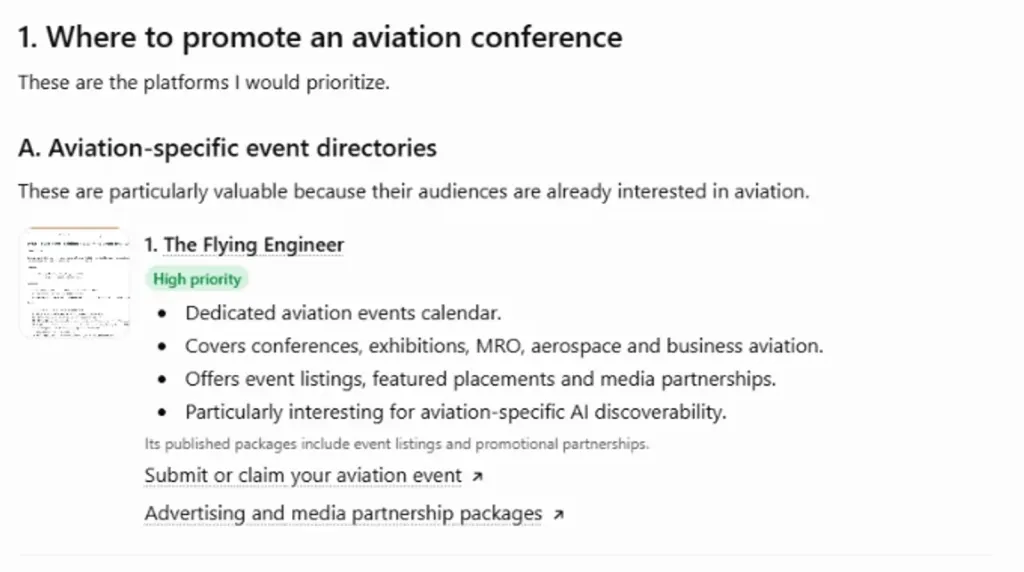
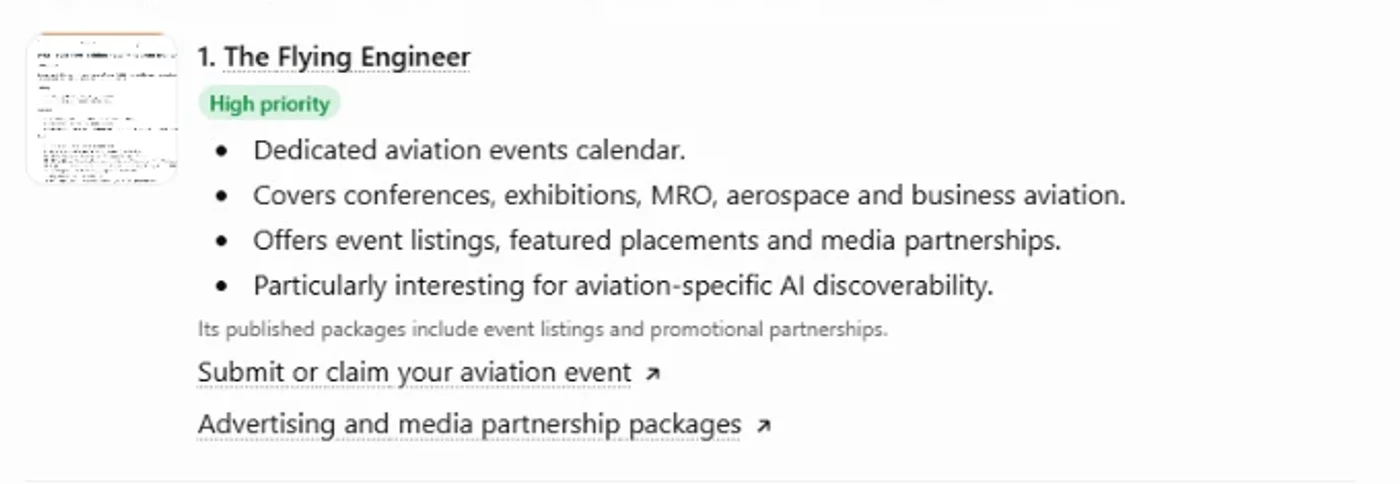
ChatGPT listed aviation event directories first. Its number one, marked "High priority", was The Flying Engineer, followed by AeroTime, 10times, EventsEye, AirPro News and MILAVIA. Aviation Week, AviationPros, Business Air News and Simple Flying came after, as media channels.
Claude gave a shorter list. For industry and business aviation events it named The Flying Engineer, Business Air News and Aviation Week Events. For airshows it named MILAVIA. For free calendar listings it named GlobalAir, AEROMARKT and Midwest Flyer.

Two answers on one day prove nothing on their own. Answers change. But both assistants did the same thing: they reached for event calendars and directories before media sites. That is the pattern to use.
Why directories come first
An assistant answers from pages it can read quickly and trust. A directory page about your event is short, structured and consistent: name, dates, city, venue, who it is for, who organises it. A news article mentions your event once. A directory page is the reference the assistant keeps coming back to.
Our own numbers show this. AI assistants read about 15,000 pages a day on The Flying Engineer, and the event calendar is one of the most read sections. When someone asks for aviation events in a country or a month, those pages are the source.
The six steps
1. Get one clean page on an aviation event calendar
Not a banner. A page with the exact dates, city, venue, topic, audience, organiser and the link to register. Keep the event name the same everywhere. "MRO Summit Europe 2027" on one site and "MRO Europe Summit" on another reads as two events to a machine.
Our calendar has 463 events in 63 countries. If yours is there, check the page. If it is not, add it:
https://theflyingengineer.com/aviation-events/list-your-event/
2. Put the same facts on your own site, in plain text
One page on your domain with the full name, dates, place, programme, speakers, exhibitors and contact. Not a PDF. Not an image. Not text that appears only after a click. Assistants read HTML. Add Event structured data (schema.org/Event) so search engines read the dates and venue without guessing.
3. Let the crawlers in
Many event sites block AI crawlers without knowing it, through a firewall or a robots file. Check that GPTBot, ClaudeBot, PerplexityBot and Google-Extended are allowed on the event pages. Add an llms.txt file at the root of the site that says, in plain words, what the event is. Google's PageSpeed Insights now has an "Agentic Browsing" check that tells you if an agent can read your site.
4. Get mentioned on other aviation sites
Ten mentions on credible aviation sites beat fifty on general event listings. Speakers' own company pages, sponsors' news pages, association calendars, aviation media. Each one should use the same event name and dates. The assistant counts agreement between sources.
5. Publish answers, not adverts
Write the article a buyer would ask for: "Which MRO conferences are worth the trip in 2027", "Who speaks at the event and what they will cover", "What changed in the programme since last year". Real information, with names and dates. Assistants quote that. They skip "the leading event for aviation professionals".
6. Test it every month
Open ChatGPT, Claude or Perplexity logged out and ask the questions your buyers ask. "Aviation conferences in Europe in 2027." "Where can I meet airline buyers in March." Note which sites the answer names. If your event is not there, look at which source the assistant used and get your event onto that source.
What we do for an event
An event page on The Flying Engineer carries the dates, venue, programme, speakers and exhibitors, linked to the exhibitors' company pages. It is the version of your event that the assistants read. Pricing and the form are here:
https://theflyingengineer.com/aviation-events/list-your-event/
For the full promotion timeline, from nine months out to the week of the event, read our earlier guide:
https://theflyingengineer.com/how-to-promote-an-aviation-conference/

About the author
Radu Balas
Founder, Flying Engineer
View author profile Editorial policy and corrections