Industry
Honda Aircraft Delivers 250th HondaJet
Honda Aircraft delivered its 250th HondaJet in January 2024, eight years after first deliveries, with the fleet past 210,000 hours and 99.7% dispatch reliability.
Updated 3 min read
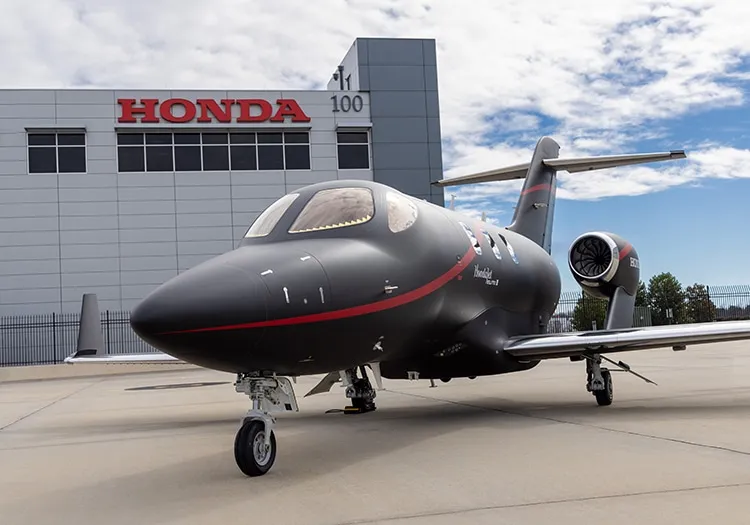
Honda Aircraft Company delivered its 250th HondaJet in late January 2024, a little over eight years after customer deliveries began in December 2015. The aircraft came off the production line at the company's headquarters in Greensboro, North Carolina, received its Standard Certificate of Airworthiness, the individual certificate that clears a newly built aircraft to fly, and was handed over at a staff event at the site.
Honda said the global HondaJet fleet had passed 210,000 flight hours with a dispatch reliability of 99.7%, meaning very few scheduled flights were delayed or cancelled for technical reasons. The aircraft held 14 type certifications from aviation authorities around the world. Hideto Yamasaki, Honda Aircraft's president and chief executive, described the milestone as part of a continuing story of engineering development rather than simply a number.
Background
The HondaJet, type designation HA-420, came out of Honda research into small business jets that began in the 1980s. A proof-of-concept aircraft flew in 2003, Honda Aircraft was set up in Greensboro in 2006 to build it, and the FAA type certificate was issued in December 2015.
The aircraft's best-known feature is the Over-The-Wing Engine Mount, which places its two engines on pylons above the wings rather than on the rear fuselage. Honda says the layout reduces drag at high speed, frees up cabin and baggage space because no engine supports are needed in the fuselage, and reduces cabin noise. The aircraft also uses a natural laminar flow wing and nose, and a composite fuselage. Its engines, the HF120, come from GE Honda Aero Engines, a joint venture between GE and Honda.
Typically flown by one pilot, the HondaJet usually has six or seven seats in total and competes with aircraft such as the Embraer Phenom 100 and Cessna Citation M2 at the light end of the business jet market. It has been popular with owner-pilots and with fractional and charter operators.
Evolution of the aircraft
- HondaJet (2015): the original certified aircraft.
- HondaJet Elite (2018): added range, cabin noise reduction and avionics upgrades.
- HondaJet Elite S (2021): higher maximum take-off weight, allowing more payload.
- HondaJet Elite II (2022): aerodynamic changes and more fuel for longer range. Autothrottle and Garmin's Emergency Autoland system, which can land the aircraft automatically if the pilot is incapacitated, were certified for it in 2023.
| HondaJet Elite II | Published figure |
|---|---|
| Maximum cruise speed | 422 KTAS (782 km/h) |
| Range | 1,547 nm (2,865 km) |
| Maximum operating altitude | 43,000 ft |
| Maximum take-off weight | 11,100 lb (5,035 kg) |
| Engines | 2 x GE Honda HF120 |
Sales and support are handled through a network of authorised sales representatives and authorised service centres in the Americas, Europe and Asia.
The HondaJet Echelon
At the time of the 250th delivery, Honda was developing a larger aircraft, the HondaJet Echelon, revealed in October 2023. It is designed to seat up to 11 people, either one pilot and 10 passengers or two crew and nine passengers, and to fly 2,625 nm with one pilot and four passengers, enough for non-stop flights across the United States. Honda quoted a maximum cruise speed of 450 knots and a ceiling of 47,000 ft, with Williams FJ44-4C engines. When it was revealed, first flight was planned for 2026 and type certification for 2028.
What has happened since
Deliveries of the Elite II have run below Honda's usual rate. The company guided to 14 to 15 deliveries in 2025, and in August 2026 told Aviation Week it expected 15 to 16 in 2026, against what it called a normal level of 25 to 26 a year, blaming a bottleneck at a tier-one supplier. Also in August 2026, Brazil's ANAC validated the Elite II type certificate, clearing the way for deliveries there.
In September 2026 Honda Aircraft announced that the Echelon's first flight had moved to 2028, with type certification and first deliveries now expected in 2031, three years later than planned. The company cited schedule changes at tier-one suppliers and continuing development work. It said the first wing structure was being completed, assembly of the first aircraft was expected to start in early 2027, and it held more than 530 letters of intent for the type.

About the author
Cristina Gabriela
Marketing Strategy Manager
View author profile Editorial policy and corrections