Guides
Crop Duster Salary: What Agricultural Pilots Earn
Top US crop duster pilots earn US$150,000 or more yearly. The best earn US$200,000 to US$250,000. Learn about pay, training, costs and job risks.
Radu BalasReviewed by Adrian Man
Published 6 min read

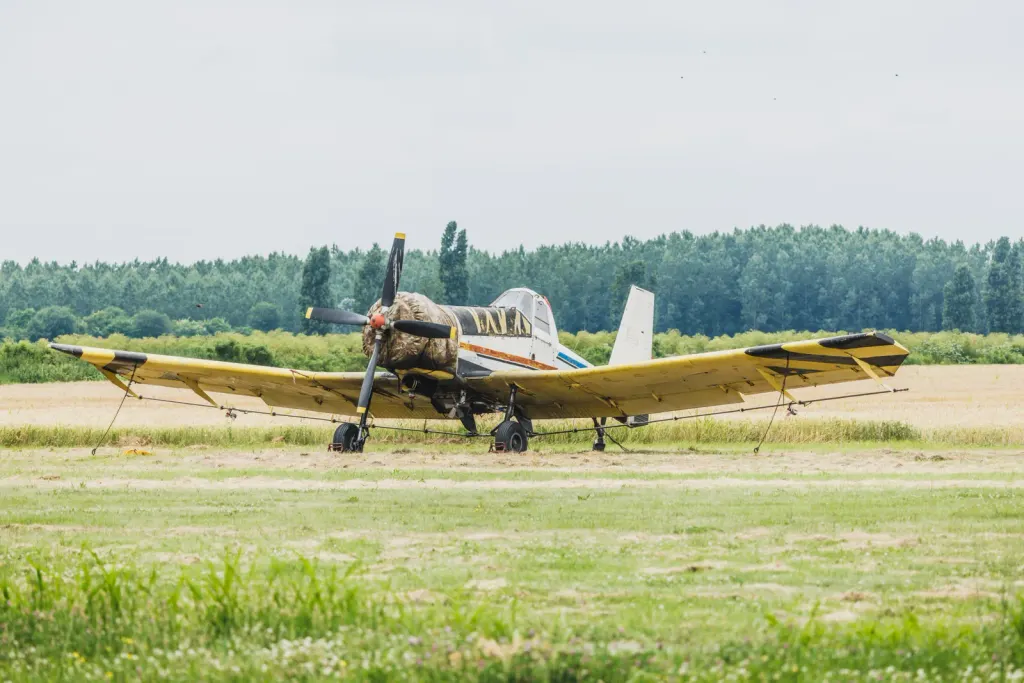
Top turboprop crop duster pilots in the US earn US$150,000 or more a year, according to AOPA's 2023 career report. The best earn US$200,000 to US$250,000 a year.
There is no separate government salary figure for agricultural pilots. The wider commercial pilot group has a median salary of US$123,220, according to the US Bureau of Labor Statistics.
A crop duster is an agricultural pilot, often called an ag pilot. The official term for the work is aerial application. Pilots spray or spread seed, fertilizer, and crop protection products from aircraft.
The job involves much more than flying. Pilots must understand their aircraft, the materials they carry, and the risks of low-level flight.
How much does a crop duster make?
Crop duster salaries vary across the industry. Experienced pilots flying larger agricultural aircraft can earn substantial annual incomes.
However, the available salary figures do not describe every agricultural pilot.
| Group | Pay | Source and year |
|---|---|---|
| Top turboprop ag pilots | US$150,000 or more yearly | AOPA, 2023 |
| Best ag pilots | US$200,000 to US$250,000 yearly | AOPA, 2023 |
| All US commercial pilots, median | US$123,220 yearly | BLS, May 2025 |
| Lowest paid tenth of commercial pilots | Under US$58,850 yearly | BLS, May 2025 |
The commercial pilot figures need some explanation.
The Bureau of Labor Statistics includes agricultural flying within commercial aviation. That group also includes charter flights and aerial tours.
Its median represents the middle salary for the entire group. It does not represent the average crop duster salary.
The government also reports that the highest paid tenth of commercial pilots earned over US$266,620 in May 2025, according to the BLS.
Starting pay for a first-season agricultural pilot is not officially published. Neither is the share of each application job fee that a pilot keeps.
These gaps make it difficult to estimate earnings for someone entering the industry.
For a broader comparison, see our aviation salary report. It covers pilot pay across aviation.
What does a crop duster do?
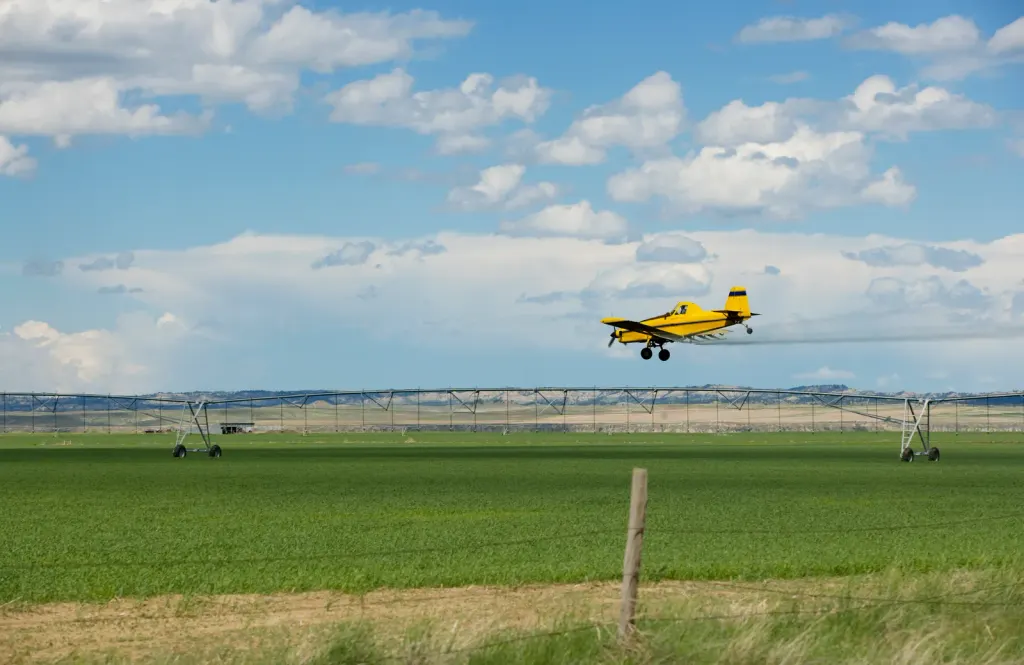
Agricultural pilots apply products to farmland using specially equipped aircraft. Their work includes spreading seed, fertilizer, and crop protection products.
The US has about 3,400 agricultural pilots, according to the National Agricultural Aviation Association (NAAA).
About 2,000 are hired pilots. Another 1,400 are owner-operators, meaning they operate their own businesses.
There are about 1,560 aerial application businesses, averaging 2.3 aircraft each. Together, they treat 127 million acres yearly, about 28% of US cropland. These figures come from the NAAA industry report.
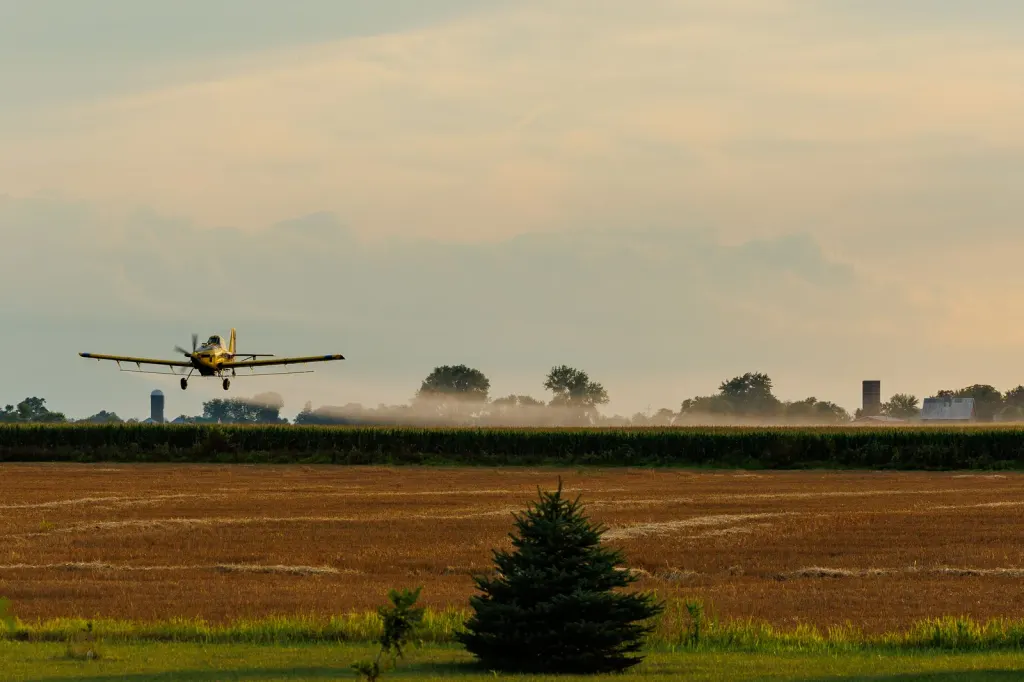
Agricultural aircraft include both airplanes and helicopters.
Fixed-wing aircraft, meaning airplanes with fixed wings, account for 84% of the fleet. Helicopters make up 16%. Turbine engines power 81%, according to NAAA.
One example is the Air Tractor AT-802A.
It carries an 800 US gallon hopper, the tank holding its application material. Its turboprop engine produces 1,295 horsepower. Its working speed is 130 to 160 mph.
These are specialized aircraft with substantial purchase costs.
NAAA places agricultural aircraft prices between US$100,000 and nearly US$2 million, according to its industry figures.
For comparison, a 2024 Air Tractor AT-802A appeared for sale at US$1.8 million in AgAir Update classifieds.
Pilots also repeat takeoffs and landings throughout the working day. NAAA reports 30 to 100 takeoffs and landings daily.
How to become a crop duster
Becoming an agricultural pilot requires professional flight training and additional agricultural flying skills.
In the US, 14 CFR 137.19 requires a current commercial pilot or airline transport pilot certificate for the pilot qualification.
The regulation also sets knowledge and flying skill tests.
The knowledge test covers safe chemical handling, poisoning symptoms, and aircraft operating limits. The skill test includes swath runs, pull-ups, and turnarounds.
A swath run is a flight along the area receiving an application.
Most agricultural airplanes also have a tailwheel, a wheel behind the main landing gear. Tailwheel flying requires training and an instructor's logbook endorsement under 14 CFR 61.31.
Applying restricted-use pesticides requires state pesticide applicator certification. The US Environmental Protection Agency explains the certification process.
Training costs depend on the program.
In September 2020, AOPA reported a US$50,000 to US$70,000 training cost at one Florida school. This included private, instrument, and commercial certificates, plus agricultural training.
Specialist schools offer agricultural flight instruction.
The NAAA flight school directory lists training options. One example is Plane Cents Aviation in Missouri. Its program provides 40 flight hours over three to four weeks.
Canada also offers specialist training. Battlefords Airspray in Saskatchewan lists its 2027 course at CAD 34,900 plus tax. It includes 40 flight hours over 4 to 6 weeks, according to Battlefords Airspray.
Scholarships can help with training expenses.
The NAAA Ag Wings of Tomorrow scholarship awarded US$25,000 in 2026. The program offered up to five scholarships of US$5,000.
Prospective pilots can explore our flight school directory. Our commercial pilot training costs guide also compares training expenses across countries.
What the job is really like
Agricultural flying has demanding working hours, especially during the application season.
According to AOPA's 2023 report, ag pilots work 14-hour days during the season. They receive about three months off during winter.
Experience plays an important role in this occupation.
NAAA reports that hired agricultural pilots average 19.4 years of experience. AOPA places the average agricultural pilot's age at 55.
Safety remains a major concern.
The NAAA's February 2026 safety report recorded 54 agricultural aviation accidents in 2024. Of these, 13 were fatal accidents.
In 2025, the industry recorded 43 accidents, the lowest on record. Four were fatal accidents.
AOPA's 2023 report estimated that 10 agricultural pilots die each season.
Power lines and towers present particular dangers.
Between 2009 and 2018, power lines were involved in 13% of agricultural aviation accidents. They were also involved in 12% of deaths. Towers were involved in 9% of deaths, according to NAAA.
The National Transportation Safety Board studied agricultural aviation safety in 2014. The review followed 78 accidents in 2013.
It identified fatigue, risk management, maintenance, and pilot training as important safety issues.
Agricultural flying is also part of a wider group of specialist aviation careers. Our guide to unusual pilot jobs beyond airlines covers crop dusters, fire pilots, and bush pilots.
Crop dusting in the UK and Europe
The crop duster job market differs greatly between countries.
In the European Union, aerial spraying is generally prohibited.
EU Directive 2009/128/EC, Article 9 establishes that prohibition. It allows exceptions only in special cases.
The UK has similar restrictions.
The Health and Safety Executive prohibits aerial spraying without authorization. Operators need an Aerial Spraying Permit for every application.
These rules leave almost no conventional crop duster job market in the UK or EU. Published crop duster salary figures are unavailable for those markets.
Australia has an established aerial application industry. The trade association AAAA reports about 130 active operators and over 300 aircraft.
For employment opportunities, our aviation recruitment directory lists recruitment agencies and job boards.
Drones and the future of the job
Agricultural drones are becoming another part of aerial application.
In 2025, the FAA counted 1,710 drone operators with aerial application approval. That represented a 58.3% annual increase, according to DroneXL's October 2026 report.
The same report cited an industry survey of drone spraying activity. It found that drones sprayed more than 16.4 million acres in 2025.
These figures show that agricultural drones already handle a substantial area of farmland.
However, the available figures do not establish how drones will affect agricultural pilot salaries. They also do not establish how many conventional pilot jobs drones might replace.
For prospective pilots, the current picture is clear. Agricultural aviation offers high earnings for some experienced pilots. It also demands specialized training and carries serious safety risks.
The published salary figures are strongest for established pilots. Anyone entering the occupation must account for the missing starting-pay data.
Sources
- AOPA, Agricultural pilot career spotlight, 2023
- US Bureau of Labor Statistics, Airline and commercial pilots
- NAAA, Agricultural aviation industry facts
- Air Tractor, AT-802A specifications
- AgAir Update, AT-802A aircraft listing
- 14 CFR 137.19, Agricultural aircraft pilot requirements
- 14 CFR 61.31, Tailwheel training requirements
- US EPA, Pesticide applicator certification
- AOPA, Agricultural pilot training costs, 2020
- NAAA, Agricultural aviation flight schools
- Battlefords Airspray, 2027 agricultural pilot course
- NAAA, Ag Wings of Tomorrow scholarship
- NAAA, Agricultural aviation accident figures, 2026
- NTSB, Agricultural aircraft safety study
- EUR-Lex, Directive 2009/128/EC
- UK HSE, Aerial spraying permits
- AAAA, Australian agricultural aviation industry
- DroneXL, Agricultural spray drone industry report, 2026

About the author
Radu Balas
Founder, Flying Engineer
View author profile Editorial policy and correctionsExplore Flight Schools
Browse 4,018 companiesCompare flight schools
Tell us what you want to learn and where, and we will pass it to suitable schools. It goes to 3 or more companies, so you can compare quotes.