Industry
Bombardier's C$7.4B Impact on Canadian Economy
A PwC study commissioned by Bombardier found its manufacturing added C$7.4 billion to Canada's GDP in 2024 and supported about 48,500 full-time jobs.
Updated 3 min read
Bombardier's manufacturing activity added C$7.4 billion to Canada's gross domestic product in 2024 and supported about 48,500 full-time jobs, according to an economic footprint study by PwC Canada that the business jet maker commissioned and published in September 2025. The report also put the company's contribution to federal and provincial government revenues at more than C$1.2 billion for the year.
What the PwC study found
PwC applied Statistics Canada's input-output multipliers to spending data supplied by Bombardier. The method counts three layers of activity: direct effects at Bombardier itself, indirect effects in its supply chain, and induced effects from employees and suppliers' staff spending their wages. All figures are in Canadian dollars.
| Measure (2024) | Figure |
|---|---|
| Contribution to Canadian GDP | C$7.4 billion, of which C$6.1 billion in Quebec |
| Full-time jobs supported | About 48,500, including 11,470 direct |
| Direct jobs in Quebec | 9,330, more than 31% of the province's aerospace jobs |
| Government revenues | More than C$1.2 billion |
| Salaries supported | Nearly C$3.2 billion |
| Revenue | C$11.5 billion |
| Business aircraft delivered | 146 |
The tax figure breaks down into C$637 million of payroll taxes, split roughly evenly between the provinces (C$327 million) and Ottawa (C$310 million), plus an estimated C$497 million in taxes on products and production. Bombardier spent more than C$9.1 billion globally in 2024 and worked with more than 1,550 Canadian suppliers. The company accounted for about a quarter of Canada's aerospace manufacturing output, making it the largest single player in the sector.
Exports are central to the numbers. About 95% of Bombardier's aircraft go to customers outside Canada, and the study estimated that the company alone represented about 5% of Quebec's total export value and 1% of Canada's exports. Aircraft were among Quebec's leading manufactured exports, with C$11.2 billion shipped in 2024.
Comparing 2024 with 2021, PwC found Bombardier's GDP contribution had grown from C$5.8 billion to C$7.4 billion and supported employment from about 33,300 to 48,500 full-time equivalents, with most of the growth in Quebec.
Projections to 2029
Bombardier told PwC it expected revenue of more than C$12.2 billion in 2025, rising each year to 2029. On that basis, the study estimated the company's Canadian manufacturing would contribute C$39.6 billion to GDP over 2025 to 2029, an average of C$7.9 billion a year, and support an average of 51,696 full-time jobs annually.
Separately, planned research and development and capital spending from 2024 to 2029 was projected to add C$3.2 billion to GDP and support 25,737 full-time-equivalent jobs over the period, or about 5,150 a year on average.
PwC stated that the forward-looking figures, including the exchange rates used to convert US dollar forecasts, came from Bombardier and were not independently verified. The projections are therefore the company's outlook run through an economic model, not an independent forecast.
Where Bombardier builds its aircraft
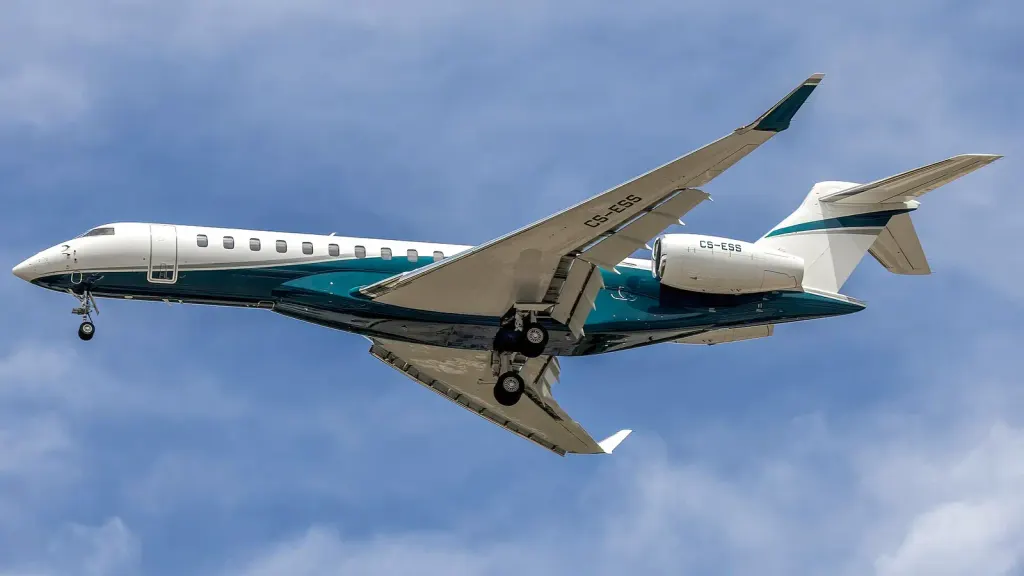
Bombardier now makes only business jets: the Challenger 3500 and 650 and the Global 5500, 6500, 7500 and 8000. Its main Canadian sites are in the Montreal area, including the Laurent Beaudoin Completion Centre where Global cabins are finished, and in the Greater Toronto Area, where the Global family is assembled. Global assembly moved to a new purpose-built facility at Toronto Pearson International Airport, which employs about 2,200 people.
The company also has a growing defence business, supplying Global and Challenger airframes for special-mission roles. Saab's GlobalEye airborne early warning aircraft, for example, is based on the Global 6500.
Chief executive Éric Martel used the report to argue that Bombardier's workforce and supplier base make it a major driver of the Canadian economy and of the country's defence and technology capabilities. The report also stressed the company's North American integration under the Canada-United States-Mexico Agreement: Bombardier's Canadian operations bought about US$2.4 billion from US and Mexican suppliers in 2024, and its US and Mexican sites employed more than 5,200 people directly.
Why it matters
Economic footprint studies commissioned by companies tend to be used in discussions with governments over trade, procurement and support. The 2024 numbers are based on actual spending and give a useful sense of scale for Canada's largest aerospace manufacturer. The five-year projections rest on Bombardier's own sales outlook and should be read in that light.
What has happened since
Bombardier beat its 2025 targets. Results published on 12 February 2026 showed revenue of US$9.55 billion, up 10%, and 157 aircraft deliveries against guidance of more than 150. Its backlog rose 22% to US$17.5 billion, defence revenue passed US$1 billion, and the company said it had completed the five-year turnaround plan begun in 2021. It guided to revenue of around US$10 billion for 2026.
The Global 8000, the long-range flagship with a top speed of Mach 0.95, received Transport Canada certification on 5 November 2025 and entered service on 8 December 2025. Launch fleet customer NetJets took its first Global 8000 in March 2026.
About the author
Ankit Kumar
Writer, Flying Engineer
View author profile Editorial policy and corrections