
How Airspace Closures Are Changing Global Flight Routes in 2026
 Radu BalasPublished Updated 18 min read
Updated on March 2026.
Ever noticed your flight to Asia suddenly takes two hours longer? Or wondered why that direct route disappeared from your airline's schedule?
The answer lies above - in the airspace closures reshaping global aviation. From Russia's closed skies to new Middle East restrictions, airlines now navigate around vast no-fly zones that didn't exist five years ago.
The result: longer flights, higher fares, and routes that would look bizarre on pre-2022 maps. Welcome to the new reality of international air travel.
Why Countries Close Their Airspace
Sovereign nations control their airspace just like their land borders. Closing airspace represents a powerful diplomatic and safety tool used for multiple reasons.
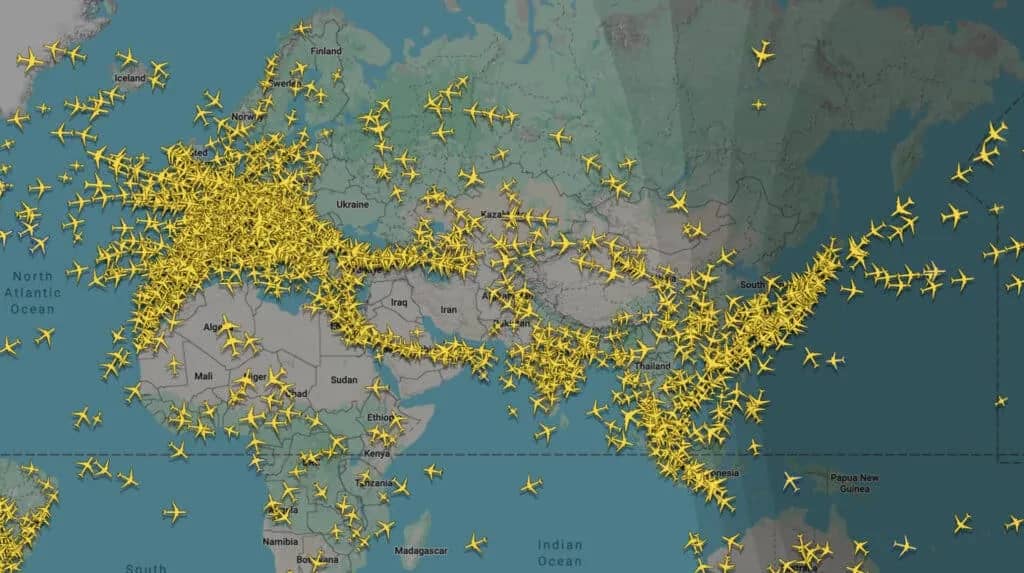
Active Conflict and Military Operations
War zones pose direct threats to civilian aircraft. Military operations involve anti-aircraft systems, missile activity, and combat aircraft that create unacceptable risks for commercial flights.
The December 2024 Azerbaijan Airlines incident near Grozny, Russia demonstrated this danger. The aircraft was struck by anti-aircraft fire intended for Ukrainian drones, killing 38 passengers. Safe Airspace, an independent aviation risk monitoring organization, tracks such incidents and provides detailed safety advisories.
When military and civilian airspace overlap during conflict, civil aviation must exit. Misidentification and coordination failures create fatal consequences.
Sanctions and Political Retaliation
Airspace bans serve as political tools. When Western nations banned Russian aircraft following the 2022 Ukraine invasion, Russia immediately closed its airspace to those same countries.
This reciprocal retaliation now affects over 35 countries. European Union members, UK, USA, Canada, and allied nations cannot use Russian airspace - representing 11 time zones of closed sky.
These closures don't reflect safety concerns. They're diplomatic weapons that hurt airlines economically while avoiding direct military confrontation.
Safety Risk Zones
International aviation bodies issue NOTAM warnings (Notice to Airmen) for dangerous airspace. The European Union Aviation Safety Agency (EASA) now warns against flying over western Russia due to air defense activity.
Airlines voluntarily avoid regions even when technically open. Japanese and South Korean carriers stopped using Russian airspace despite not being banned - choosing safety over efficiency.
ICAO and Sovereign Rights
The International Civil Aviation Organization (ICAO) governs civil aviation globally. ICAO sets standards for international air navigation. However, sovereign nations ultimately control their airspace completely.
Countries grant overflight rights through bilateral agreements. Airlines pay fees for crossing foreign airspace - fees that disappear when access closes.
Which Airspace Is Currently Restricted in 2026?
Multiple regions remain closed or restricted to civil aviation in 2026. These closures create a patchwork of no-fly zones forcing complex rerouting.
Russia-Ukraine Conflict Zone

Ukraine's airspace has been completely closed to civil aviation since February 2022. This closure appears permanent until the conflict ends.
Russian airspace remains closed to airlines from 35+ countries and territories including all EU members, UK, USA, Canada, Norway, Switzerland, Iceland, and others.
This represents 17 million square kilometers of closed airspace - roughly twice the size of the continental United States. The impact on Europe-Asia routes is massive.
European airlines alone lost $420 million annually in overflight fees they previously paid Russia. However, airlines lost far more in operational costs from detours.
Middle East Closures (Late February 2026)
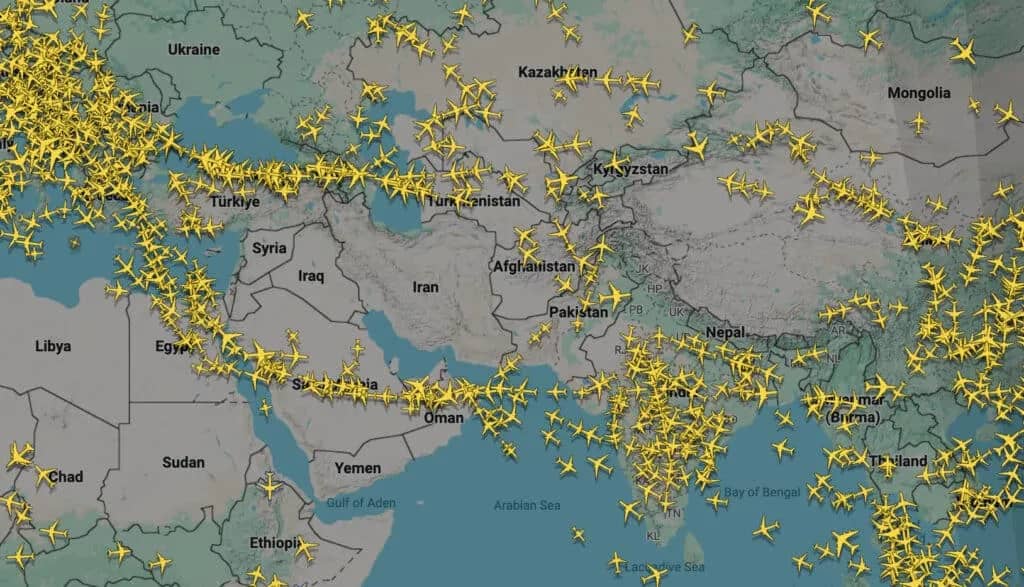
New closures erupted in late February 2026 following military operations between multiple nations. Eight Middle Eastern countries declared airspace closed or partially restricted.
Currently affected:
- Iran: Completely closed to most commercial traffic
- Israel: Closed during active operations
- Iraq: Partially closed
- Kuwait: Suspended Iran flights
- Qatar: Temporarily suspended operations
- Bahrain: Airspace restrictions
- UAE: Limited operations (Emirates, Etihad affected)
- Jordan: Partial closures
These closures compound the Russia problem. Airlines can't fly north (Russia) or through the Middle East, forcing narrow corridors through remaining open airspace.
The Caucasus Corridor Bottleneck

With Russia closed to the north and Middle East restrictions, airlines squeeze through the Caucasus corridor - the slim passage between the Black and Caspian Seas.
At its narrowest, this corridor measures just 100 miles wide between Russian and Iranian airspace. It's aviation's biggest bottleneck, handling traffic that previously spread across thousands of miles. IATA (International Air Transport Association) has called for coordinated responses to airspace restrictions affecting global connectivity.
Countries benefiting: Georgia, Azerbaijan, Armenia, and Turkey. These nations now handle dramatically increased overflight traffic and associated fees. Real-time flight tracking services like Flightradar24 clearly show the concentration of aircraft through this narrow corridor compared to the dispersed patterns before 2022.
Red Sea and Yemen
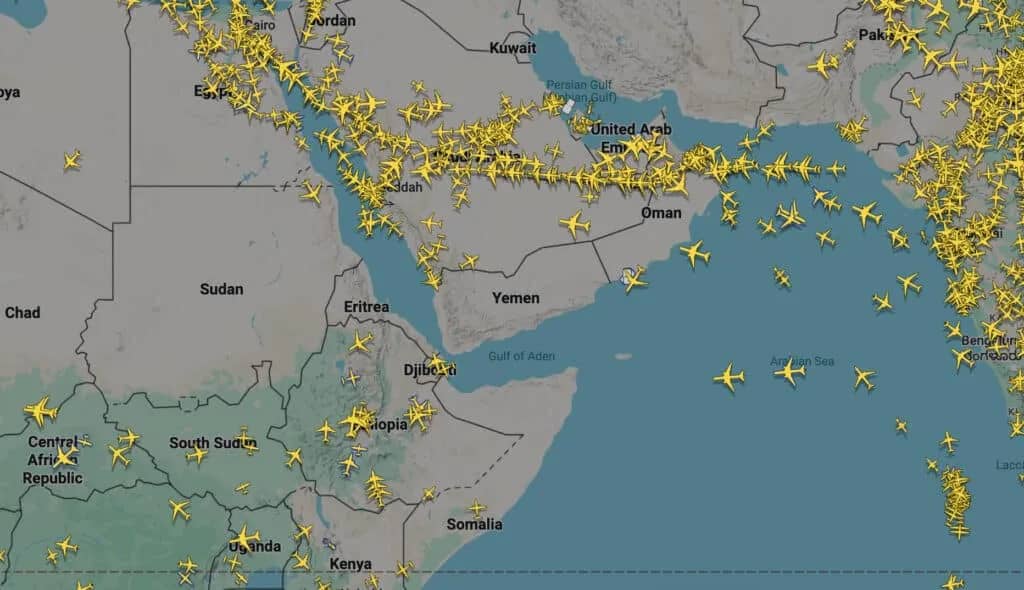
The Red Sea region faces threats from drone and missile activity affecting both maritime shipping and aviation routes over water.
While not formally closed, many airlines avoid the area or fly at higher altitudes when transiting between Europe, Africa, and Asia.
Other Sensitive Regions
Syria maintains partial closures, particularly along its southern border. Libya has faced intermittent restrictions. Parts of Afghanistan remain avoided by most international carriers.
How Airlines Reroute Around Closed Airspace
When massive airspace chunks close, airlines must completely rethink routing. The solutions involve geography, aircraft capability, and operational costs.
Southern Detours via Central Asia
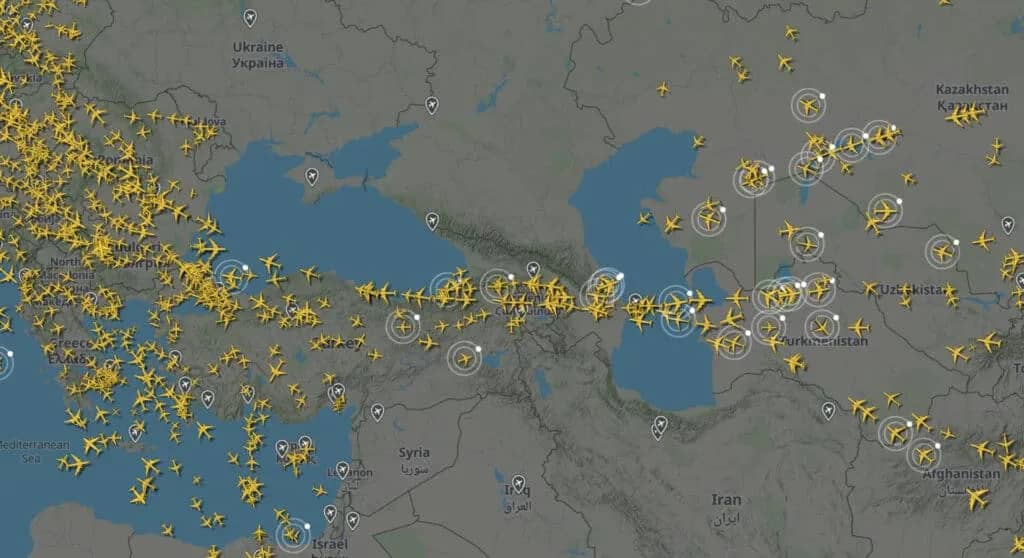
European airlines flying to East Asia now route south of Russia through Turkey, Central Asian countries (Kazakhstan, Uzbekistan), China, and Mongolia.
A London-Tokyo flight that previously flew over Moscow now goes through Istanbul, Turkmenistan, and northern China. This adds 1-4 hours depending on destination.
British Airways' London-Tokyo route increased from 12 to 14+ hours. Finnair's Helsinki-Tokyo jumped from 9 to 13 hours - a four-hour penalty.
Polar Routes (Eastbound from Europe)
Some routes go opposite directions to avoid Russian airspace. Japan Airlines' Tokyo-London flight now flies east across the Pacific, over Alaska and Canada, then to Europe.
This seems backwards but works for specific city pairs. The route adds 4.5 hours and approximately $20,000 in extra fuel costs per flight.
Extended ETOPS Operations
ETOPS (Extended-range Twin-engine Operational Performance Standards) allows twin-engine aircraft to fly routes far from diversion airports. Modern ETOPS-330 certification permits 330 minutes (5.5 hours) from the nearest airport.
Airlines deploy long-range twin-engine aircraft like Boeing 787 and Airbus A350 on routes that previously used older four-engine planes. Understanding the Boeing 787 vs Airbus A350 capabilities shows how these aircraft efficiently handle extended detours despite longer distances.
Understanding modern aircraft deployment strategies shows how airlines adapt fleet planning to airspace restrictions.
Oceanic and Over-Water Routes
Flights between Europe and India previously crossed Russia and Central Asia. Now they route over the Mediterranean, around the Arabian Peninsula, and across the Indian Ocean.
This requires aircraft with sufficient range and reliable twin-engine performance over water. Not all aircraft in airline fleets can handle these extended oceanic segments. Airlines pioneering ultra-long-haul operations demonstrate the capabilities needed for these extended detours.
Great Circle Route Modifications
The great circle route represents the shortest distance between two points on Earth's spherical surface. Airlines normally fly great circles to minimize distance.
Airspace closures break this efficiency. Aircraft now fly modified routes significantly longer than the theoretical shortest path.
Why Flights Are Now Longer (And More Expensive)
Airspace closures create a cascade of operational costs that ultimately reach passengers. The impacts extend beyond just extra flight time.
Increased Fuel Burn
Longer routes consume more fuel - the single largest operational cost for airlines. A route adding 2 hours might burn 15-20% additional fuel.
Japan Airlines' Tokyo-London detour burns approximately 5,600 extra gallons per flight. At jet fuel prices, this costs roughly $20,000 additional per one-way flight.
Multiply this across thousands of weekly flights, and fuel costs add hundreds of millions annually to airline operating expenses.
Crew Time and Duty Limits
Flight crew regulations limit duty hours for safety. A route that previously fit within crew limits might now exceed them, requiring additional crew members.
Extra crew means higher labor costs. Airlines must also position crews in different cities, pay for accommodations, and manage more complex scheduling.
Some routes require mid-flight crew changes or fuel stops that didn't exist before closures. Each adds operational complexity and cost.
Airport Slot Constraints
Longer flight times affect airport slot availability. An aircraft delayed by detours might miss its assigned landing slot at congested airports.
Airlines must reschedule entire networks when key routes take longer. Aircraft that previously completed two round-trips daily might manage only one, reducing productivity.
Maintenance Cycle Impacts
Aircraft maintenance schedules trigger based on flight hours and cycles. Longer routes accelerate when aircraft need expensive maintenance checks.
An airline operating detoured routes accumulates flight hours faster, bringing forward costly inspections and reducing aircraft availability. Commercial aviation insurance costs may also increase.
Actual Cost Increases
Routes between Europe and Asia see 5-20% higher operating costs due to detours. This varies by specific city pairs and aircraft type.
These costs pass to passengers through higher ticket prices. Airlines can't absorb these increases indefinitely without losing money on routes.
Which Routes Have Changed the Most?
Certain routes face dramatic changes while others remain largely unaffected. Geography determines impact.
Europe to Northeast Asia (Japan, South Korea)
Most affected routes globally. Flights from London, Paris, Frankfurt, or Helsinki to Tokyo or Seoul previously flew straight across Russia - the shortest path.
Now these routes detour thousands of miles south through Turkey and Central Asia, or east over Alaska and Canada.
Specific impacts:
- Finnair Helsinki-Tokyo: +4 hours (9h → 13h)
- British Airways London-Tokyo: +2 hours (12h → 14h)
- Lufthansa Frankfurt-Seoul: +2.5 hours
- Air France Paris-Tokyo: +3 hours
Finnair, headquartered in Helsinki, suffered particularly. Their business model relied on being Europe's fastest route to Asia via Russia. That advantage vanished overnight.
| Route | Pre-2022 Time | 2026 Time | Time Added | Impact |
|---|---|---|---|---|
| Finnair Helsinki-Tokyo | 9 hours | 13 hours | +4 hours | Severe |
| British Airways London-Tokyo | 12 hours | 14+ hours | +2 hours | Major |
| JAL Tokyo-London | 11.5 hours | 16 hours | +4.5 hours | Severe (reverse routing) |
| Lufthansa Frankfurt-Seoul | 10.5 hours | 13 hours | +2.5 hours | Major |
| Air France Paris-Tokyo | 11 hours | 14 hours | +3 hours | Major |
| BA London-Delhi | 8.5 hours | 9.5 hours | +1 hour | Moderate |
Note: Times are approximate and vary by winds, aircraft type, and specific routing chosen. Severe impacts (red) indicate +3-4 hours. Major impacts (orange) indicate +2-3 hours. Moderate impacts (yellow) indicate +1-2 hours. Swipe left to see full table on mobile devices.
Europe to China
Flights to Beijing, Shanghai, and other Chinese cities route south of Russia through Central Asia. However, Chinese carriers still use Russian airspace - creating competitive imbalance.
Chinese airlines maintain pre-2022 flight times while European competitors fly 1-3 hours longer. This gives Chinese carriers pricing and convenience advantages.
North America to India
US and Canadian carriers flying to India previously crossed the Arctic and Russian airspace. These routes now detour significantly.
United Airlines suspended direct flights from Newark and San Francisco to Delhi, operating them seasonally when viable. Air India maintains routes using Russian airspace unavailable to US carriers.
Intra-Asia Routes
Routes within Asia face less impact unless they specifically crossed Russian territory. Japan-Europe and Korea-Europe routes suffer most.
Southeast Asian carriers like Singapore Airlines and Thai Airways experience minimal effects as their routes to Europe don't require Russian airspace.
Cargo Routes
Air cargo faces identical rerouting challenges. Freight between Europe and Asia takes longer, costing more and reducing capacity.
The Impact on Air Cargo

Airspace closures don't just affect passengers. Air freight operations face severe disruption impacting global supply chains.
Longer Transit Times
Time-sensitive cargo depends on fast air freight. Medical supplies, electronics, automotive parts, and perishables all need quick delivery.
Routes now taking 2-4 hours longer delay cargo arrival. This affects manufacturing schedules, hospital supplies, and retail inventory.
Understanding time-sensitive shipment challenges shows how detours cascade through supply chains.
Higher Freight Rates
Cargo rates increased 10-25% on affected routes. Airlines pass fuel and operational costs to shippers, who pass them to end customers.
The cost to ship one kilogram from Frankfurt to Tokyo increased significantly compared to pre-2022 levels purely from routing changes. Understanding air freight cost analysis helps explain these price dynamics.
Widebody Freighter Dependency
Long detours require aircraft with maximum range. Freighter aircraft like Boeing 747-400F and 777F become more valuable as they can handle extended routes.
Cargo carriers operating these long-range freighters gain competitive advantages over those with shorter-range aircraft requiring fuel stops.
Belly Cargo Reduction
Passenger aircraft carry cargo in belly holds below passengers. Longer routes mean aircraft carry more fuel, reducing weight available for cargo.
Some routes now carry 20-30% less belly cargo due to fuel requirements. This capacity loss tightens the air freight market further.
Which Airlines Have Advantages?
Not all airlines face equal impacts. Some maintain access to Russian airspace, creating significant competitive advantages.
Chinese Carriers
Air China, China Eastern, China Southern, and Hainan Airlines freely use Russian airspace. Their Europe-China flights maintain pre-2022 schedules and times.
This gives Chinese carriers 1-3 hour advantages over European competitors on identical city pairs. Lower costs allow more competitive pricing.
Middle Eastern Carriers
Emirates, Etihad, and Qatar Airways use Russian airspace for specific routes, including polar routes to North America.
However, recent Middle East conflicts affected these carriers. Emirates and Etihad suspended operations temporarily in late February 2026 during regional airspace closures.
Turkish Airlines
Turkey maintains neutral stance allowing access to Russian airspace. Turkish Airlines operates normally while European neighbors detour.
Istanbul's geographic position also makes Turkish Airlines a natural connection hub for detoured traffic. The carrier benefits doubly from airspace restrictions.
Air India
Indian carriers use Russian airspace for North America and Europe routes. This provides time and fuel advantages over US and European competitors.
Air India's Delhi-New York and Delhi-London routes maintain efficient routings unavailable to Western carriers on reverse directions.
Disadvantaged Airlines
Finnair suffered most dramatically. Their Helsinki hub's advantage depended entirely on Russian overflight rights. They've cut Asian routes significantly.
Scandinavian Airlines (SAS) face similar challenges. British Airways, Lufthansa, and Air France absorb higher costs but maintain routes through financial strength.
| Airline/Country | Russian Airspace Access | Competitive Impact | Example Route Advantage |
|---|---|---|---|
| Chinese Airlines (Air China, China Eastern, China Southern) |
✓ Full Access | 1-3 hour time advantage over European competitors | Beijing-Frankfurt maintains pre-2022 times |
| Turkish Airlines | ✓ Full Access | Neutral stance benefits; Istanbul hub growth | Europe-Asia connections via Istanbul |
| Emirates, Etihad, Qatar Airways | ✓ Full Access | Polar routes to US maintained; Gulf hub advantage | Dubai-US West Coast polar routing |
| Air India | ✓ Full Access | Time/fuel advantage over US carriers on reverse routes | Delhi-US/Canada via Russia |
| European Airlines (BA, Lufthansa, Air France, KLM) |
✗ No Access | +1-4 hours on Asia routes; higher costs | London-Tokyo: +2 hours |
| Finnair | ✗ No Access | Business model severely damaged; 30% capacity cuts | Helsinki-Tokyo: +4 hours |
| US Airlines (United, Delta, American) |
✗ No Access | Route suspensions to India; Arctic detours | Newark-Delhi suspended |
| JAL, ANA | ✗ Voluntary Avoidance | Allied with West; reverse polar routing | Tokyo-London: +4.5 hours via Alaska |
Note: Green rows indicate airlines maintaining Russian airspace access, providing significant competitive advantages. Red rows indicate airlines forced to detour or voluntarily avoiding Russian airspace. JAL and ANA technically could use Russian airspace but choose not to for geopolitical alignment. Swipe left to see full table on mobile devices.
Are Airspace Closures Temporary or Long-Term?
The critical question: when will airspace reopen? The answer appears to be "not soon."
Russia-Ukraine Situation
Russian airspace closures show no signs of ending. The conflict continues with no clear resolution path. Aviation sanctions remain tied to broader geopolitical disputes.
Three indicators would suggest reopening: credible peace negotiations, regulatory changes from EU/US transport authorities, or airlines filing Siberian routes for future schedules. None are currently happening.
Aviation analysts expect closures to persist through at least 2027-2028. Some suggest these could become semi-permanent fixtures.
Middle East Volatility
Middle Eastern airspace closures fluctuate based on active conflicts. The late February 2026 closures may be temporary or extended depending on developments.
However, the region's ongoing tensions suggest recurring closures remain possible. Airlines must plan for intermittent disruption rather than stable access.
Insurance and Risk Assessment
War risk insurance costs increased dramatically for airlines operating near conflict zones. Even when airspace technically opens, insurance costs may keep airlines away.
Carriers perform independent risk assessments. Many voluntarily avoid regions despite technical permission, prioritizing passenger safety over efficiency.
Long-Term Planning Assumptions
Airlines now plan fleet and network strategies assuming closures persist. This means ordering long-range aircraft, establishing new hubs, and restructuring route networks permanently.
The industry has shifted from viewing closures as temporary inconveniences to accepting them as the new normal requiring strategic adaptation.
How Airlines Adapt Strategically
Airlines don't just react - they strategically evolve to thrive despite constraints.
Fleet Modernization
Airlines accelerate orders for long-range, fuel-efficient aircraft. The Boeing 787 and Airbus A350 become more valuable as they handle extended detours efficiently. Strategic aircraft leasing arrangements help airlines access these capabilities without massive capital outlays.
The Airbus A321XLR (Extra Long Range) enters service in 2026, enabling narrowbody aircraft to fly routes previously requiring widebodies. This aircraft can operate 8-9 hour detoured routes economically.
Hub Strategy Restructuring
Airlines evaluate hub locations based on new routing realities. Hubs positioned to avoid closures gain value.
Dubai, Doha, and Abu Dhabi benefit as connection points for detoured Europe-Asia traffic (when Middle East airspace operates normally). Istanbul grows similarly as a strategic connection hub.
Alliance Coordination
Airline alliances coordinate to share capacity on affected routes. Partners with better geographic positions carry traffic for those facing disadvantages.
Codeshare agreements expand, allowing airlines to sell seats on partners' aircraft when their own routes become uncompetitive.
Route Suspension and Restructuring
Some routes become economically unviable with detours. Airlines suspend these and redeploy aircraft to profitable markets.
Finnair reduced Asian capacity by 30%+ compared to pre-2022 levels. They refocus on European and transatlantic routes where Russian airspace doesn't matter. New airline routes emerge while others disappear.
Fuel Hedging Strategies
Fuel hedging becomes more critical when consumption increases. Airlines lock in fuel prices to protect against volatility affecting longer routes.
What This Means for Passengers in 2026
Airspace closures create tangible impacts every time you fly. Passengers face several consequences:
Longer Travel Times
Routes to Asia, India, or through affected regions take 1-4 hours longer than before 2022. Your 10-hour flight might now take 12-13 hours.
Jet lag worsens with extended travel time. Business travelers lose productive hours. Families with children face longer journeys.
Higher Ticket Prices
Fares increased 10-20% on affected routes due to operational costs. Airlines can't absorb fuel and crew expenses indefinitely.
Premium cabin prices rise even faster as demand concentrates on fewer direct flights. Award seats become scarcer as airlines fly less frequency.
More Connections Required
Previously direct routes now require connections. Airlines split long detoured routes into segments to manage crew limits and fuel.
Your nonstop Europe-Asia flight might now connect through Istanbul, Dubai, or Delhi. This adds time and complicates travel.
Different Departure Times
Flight schedules changed to accommodate longer block times. Your preferred morning departure might shift to afternoon or evening.
Arriving at different times affects hotel bookings, meetings, and connections. Passengers must adjust plans around new schedules.
Aircraft Type Changes
Some routes switch to different aircraft capable of handling detours. Your expected A350 might become a 787, or vice versa.
Older aircraft might retire from routes as only newest long-range planes can operate efficiently with detours.
Competitive Advantage Shopping
Passengers can sometimes benefit by choosing airlines with Russian access. Chinese, Turkish, or Indian carriers often fly faster and cheaper on affected routes.
However, comfort, service, and loyalty programs matter. The time savings must be weighed against other preferences.
Environmental Impact of Airspace Closures
Longer routes create environmental consequences beyond operational costs.
Increased CO2 Emissions
A November 2025 study in Communications Earth & Environment found airspace closures increased global aviation CO2 emissions significantly.
Between March 2022 and December 2023, detoured flights produced measurably more carbon dioxide than the same routes pre-closure. The 750,000 flights analyzed showed clear emissions increases.
This creates a geopolitical obstacle to aviation's environmental goals. Even as airlines adopt sustainable aviation fuel and efficient aircraft, forced detours undermine progress.
Fuel Burn Per Passenger
Longer routes mean more fuel burned per passenger-mile. A 15% longer route doesn't just burn 15% more fuel - it often burns more due to extra weight from the fuel itself.
Frequently Asked Questions
Why are flights avoiding Russian airspace?
Western countries banned Russian aircraft following the 2022 Ukraine invasion, and Russia retaliated by closing its airspace to those same countries. Over 35 nations and territories cannot use Russian airspace, forcing detours around this vast 11-time-zone region. The closures function as diplomatic tools rather than safety measures, though safety concerns near the Ukraine border also exist.
Why do flights to Asia take longer now?
Europe-Asia flights previously flew the shortest path across Russia. With Russian airspace closed, airlines detour south through Turkey and Central Asia, or east over Alaska and Canada. These routes add 1-4 hours depending on destinations. Finnair's Helsinki-Tokyo route increased from 9 to 13 hours - a four-hour penalty for routing around Russia.
Do airspace closures increase ticket prices?
Yes, significantly. Longer routes consume 15-20% more fuel, require additional crew time, and reduce aircraft productivity. Airlines pass these costs to passengers through 10-20% higher fares on affected routes. Premium cabins see even larger increases as direct flight availability decreases.
How do airlines plan new routes around closures?
Airlines use sophisticated flight planning systems that calculate optimal routes considering closed airspace, winds, fuel, and air traffic control requirements. They must obtain overflight permissions from each country along new routes. Planners deploy long-range aircraft capable of extended detours and adjust schedules to accommodate longer block times. The process involves continuous monitoring of geopolitical changes.
Can airlines fly over war zones safely?
Generally no, and most choose not to even when technically permitted. The 2014 Malaysia Airlines shootdown over Ukraine and 2024 Azerbaijan Airlines incident near Russia demonstrate the risks. International bodies like EASA issue warnings against flying near conflict zones. Airlines perform independent risk assessments and often avoid regions despite regulatory permission.
What is overflight permission?
Overflight permission is the right granted by a country to airlines allowing their aircraft to cross that nation's airspace. Countries charge fees for overflight rights. European airlines previously paid Russia approximately $420 million annually for these permissions. When permission is denied through closures, airlines must reroute completely around that country's territory.
Which airlines can still fly over Russia?
Airlines from non-sanctioning countries maintain Russian access. Chinese carriers (Air China, China Eastern, China Southern, Hainan Airlines), Turkish Airlines, Emirates, Qatar Airways, Air India, and several others freely use Russian airspace. This creates competitive advantages through shorter flight times and lower costs versus Western competitors.
Will Russian airspace ever reopen to Western airlines?
Not in the near term. The closures tie to broader geopolitical disputes with no clear resolution timeline. Aviation analysts expect restrictions to persist through at least 2027-2028, possibly longer. Reopening would require credible peace negotiations, regulatory changes from EU/US authorities, and airlines resuming route schedule filings - none currently happening.
Conclusion
Airspace closures in 2026 have fundamentally reshaped global aviation. What began as temporary measures in 2022 now appear semi-permanent, forcing airlines to adapt strategically rather than wait for reopening.
The impact extends beyond inconvenience. Flights take 1-4 hours longer, cost 10-20% more, and produce additional CO2 emissions. Routes that flew straight lines now zigzag around closed regions.
Recent Middle East closures in late February 2026 compound the Russia problem. Airlines squeeze through the narrow Caucasus corridor - just 100 miles wide at points - creating bottlenecks where thousands of miles previously operated freely.
Some airlines gain advantages. Chinese, Turkish, Indian, and Gulf carriers maintain Russian access, offering faster flights and lower costs on Europe-Asia routes. Western carriers can't compete on timing.
For passengers, this means accepting new realities: longer journeys, higher fares, more connections, and changed schedules. The 8-hour nonstop might now take 10-11 hours with a stop.
Airlines respond through fleet modernization, hub restructuring, and route networks designed for permanent closures rather than temporary disruptions. Orders focus on long-range, efficient aircraft capable of extended detours.
The environmental cost troubles the industry. Just as aviation pursues sustainability goals, geopolitics forces longer flights producing more emissions. Progress in one area gets undermined by constraints in another.
Looking ahead, expect closures to persist through 2027-2028 at minimum. Some may become permanent features of aviation geography, like Cold War-era restrictions that lasted decades.
The sky isn't limitless anymore. Politics drew borders where only air existed, and those borders reshape every international flight. Understanding aircraft capabilities and airline strategies helps navigate this new reality.
Welcome to aviation's most complex operational environment in fifty years. Every flight now threads through a maze of restrictions, flying around vast regions that maps show but airlines cannot touch.
About the author
Radu Balas
Founder, Flying Engineer
View author profile Editorial policy and correctionsExplore Aircraft Charter
Browse 844 companiesNeed a charter, a part or a service?
Tell us what you need and we share it with up to 3 relevant companies, who reply to you directly.


