
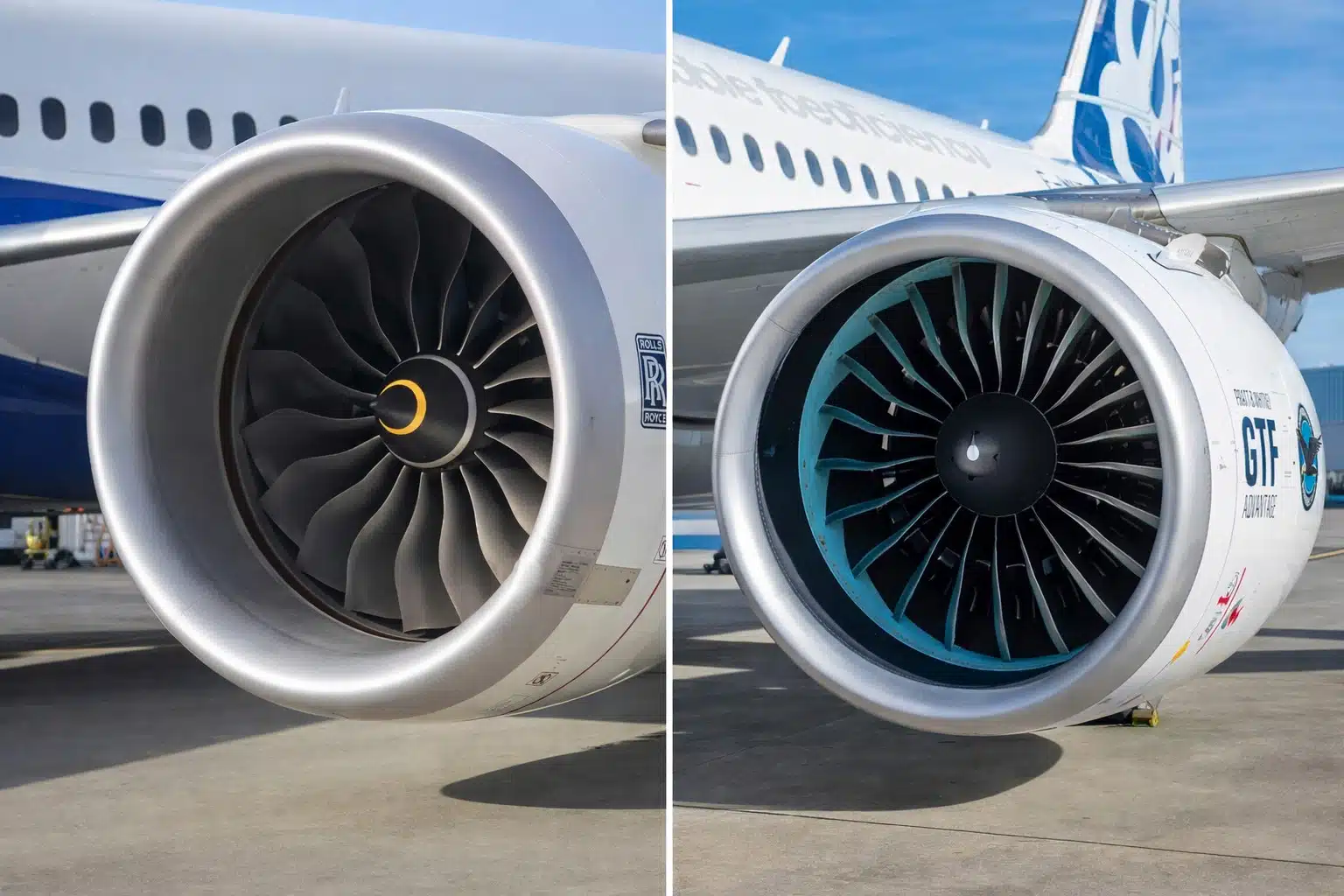
Walk up to any commercial aircraft and you’ll see one of three engine manufacturers powering it: General Electric, Rolls-Royce, or Pratt & Whitney. But while GE dominates with sheer market share, the engineering battle between Rolls-Royce and Pratt & Whitney reveals fundamentally different philosophies about how jet engines should work.
Rolls-Royce builds engines with three independent rotating assemblies – a design no other manufacturer uses commercially. Pratt & Whitney pioneered the geared turbofan, placing a planetary gearbox between the fan and turbine to let each spin at different speeds.
These aren’t minor technical differences. They shape which aircraft these engines power, how airlines maintain them, and – as recent events prove – their real-world reliability when problems emerge.
The Two Giants Of Aircraft Engine Manufacturing
Rolls-Royce Holdings traces its aviation roots to 1914 and became synonymous with jet engines through the RB211 program in the 1970s. Today, the British manufacturer holds an 18% share of the commercial aircraft engine market.
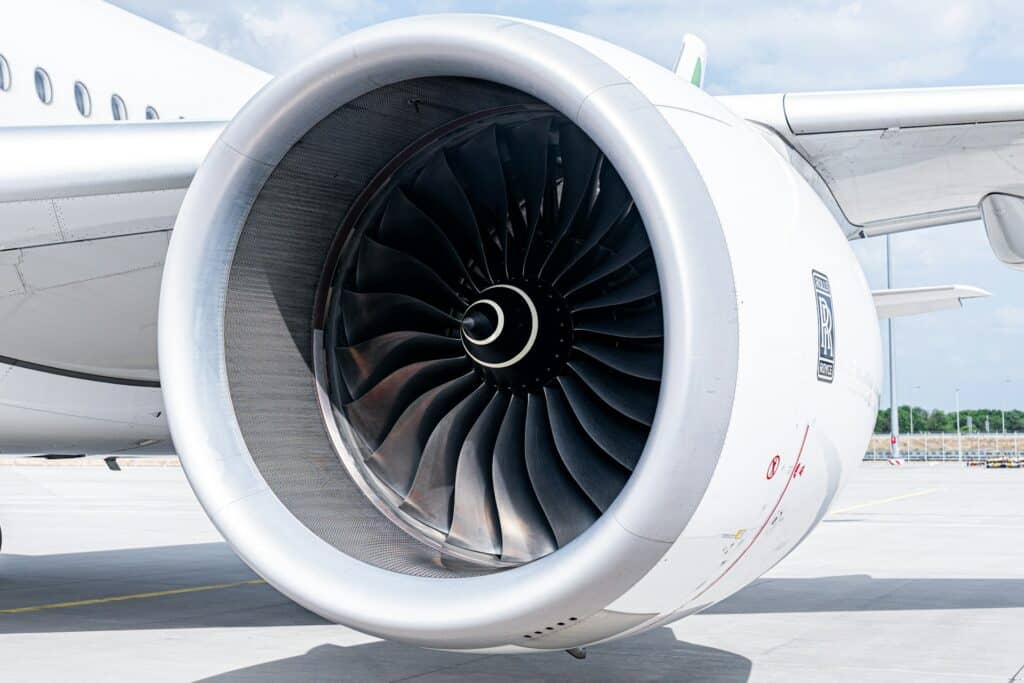
The company’s Trent family powers nearly every major widebody aircraft: Airbus A330, A350, A380, Boeing 777, and 787. In 2019, Rolls-Royce delivered 510 Trent engines valued at billions in revenue.
Pratt Pratt & Whitney, founded in 1925 Whitney, founded in 1925, powered the Douglas DC-3 that revolutionized air travel. The Connecticut-based manufacturer, now part of RTX Corporation, commands 26% market share through joint ventures.
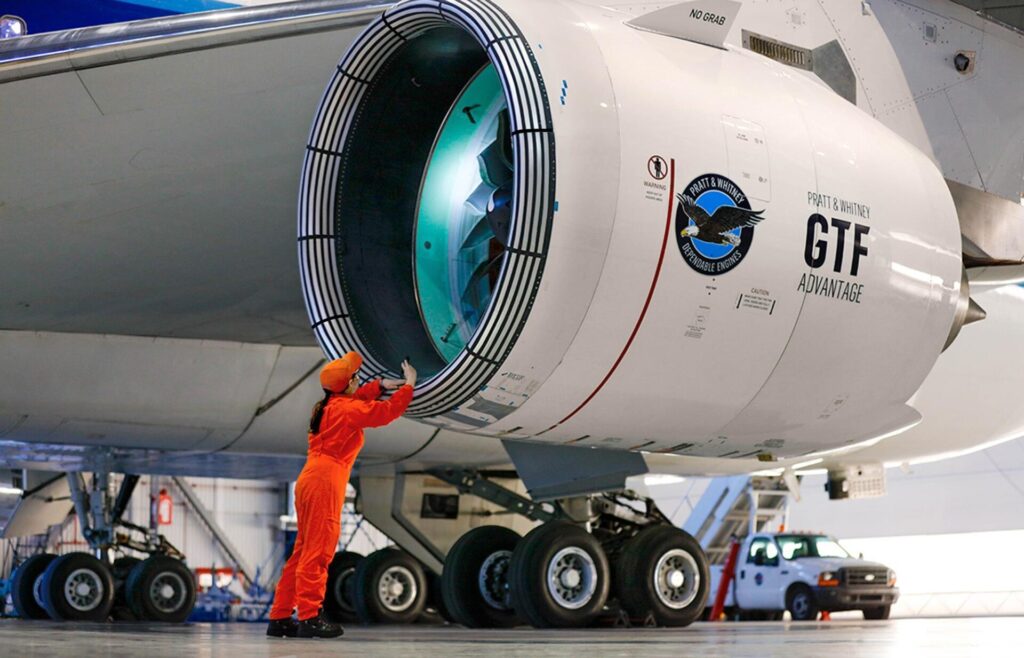
Pratt & Whitney’s PW1000G geared turbofan family dominates narrowbody aircraft: Airbus A220, A320neo family, and Embraer E-Jets E2. The company invested $10 billion developing this revolutionary engine technology.
Understanding aircraft manufacturers helps explain why engine choice matters strategically for airlines and airframers alike.
How Rolls-Royce Designs Its Aircraft Engines
Every Rolls-Royce Trent engine uses three-spool architecture – a design the company pioneered and patented. This means three independent rotating assemblies, each turning at its own optimal speed.
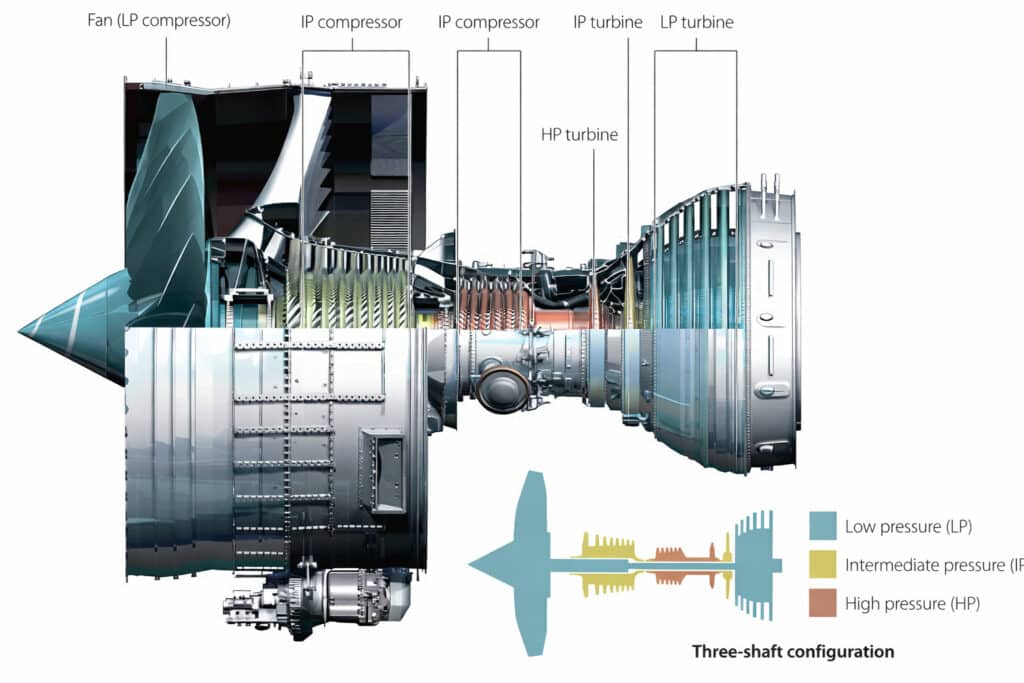
The Triple-Spool Engine Architecture
Low-Pressure (LP) Spool: The massive fan you see from outside connects to a low-pressure turbine through a shaft running through the engine’s center. On the Trent 1000, a 2.85-meter fan driven by six turbine stages generates most of the engine’s thrust.
Intermediate-Pressure (IP) Spool: Eight compressor stages sit concentrically around the LP shaft, driven by a single turbine stage. This IP system does work conventional engines assign to the high-pressure system.
High-Pressure (HP) Spool: Six compressor stages compress air to extreme pressures, driven by a single turbine stage operating at temperatures exceeding metal melting points. Laser-drilled cooling holes and thermal barrier coatings keep turbine blades alive.
The three spools rotate independently and concentrically – like three tubes sliding inside each other. The HP spool might spin at 10,000 RPM while the LP spool turns at 3,000 RPM, each tuned for its specific function.
Why Rolls-Royce Uses Three Spools
The third spool solves a fundamental problem: compressor efficiency versus turbine efficiency. High-pressure compressors work best spinning fast. Large fans work best spinning slowly. Connecting them directly forces compromises.
Rolls-Royce splits high-pressure compression between IP and HP spools. Each operates at its ideal speed without compromise. The result: stable airflow across wider operating ranges, less risk of compressor stall, and flexibility to scale engine families.
The Trent family thrust range spans 61,900 to 97,000 pounds simply by resizing spools. Trent 700 for A330? Scale the IP compressor one way. Trent XWB for A350? Scale it another. Same basic architecture, different sizes.
How Pratt & Whitney Designs Its Aircraft Engines
Pratt & Whitney took a radically different approach: add a gearbox. The PW1000G family uses conventional two-spool architecture but places a planetary reduction gearbox between the fan and low-pressure turbine.

The Geared Turbofan Revolution
In conventional engines, the fan and low-pressure turbine rotate on the same shaft at the same speed. This creates a problem: fans want to spin slowly, turbines want to spin fast.
Pratt & Whitney’s solution: a 3:1 reduction gearbox. The low-pressure turbine spins at 10,000+ RPM while the gearbox slows the fan to 3,000-4,000 RPM. Each component operates at its optimal speed.
The gearbox itself measures just 17 inches diameter but transmits 35,000 horsepower. It weighs 500 pounds and achieves 99.7% efficiency through advanced materials and lubrication. The planetary design uses five planet gears orbiting a sun gear, sharing the load.
This enables bypass ratios around 12:1 – meaning 12 times more air flows around the engine than through it. Higher bypass ratios equal better fuel efficiency and dramatically lower noise.
How Geared Turbofans Achieve Efficiency
Slower fan speeds deliver three advantages. First, fan blade tips never approach supersonic speeds, eliminating shock waves that create noise. The PW1000G produces 75% less noise than previous engines.
Second, the larger, slower-turning fan moves more air at lower velocity. Moving lots of air slowly beats moving less air quickly for propulsive efficiency – the fundamental goal of high-bypass turbofans.
Third, the turbine spinning faster operates more efficiently, extracting more energy from exhaust gases. Combined with the efficient fan, fuel burn drops 16% compared to previous-generation engines.
Triple-Spool vs Geared Turbofan: The Core Engineering Difference
Both designs solve the same problem – optimizing component speeds independently – through different engineering approaches. The trade-offs shape their applications.
| Feature | Rolls-Royce (Triple-Spool) | Pratt & Whitney (Geared) |
|---|---|---|
| Architecture | Three independent spools | Two spools + reduction gearbox |
| Rotating Assemblies | LP, IP, HP shafts (concentric) | LP, HP shafts + gearbox |
| Speed Optimization | Each spool at optimal RPM | Gearbox decouples fan/turbine |
| Bypass Ratio | 10:1 typical | 12:1 (higher efficiency) |
| Weight | Three shafts + bearings | Gearbox adds 500 lbs |
| Complexity | More bearings, seals, controls | Gearbox maintenance critical |
| Scalability | Easy (resize spools) | Modular core architecture |
| Best Application | Widebody aircraft | Narrowbody aircraft |
Note: Pratt & Whitney’s geared design achieves higher bypass ratios (12:1 highlighted green), delivering superior fuel efficiency for narrowbodies. Rolls-Royce’s triple-spool offers easier scalability across thrust ranges (highlighted green). Swipe left to see full table on mobile devices.
Which Aircraft Use Rolls-Royce Engines?
Rolls-Royce dominates the widebody market with Trent engines powering twin-engine long-haul aircraft where reliability and range matter most.
Airbus A350: The Trent XWB (Extra Wide Body) is the sole engine option, producing 84,000-97,000 pounds thrust. It achieved the fastest certification in Rolls-Royce history and powers every A350 delivered.
Boeing 787 Dreamliner: The Trent 1000 competes with GE’s GEnx. Airlines like British Airways, Virgin Atlantic, and Air New Zealand selected Rolls-Royce for their 787 fleets. The complete 787 vs A350 comparison explains how engine choice influences aircraft selection.
Airbus A330neo: The Trent 7000 is the exclusive powerplant, derived from Trent XWB technology. It delivers 72,000 pounds thrust with double the bypass ratio of previous A330 engines.
Airbus A380: The Trent 900 produces 70,000-80,000 pounds thrust. Emirates, the largest A380 operator, chose Rolls-Royce for its entire fleet of the double-decker aircraft.
Boeing 777: The Trent 800 captured 40% of early 777 orders, competing against GE90 and PW4000. It produces 90,000-95,000 pounds thrust for long-haul operations.
Which Aircraft Use Pratt & Whitney Engines?
Pratt & Whitney’s geared turbofan conquered the narrowbody market where fuel efficiency and noise reduction deliver immediate economic benefits.
Airbus A320neo Family: The PW1100G-JM powers roughly 40% of A320neo orders. It produces 24,000-33,000 pounds thrust, competing directly with CFM International’s LEAP-1A. Airlines like Wizz Air, IndiGo, and Spirit Airlines built fleets around GTF-powered A320neos.
Airbus A220: The PW1500G is the exclusive engine, producing 19,000-23,000 pounds thrust. The A220 pioneered GTF technology entering service in 2016. Delta, JetBlue, and Air Canada operate large A220 fleets.
Embraer E-Jets E2: The PW1900G powers all three E2 variants (E175-E2, E190-E2, E195-E2). The engine produces 15,000-21,000 pounds thrust for regional operations.
Pratt & Whitney also produces the PW4000 family for widebodies, including older Boeing 777s and Airbus A330s. However, the company’s commercial focus shifted entirely to geared turbofans for new aircraft.
Power Output And Performance Comparison
Engine thrust varies dramatically between narrowbody and widebody applications, shaping which manufacturer dominates each market segment.
| Engine Model | Aircraft | Thrust Range | Market Segment |
|---|---|---|---|
| Trent XWB | Airbus A350 | 84,000-97,000 lbs | Widebody exclusive |
| Trent 1000 | Boeing 787 | 62,000-81,000 lbs | Widebody competitive |
| Trent 7000 | Airbus A330neo | 68,000-72,000 lbs | Widebody exclusive |
| Trent 900 | Airbus A380 | 70,000-80,000 lbs | Widebody exclusive |
| PW1100G-JM | Airbus A320neo | 24,000-33,000 lbs | Narrowbody competitive |
| PW1500G | Airbus A220 | 19,000-23,000 lbs | Narrowbody exclusive |
| PW1900G | Embraer E2 | 15,000-21,000 lbs | Regional exclusive |
Note: Rolls-Royce Trent engines (green rows) dominate widebody thrust ranges 60,000-97,000 lbs. Pratt & Whitney GTF engines (yellow rows) dominate narrowbody thrust ranges 15,000-33,000 lbs. Clear market segmentation between manufacturers. Swipe left to see full table on mobile devices.
The thrust divide reveals strategic focus: Rolls-Royce owns widebodies, where triple-spool scalability and reliability matter most. Pratt & Whitney owns narrowbodies, where geared turbofan efficiency delivers maximum economic benefit.
Reliability And Maintenance Comparison
Recent years exposed dramatic reliability differences between the manufacturers, with real-world consequences for airlines and passengers.
The Pratt & Whitney GTF Crisis
In 2023, Pratt & Whitney discovered powder metal contamination in high-pressure turbine and compressor discs manufactured between 2015-2021. Microscopic impurities cause cracks under extreme heat and stress.
By early 2026, 835 aircraft remain grounded globally – 38% of the GTF-powered A320neo fleet. Airlines like Wizz Air (40+ aircraft), IndiGo (70+ aircraft), and Spirit Airlines face severe capacity constraints.
Engine overhaul times stretched to 250-300 days versus normal 60-90 days. Shop capacity overwhelmed. Airlines wet-lease replacements at $50,000+ daily. The crisis cost RTX Corporation $6-7 billion, similar to costs analyzed in aircraft leasing economics.
The PW1500G (A220) and PW1900G (E-Jets E2) avoid the crisis – different manufacturing processes and materials. But the PW1100G problems devastated airlines dependent on A320neo fleets. The complete A320neo grounding analysis reveals the full operational impact.
Rolls-Royce Trent Reliability
Rolls-Royce faced its own challenges, particularly with the Trent 1000 powering Boeing 787s. Intermediate-pressure turbine blade cracking emerged in 2016, grounding up to 44 aircraft and costing Rolls-Royce £1.3 billion.
The issues stemmed from vibration-induced cracking in IP compressor blade roots. Rolls-Royce redesigned blades, shifting mass toward blade tips to avoid resonance frequencies. The Trent 1000 TEN variant incorporated fixes.
Despite early problems, Trent engines generally achieve 99.9% dispatch reliability – industry-leading performance. The Trent 7000 on A330neo claims the world’s most reliable widebody engine record.
However, United Airlines’ February 2026 dispute with Rolls-Royce over $175 million in engine commitments shows relationship challenges persist. United’s cancelled A350 order partly stems from Rolls-Royce’s exclusive engine position creating single-source vulnerability.
Maintenance Economics
Triple-spool engines require more bearings, seals, and oil systems to support three independent shafts. This increases parts count and routine maintenance complexity.
Geared turbofans concentrate complexity in the planetary gearbox. While the gearbox proves remarkably reliable at 99.7% efficiency, inspection intervals and overhaul requirements remain stricter than conventional engines.
The GTF’s modular design aids maintenance. Technicians remove and replace the fan, compressor, combustor, or turbine independently. The Trent’s concentric spools complicate disassembly – accessing inner components requires removing outer assemblies.
Market Position And Competitive Dynamics
The commercial aircraft engine market divides into three tiers: GE/CFM (55%), Pratt & Whitney (26%), Rolls-Royce (18%). CFM International – the GE/Safran joint venture – dominates narrowbodies with LEAP engines.
Rolls-Royce strategy focuses on widebody exclusivity. The company powers every A350, every A330neo, and competes strongly on 787s. This concentration delivers high-margin business but limits volume.
Pratt & Whitney’s geared turbofan captured 40% of A320neo orders against CFM’s LEAP. The GTF crisis damaged that position – airlines shifted toward LEAP after grounding issues emerged. Understanding aircraft parts suppliers reveals the complex supply chains supporting these engine programs.
Future Technology Developments
Rolls-Royce UltraFan: A geared triple-spool engine combining both companies’ philosophies. The planetary gearbox drives a massive 140-inch fan for bypass ratios exceeding 15:1. The three-spool core maintains Rolls-Royce’s architectural advantage.
UltraFan targets 25% fuel burn improvement over first-generation Trent engines. Ground testing completed in 2024. The design works for both narrowbody and widebody applications – potentially entering Rolls-Royce into narrowbody competition.
Pratt & Whitney GTF Advantage: An upgraded PW1100G with 35 redesigned components addressing durability issues. It promises double time-on-wing compared to original GTF engines. Entry into service began 2026.
The GTF Advantage incorporates military-derived cooling technology, advanced materials, and improved combustor designs. Rolls-Royce’s comparison with 787 operational experience shows how engine reliability shapes airline fleet decisions.
Which Engine Manufacturer Is Better?
The question has no single answer because better depends on application. Rolls-Royce dominates widebodies through triple-spool advantages. Pratt & Whitney revolutionized narrowbodies with geared turbofans.
For widebody operators prioritizing range, reliability, and proven performance, Rolls-Royce Trent engines deliver. Airlines like Qatar Airways, Singapore Airlines, and Cathay Pacific built their fleets on Trent technology.
For narrowbody operators maximizing fuel efficiency and noise reduction, Pratt & Whitney GTF engines – when operating properly – provide unmatched economics. The 16% fuel burn improvement and 75% noise reduction transform narrowbody operations.
But the 2023-2026 GTF crisis exposed geared turbofan vulnerability. When problems emerge in revolutionary technology, the entire fleet suffers. Conventional engines like CFM’s LEAP offer lower peak efficiency but proven reliability.
Frequently Asked Questions
Which engines are better: Rolls-Royce or Pratt & Whitney?
Neither is universally better – they excel in different applications. Rolls-Royce Trent engines dominate widebodies (A350, 787, A330neo) with triple-spool reliability and scalability. Pratt & Whitney GTF engines revolutionized narrowbodies (A320neo, A220, E-Jets E2) with 16% better fuel efficiency and 75% quieter operations. However, the 2023-2026 GTF crisis grounded 835 aircraft due to powder metal contamination, while Trent engines generally achieve 99.9% dispatch reliability. For widebody long-haul, choose Rolls-Royce. For narrowbody efficiency, GTF offers advantages when reliability issues are resolved.
What aircraft use Rolls-Royce engines?
Rolls-Royce powers major widebody aircraft exclusively or competitively. The Trent XWB is the sole engine for Airbus A350 (all variants). The Trent 7000 exclusively powers A330neo. The Trent 900 exclusively powers A380. The Trent 1000 competes with GE GEnx on Boeing 787 Dreamliner. The Trent 800 competes with GE90 and PW4000 on Boeing 777. Rolls-Royce holds approximately 18% commercial engine market share, concentrated in widebody twin-engine aircraft where range and reliability matter most for long-haul operations.
What is the Pratt & Whitney GTF engine?
GTF (Geared Turbofan) is the PW1000G family using a planetary reduction gearbox between fan and turbine. The 3:1 gearbox lets the fan spin slowly (3,000 RPM) while the turbine spins fast (10,000+ RPM), each at optimal speeds. This enables 12:1 bypass ratios, 16% better fuel efficiency, and 75% noise reduction versus previous engines. The gearbox measures 17 inches diameter, weighs 500 pounds, transmits 35,000 horsepower, and operates at 99.7% efficiency. Variants include PW1100G (A320neo), PW1500G (A220), and PW1900G (E-Jets E2). Despite revolutionary benefits, powder metal contamination grounded 835 aircraft in 2023-2026.
How does Rolls-Royce triple-spool architecture work?
Three independent concentric shafts rotate at different speeds for optimal efficiency. The Low-Pressure spool connects the large fan to six turbine stages. The Intermediate-Pressure spool drives eight compressor stages via one turbine stage, sitting concentrically around the LP shaft. The High-Pressure spool powers six compressor stages through one turbine stage, running through the center at 10,000+ RPM. Each spool operates at its ideal speed without compromise. This design enables stable airflow, reduces compressor stall risk, and allows easy scaling across thrust ranges 61,900-97,000 pounds. Only Rolls-Royce uses triple-spool commercially – the design is patented.
Why are so many A320neos grounded?
Powder metal contamination in Pratt & Whitney PW1100G engines manufactured 2015-2021 caused the crisis. Microscopic impurities in high-pressure turbine and compressor discs lead to cracks under extreme heat and stress. By early 2026, 835 aircraft remain grounded (38% of GTF-powered A320neo fleet). Engine overhaul times reached 250-300 days versus normal 60-90 days. Affected airlines include Wizz Air (40+ grounded), IndiGo (70+ grounded), Spirit Airlines, Volaris, and VivaAerobus. The crisis cost RTX Corporation $6-7 billion, similar to costs analyzed in aircraft leasing economics. The PW1500G (A220) and PW1900G (E-Jets E2) are not affected – different manufacturing processes avoid the contamination issue.
Which engine is more powerful: Rolls-Royce or Pratt & Whitney?
Rolls-Royce produces significantly more powerful engines – up to 97,000 pounds thrust versus Pratt & Whitney’s 33,000 pounds. The Trent XWB (A350) reaches 84,000-97,000 lbs, Trent 900 (A380) produces 70,000-80,000 lbs, and Trent 1000 (787) generates 62,000-81,000 lbs. Pratt & Whitney’s most powerful GTF, the PW1100G-JM (A320neo), reaches only 24,000-33,000 lbs. This reflects market segmentation: Rolls-Royce focuses on widebody aircraft requiring massive thrust for long-haul operations, while Pratt & Whitney dominates narrowbodies where lower thrust suffices but efficiency matters more. Pratt’s older PW4000 family reached 90,000 lbs but is being phased out.
What is the most reliable aircraft engine?
The Rolls-Royce Trent 7000 claims the most reliable widebody engine record with 99.9% dispatch reliability. Dispatch reliability measures the percentage of flights departing on time without engine-related delays. The Trent 7000 powers Airbus A330neo, entering service 2018 with technology from Trent XWB. For narrowbodies, CFM International’s LEAP-1A/B engines demonstrate superior reliability versus Pratt & Whitney GTF – approximately 4% maintenance rates compared to GTF’s 33-38% grounded rates during the 2023-2026 crisis. The Trent 1000 (787) overcame early turbine blade issues to achieve strong reliability. Engine reliability directly impacts airline profitability through maintenance costs and operational availability.
Will Pratt & Whitney fix the GTF problems?
Pratt & Whitney expects issues largely resolved by end of 2026, but industry experts remain skeptical. The company introduced GTF Advantage in 2026 with 35 redesigned components promising double time-on-wing. The Hot Section Plus upgrade retrofits existing PW1100G engines with improved durability. However, 600-700 engines still require shop visits through 2027-2028. Engine overhaul capacity increased with new MRO facilities in UAE and Spain, but 250-300 day turnaround times continue. Airlines shifted future orders toward CFM LEAP engines due to reliability concerns. New A320neos delivered from 2024 onward receive improved engines not affected by powder metal defects, but retrofitting the existing fleet represents years of work.
Conclusion
Rolls-Royce and Pratt & Whitney represent fundamentally different engineering philosophies. Triple-spool architecture versus geared turbofans. Widebody dominance versus narrowbody revolution. Proven reliability versus breakthrough efficiency.
The GTF crisis exposed the risks of revolutionary technology. When Pratt & Whitney’s geared turbofan works, it delivers unmatched fuel efficiency and noise reduction. When it fails, 835 aircraft sit grounded and airlines lose billions. Rolls-Royce’s conservative triple-spool approach sacrifices peak efficiency for proven reliability.
Neither manufacturer is universally better. Airlines choose based on aircraft type, route networks, and risk tolerance. But recent years proved that reliability matters more than marginal efficiency gains when problems ground your fleet.