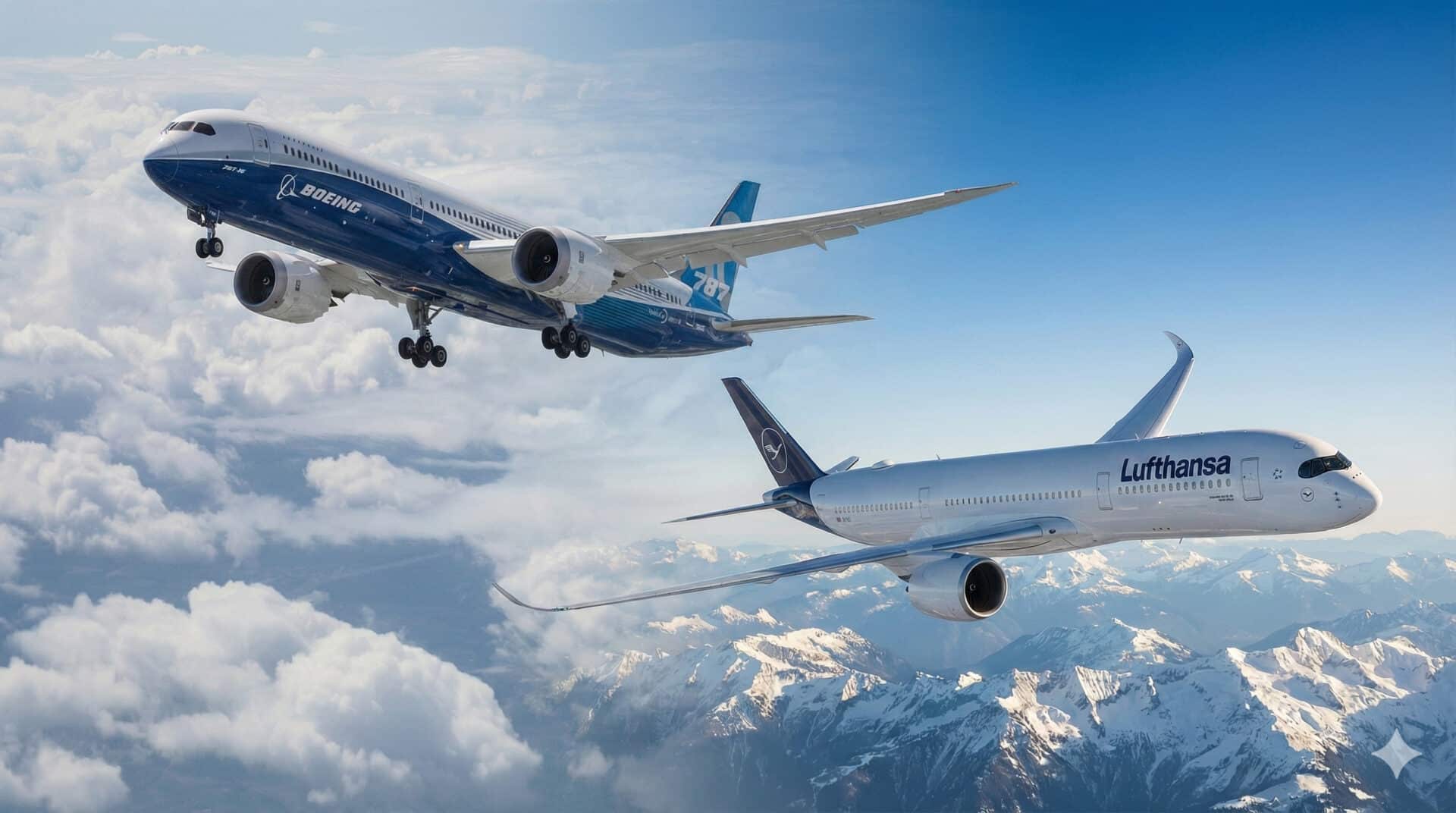
The Boeing 787 Dreamliner and Airbus A350 XWB represent the two most advanced widebody aircraft programs in commercial aviation. Both feature composite fuselages, advanced aerodynamics, and fuel efficiency that makes older widebodies obsolete.
But these aircraft serve different mission profiles.
The Boeing 787 excels at point-to-point operations with lower operating costs. The Airbus A350 offers superior range and capacity for ultra-long-haul routes.
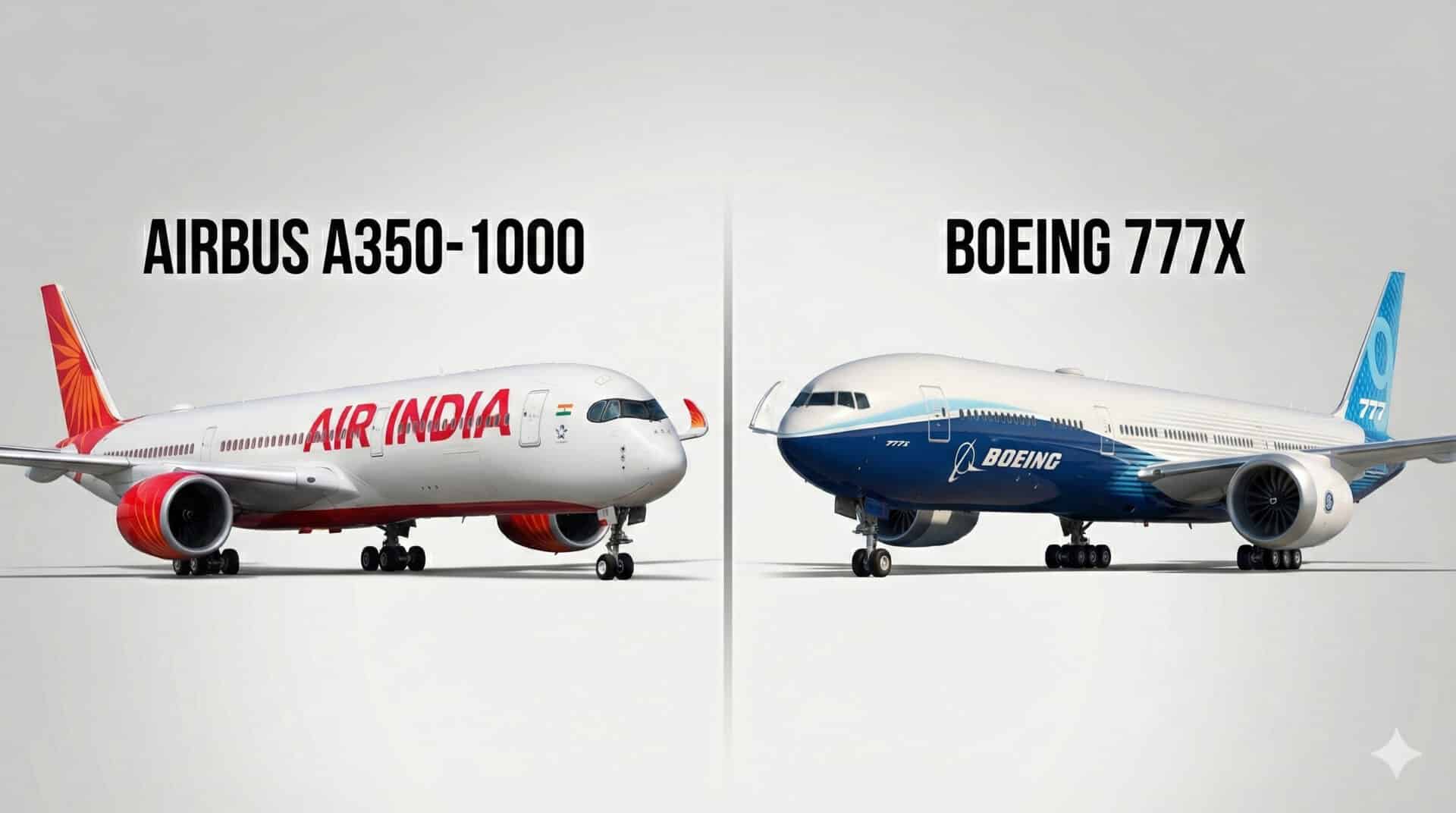
This comparison examines which widebody aircraft delivers better value for airlines. We analyze the 787-10 and A350-1000 variants as the closest competitors in size and capability.
For airlines evaluating fleet decisions, this guide covers capacity, range, fuel efficiency, pricing, and real-world operator experience with both aircraft.
How We Compared the Boeing 787 and Airbus A350
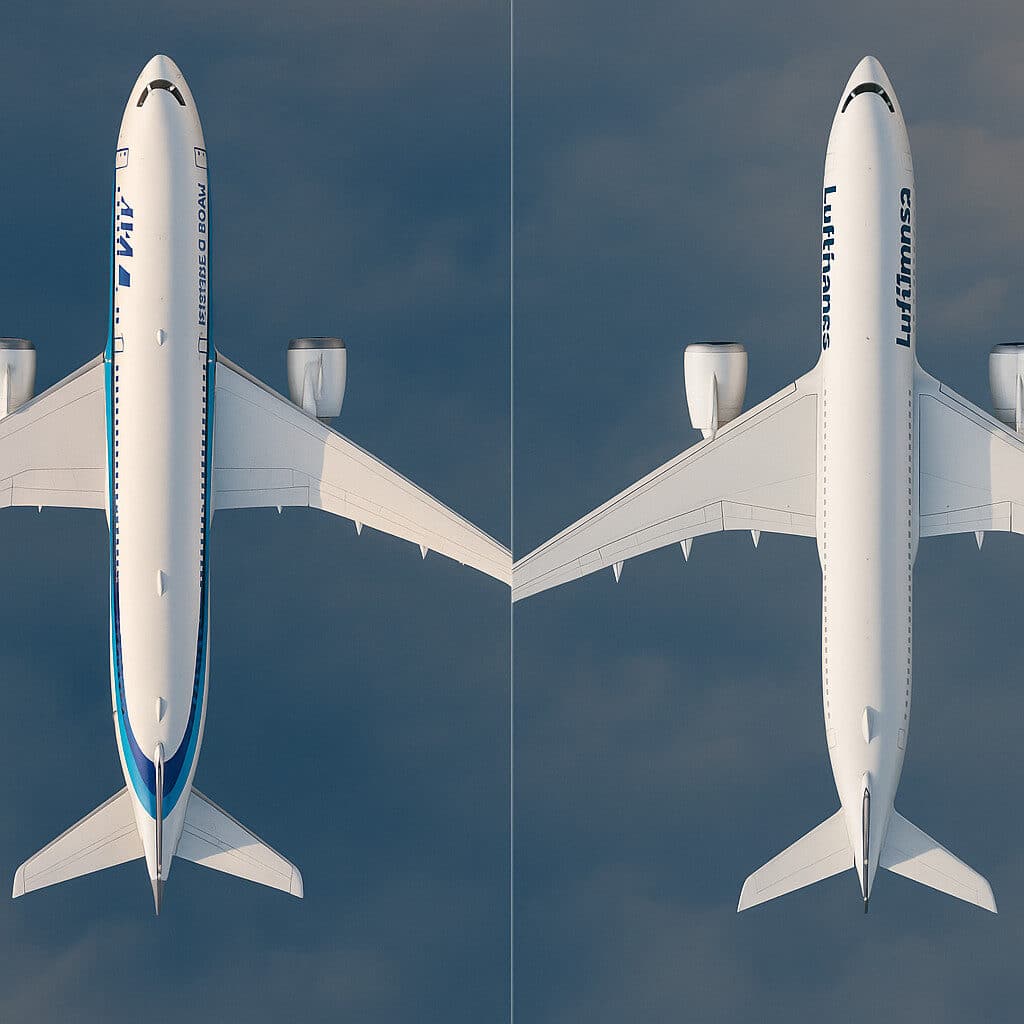
Aircraft comparisons require context. The right aircraft depends on an airline’s specific network, passenger demographics, and financial targets.
Airline-Focused Criteria
This comparison evaluates both aircraft across six dimensions that matter to airline planners:
Passenger Capacity. Maximum and typical seating configurations determine revenue potential per flight.
Range. Operational range determines which city pairs the aircraft serves without payload restrictions.
Fuel Burn and Operating Economics. Trip cost and seat-mile cost drive profitability.
Purchase Price. List price and typical discount levels affect fleet acquisition strategy.
Fleet Commonality. Training costs and operational flexibility depend on cockpit compatibility with existing fleet.
Cargo Volume. Belly cargo capacity provides ancillary revenue on long-haul routes.
Why Compare the 787-10 vs A350-1000?
The 787-10 and A350-1000 represent the largest variants in each family. They compete directly for high-density long-haul routes.
Smaller variants (787-8/9 and A350-900) serve different markets. The upcoming Boeing 777X competes at a higher capacity level than both aircraft.
Quick Specs Comparison: A350-1000 vs 787-10
| Specification | Airbus A350-1000 | Boeing 787-10 |
|---|---|---|
| Typical Seating | 350-410 passengers | 318-336 passengers |
| Maximum Seating | 480 passengers | 440 passengers |
| Length | 73.78 m (242 ft) | 68.28 m (224 ft) |
| Wingspan | 64.75 m (212 ft) | 60.12 m (197 ft) |
| Range | 8,700 NM (16,112 km) | 6,330 NM (11,730 km) |
| MTOW | 319 tonnes | 254 tonnes |
| Engines | Rolls-Royce Trent XWB-97 | GEnx-1B / Trent 1000 |
| Max Thrust (per engine) | 97,000 lbf | 76,000 lbf |
| Cruise Speed | Mach 0.85 | Mach 0.85 |
The A350-1000 is larger in every dimension. The 787-10 is lighter and more efficient for shorter missions.
Capacity Comparison: A350 Is the Bigger Jet
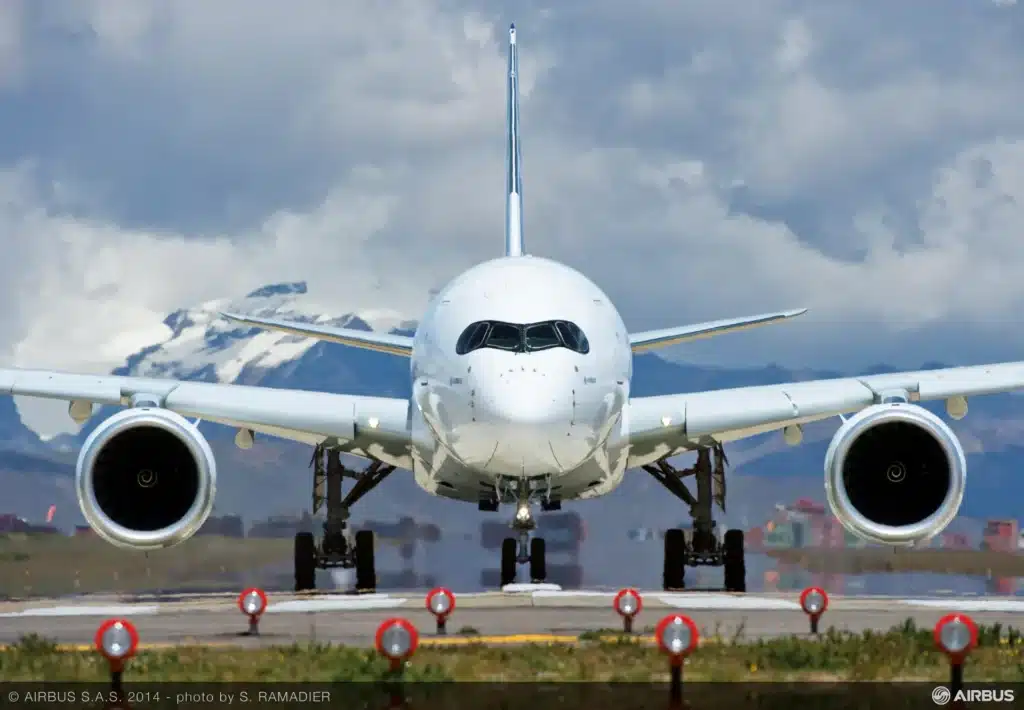
Passenger capacity determines revenue potential. The A350-1000 leads in both typical and maximum configurations.
Cabin Width Advantage
The A350 cabin measures 18 ft 5 in (5.61 m) wide. The 787 cabin measures 18 ft (5.49 m) wide.
This 5-inch difference allows Airbus to offer slightly wider seats in economy class while maintaining 9-abreast seating. Airlines prioritizing passenger comfort choose the A350 for premium long-haul services.
Both aircraft support 9-abreast economy configurations. The A350’s extra width provides more aisle clearance for service carts and deplaning.
Fuselage Length Advantage
The A350-1000 stretches 5.5 meters longer than the 787-10. This additional length translates to approximately 40-60 more passengers depending on configuration.
For airlines operating high-density routes like London-Dubai or Singapore-Sydney, the A350-1000 offers superior revenue per departure.
Cargo Capacity
The A350-1000 accommodates 36 LD3 containers in the belly hold. The 787-10 fits 28 LD3 containers.
Belly cargo generates $2,000-5,000+ per flight on long-haul routes. The A350’s larger hold provides meaningful ancillary revenue advantages on cargo-rich corridors.
Range Comparison: A350 Dominates Long-Haul
Range determines route possibilities. The A350-1000 offers 37% more range than the 787-10.
A350-1000: Up to 8,700 NM
The A350-1000 serves ultra-long-haul routes without payload restrictions. Qantas selected the A350-1000 for Project Sunrise connecting Sydney to London and New York nonstop.
Singapore Airlines operates A350-900ULR variants on the world’s longest flights. The -1000 variant maintains similar range capability with higher passenger capacity.
Routes requiring 15+ hours of flight time favor the A350 platform.
787-10 Range: 6,330 NM
The 787-10 is optimized for high-demand medium and long-haul routes. Range covers transatlantic, transpacific (with stops), and intra-Asia operations.
Routes under 12 hours favor the 787-10. United Airlines uses the 787-10 for Newark-Frankfurt, Newark-Tel Aviv, and premium transcontinental routes.
The 787-10 struggles on ultra-long-haul city pairs. Airlines cannot operate New York-Singapore or Dallas-Sydney directly with the 787-10.
Explore the top 5 longest non-stop flights served by these aircraft.
Fuel Burn and Operating Economics: 787-10 Has the Edge

Operating costs determine route profitability. The lighter 787-10 delivers better trip economics on shorter missions.
Weight Comparison
A350-1000 Operating Empty Weight: ~155 tonnes
787-10 Operating Empty Weight: ~136 tonnes
The 787-10 weighs approximately 19 tonnes less than the A350-1000. Lower weight reduces fuel consumption on every flight.
Trip Cost Advantage
On routes under 6,000 NM, the 787-10 burns less fuel per departure. Airlines report 5-8% lower trip costs compared to the A350-1000 on equivalent routes.
This advantage diminishes on longer routes where the A350-1000’s greater fuel capacity becomes necessary.
Seat-Mile Cost Comparison
The A350-1000’s higher capacity offsets its weight disadvantage on dense routes. With 60+ additional seats, the A350-1000 delivers lower cost per available seat mile (CASM) despite burning more fuel per trip.
Airlines must evaluate their specific route economics. High load factor routes favor the A350-1000. Routes with variable demand favor the 787-10’s flexibility.
Price Comparison: 787 Is Cheaper
List prices provide a baseline for comparison. Actual transaction prices involve significant discounts.
Catalog Prices (2024)
Boeing 787-10: $338.4 million
Airbus A350-1000: $355.7 million
The 787-10 lists at $17.3 million less than the A350-1000. This 5% price difference compounds across large fleet orders.
Real Transaction Prices
Airlines typically receive 40-60% discounts from list prices depending on order size, timing, and competitive pressure.
Qatar Airways’ $96 billion Boeing order demonstrates how major customers negotiate favorable terms. Emirates, Singapore Airlines, and other large operators secure similar discounts from Airbus.
Actual per-aircraft prices range from $140-180 million for both types in large orders.
Fleet Commonality: Tipping the Scale for Airlines
Training costs and operational flexibility depend on fleet commonality. Airlines already operating Boeing or Airbus widebodies gain advantages from sticking with their existing manufacturer.
A350 Fleet Commonality
The A350 shares a common type rating with the A330. Pilots transition between aircraft with minimal additional training.
Airlines operating A330 fleets can add A350s without expanding pilot groups. This reduces training costs and improves crew scheduling flexibility.
The A350 cockpit uses Airbus fly-by-wire philosophy. Pilots transitioning from A320 family aircraft adapt quickly to A350 systems.
787 Fleet Commonality
The 787 shares cockpit design philosophy with the 777. Boeing designed similar system architectures and display formats across both programs.
Airlines operating 777 fleets find 787 transitions straightforward. United, American, and ANA leverage this commonality.
The 787 also appeals to airlines switching from Boeing to Airbus or vice versa as a modern platform with advanced training systems.
Sales and Popularity: Who’s Winning?
Order books indicate market preference. Both aircraft have achieved commercial success.
Boeing 787 Family Orders
Total Orders: 1,843+
Operators: 72 airlines
787-10 Specific Orders: 243
The 787 launched first (2011 entry into service) and built a larger installed base. The 787-9 dominates orders as the “sweet spot” variant balancing range and capacity.
Airbus A350 Family Orders
Total Orders: 1,000+
Operators: 36 airlines
A350-1000 Specific Orders: 226
The A350 entered service in 2015. Despite the later start, order momentum has been strong. The A350-900 leads orders, with the -1000 gaining share for premium long-haul applications.
Why Mid-Size Variants Sell Better
The 787-9 and A350-900 offer the best combination of range, capacity, and economics for most route networks. Airlines prefer flexibility over maximum size.
Large variants (787-10 and A350-1000) serve specific high-density routes. Most airline networks have limited demand for 350+ seat widebodies.
Airline Use Cases: Real-World Operations
Operator choices reveal how airlines apply each aircraft type.
A350-1000 Operators
Qatar Airways operates the largest A350-1000 fleet with 20+ aircraft. Routes include Doha-Los Angeles, Doha-Sydney, and premium European services. Qatar emphasizes the Qsuite business class product.
British Airways uses A350-1000s on long-haul routes from London Heathrow including Toronto, Dubai, and Bangalore. The larger capacity serves BA’s hub strategy.
Cathay Pacific operates A350-1000s on premium routes from Hong Kong. The aircraft replaced Boeing 777-300ERs on select services.
787-10 Operators
United Airlines deploys 787-10s on premium transcontinental and transatlantic routes. Newark-Los Angeles, Newark-Frankfurt, and Newark-Tel Aviv showcase the aircraft’s versatility.
Singapore Airlines operates 787-10s on medium-haul routes within Asia. The aircraft complements the A350-900ULR fleet for ultra-long-haul.
ANA uses 787-10s on high-density domestic routes and intra-Asia services. The aircraft replaced older 777-200s.
Etihad Airways operates 787-10s on routes from Abu Dhabi including Melbourne, Seoul, and European destinations.
Which Plane Is Best?
The answer depends on your airline’s mission profile.
Choose the A350-1000 If:
Range matters most. Ultra-long-haul routes (8,000+ NM) require the A350-1000’s fuel capacity.
Capacity drives revenue. High-density routes benefit from 350+ seats per departure.
You already operate Airbus widebodies. Fleet commonality with A330 reduces training costs.
Premium cabin space is a priority. The wider fuselage accommodates elaborate business class products.
Choose the 787-10 If:
Operating economics drive decisions. Lower trip costs matter on routes under 6,000 NM.
Route network requires flexibility. The 787-10 serves both medium and long-haul efficiently.
You already operate Boeing widebodies. Fleet commonality with 777 improves operations.
Purchase price is a constraint. Lower acquisition cost improves return on investment.
No Universal Winner
Both aircraft dominate specific market segments. The “best” aircraft is the one that fits your route network, passenger mix, and financial model.
Airlines like Singapore Airlines operate both types. The 787-10 serves regional routes while the A350 handles ultra-long-haul.
FAQs About Boeing 787 vs Airbus A350
Which is more fuel efficient, the 787 or A350?
The 787-10 burns less fuel per trip due to lower weight. The A350-1000 offers better fuel efficiency per seat on high-density routes due to greater capacity.
Why do airlines choose the 787-10 over the A350-1000?
Airlines select the 787-10 for lower operating costs on medium-haul routes, cheaper acquisition price, and fleet commonality with existing Boeing operations.
Can the 787-10 fly as far as the A350-1000?
No. The 787-10 range is 6,330 NM vs 8,700 NM for the A350-1000. Ultra-long-haul routes require the A350.
Which aircraft has better passenger comfort?
The A350’s wider cabin allows slightly more space per passenger. Both aircraft feature lower cabin altitude and higher humidity than older widebodies.
How many airlines operate the A350-1000?
Approximately 15 airlines operate the A350-1000 including Qatar Airways, British Airways, Cathay Pacific, Virgin Atlantic, and Etihad.
What engines power the A350-1000?
The A350-1000 uses exclusively Rolls-Royce Trent XWB-97 engines producing 97,000 lbf thrust. No alternative engine is offered.
What engines power the 787-10?
The 787-10 offers two engine options: GE GEnx-1B or Rolls-Royce Trent 1000. Airlines choose based on existing fleet and support agreements.
The Widebody Market Outlook
Both aircraft programs will continue production through the 2030s. Order backlogs extend 5+ years at current production rates.
The Boeing 787 and Airbus A350 have effectively replaced the previous generation (767, 777-200, A340) for most long-haul applications. Sustainable aviation fuel compatibility ensures both aircraft meet evolving environmental requirements.
Competition between Boeing and Airbus benefits airlines. Aggressive pricing, product improvements, and support commitments result from the ongoing battle for market share.
For fleet planners, the decision comes down to mission requirements. Both aircraft deliver exceptional reliability, passenger experience, and operating economics compared to any predecessor.
Explore more aircraft comparisons: A330neo vs 787-10 and A321XLR vs 737 MAX 10.