
Royal Navy Completes First Ship-to-Ship Drone Delivery
A Malloy T-150 drone flew spare parts from HMS Prince of Wales to HMS Dauntless during the 2025 carrier strike group deployment, the Royal Navy's first ship-to-ship drone delivery.
 Cristina GabrielaMarketing Strategy ManagerPublished Updated 3 min read
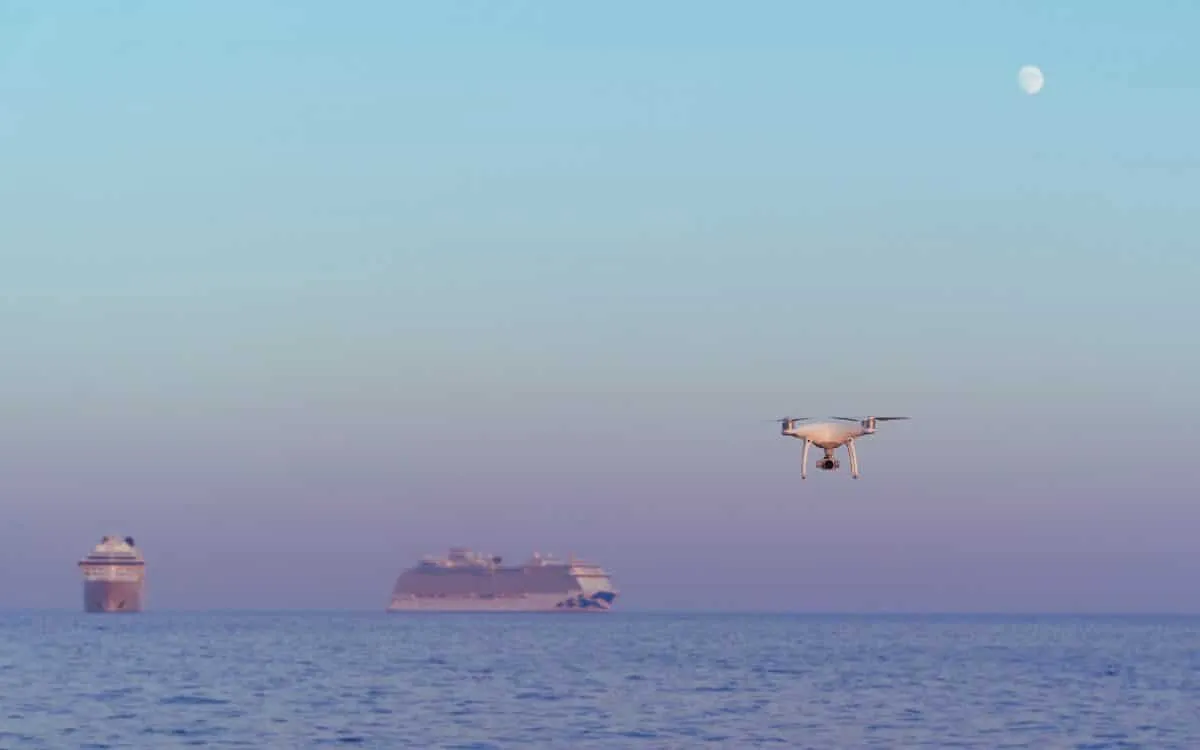
The Royal Navy has used a drone to carry supplies from one warship to another for the first time. During the UK Carrier Strike Group's 2025 deployment, a Malloy T-150 uncrewed aircraft flew from the aircraft carrier HMS Prince of Wales to the Type 45 destroyer HMS Dauntless with spare and repair parts, covering just over a mile of open sea. The Royal Navy announced the flight on 1 September 2025.
How the delivery worked
The T-150 took off from the carrier and flew the transit autonomously, following a pre-programmed route. As it approached Dauntless, a team on board the destroyer took control and guided the aircraft down to a landing on the ship's flight deck. The handover between the two ships' operators was the main point of the trial: it showed that a drone launched by one vessel can be recovered by another, which is how routine logistics flights within a task group would need to work.
The flight was carried out by 700X Naval Air Squadron, the Royal Navy's trials unit for uncrewed aircraft. Lieutenant Matt Parfitt, the squadron's pioneer flight commander, called the delivery a key milestone for the trial. Captain Colin McGannity, Commander Air Group for the strike group, described it as progress towards a fully integrated hybrid air wing that mixes crewed and uncrewed aircraft. Neil Appleton, chief executive of Malloy Aeronautics, and Armed Forces Minister Luke Pollard also welcomed the result, with Pollard saying autonomy would be central to how the armed forces operate in future.
The deployment
The delivery took place during Operation Highmast, the eight-month deployment of the UK Carrier Strike Group (CSG25) that took HMS Prince of Wales through the Mediterranean, the Middle East and the Indo-Pacific. The group included the carrier, the destroyer HMS Dauntless and ships from allied navies, with an air wing built around F-35B Lightning jets and Merlin helicopters.
Nine Malloy T-150s were embarked in the carrier's air group alongside the jets and helicopters. By the time of the ship-to-ship delivery they had flown more than 20 hours of sorties and completed close to 150 deck landings, moving items such as food, mail and engineering parts around the task group.
The Malloy T-150
Malloy Aeronautics was founded in 2013 and is based in Maidenhead, England. BAE Systems acquired the company in February 2024. The T-150 is an electric heavy-lift drone with eight rotors arranged in coaxial pairs on four arms, so it is described both as a quadcopter and as an octocopter. It carries its load in an underslung pod and is operated by a two-person team.
| Specification | Malloy T-150 |
|---|---|
| Power | Electric |
| Rotors | Eight, in four coaxial pairs |
| Maximum payload | About 68 kg |
| Maximum speed | About 60 mph (97 km/h) |
| Endurance | Roughly 20 to 40 minutes, depending on load |
| Crew | Two (remote pilot and systems monitor) |
The Royal Marines confirmed an order for 22 T-150s in February 2024, and in April 2025 the Royal Navy said nine would deploy with 700X Naval Air Squadron on the carrier group. The type has also been used in combat. The UK supplied T-150s to Ukraine as military aid, where they have been reported delivering blood, ammunition and other supplies to Ukrainian marines along the Dnipro river. Malloy also builds the larger T-650, which can lift around 300 kg and has been shown carrying weapons such as the Sting Ray torpedo.
Why it matters
Moving small, urgent items between ships at sea has traditionally meant a helicopter sortie or a boat transfer. Both are expensive in crew time, fuel and airframe hours, and boat transfers depend heavily on sea state. A Merlin helicopter tasked with carrying a box of spare parts is not available for anti-submarine patrols or other primary duties.
The Royal Navy's case for drones such as the T-150 is that they can take over this routine work at low cost, leaving crewed helicopters free for the missions only they can perform. The concept fits the service's wider plan for carrier air wings that combine crewed aircraft with a growing number of uncrewed systems for logistics, surveillance and, in time, other tasks. The payload limit of the T-150 means it cannot replace helicopters for heavy loads, but a large share of everyday ship-to-ship traffic consists of parts, mail and medical supplies well within its capacity.
What has happened since
- September 2025: In mid-September, the Royal Navy confirmed the T-150 was ready for release to service following around two years of trials with naval and commando units, including Arctic and Indian Ocean operations.
- November 2025: HMS Prince of Wales returned to Portsmouth on 30 November 2025, accompanied by HMS Dauntless and the Norwegian frigate HNoMS Roald Amundsen, bringing Operation Highmast to a close.
About the author
Cristina Gabriela
Marketing Strategy Manager
View author profile Editorial policy and correctionsExplore Drone Services
Browse 874 companiesNeed drone services? Get quotes
Tell us what you need and we will pass it to suitable companies.


