Airbus Delivers 61 Aircraft in August 2025 as Engine Shortages Persist
 Radu BalasUpdated 3 min read
Airbus delivered 61 commercial aircraft in August 2025, taking its total for the first eight months of the year to 434. With a full-year target of around 820 deliveries, the manufacturer went into the final third of 2025 needing to hand over close to 100 aircraft a month, and engine shortages remained the main obstacle.
The August numbers
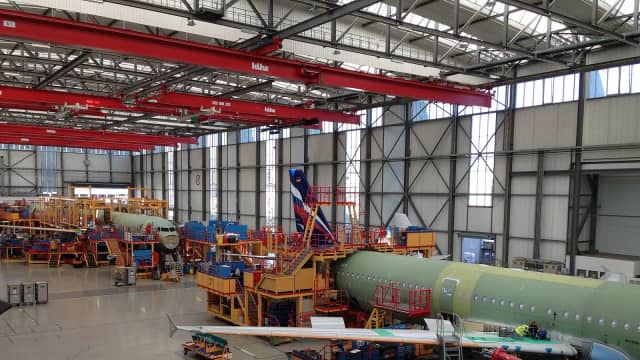
August is usually a slow month for Airbus because of the European summer break at its final assembly lines. As in most months, the A320neo family accounted for the bulk of handovers, with the A220, A330neo and A350 making up the rest.
The arithmetic for the rest of the year was demanding. Reaching about 820 required some 386 deliveries in September to December, an average of roughly 96 a month. Airbus has a history of heavy year-end deliveries, but that pace was well above anything it had sustained earlier in 2025, and analysts said the company faced a sprint to meet its goal.
Gliders and the engine bottleneck
The main reason deliveries lagged behind production was a shortage of engines. Airbus had been completing A320neo-family airframes faster than engine makers could supply power plants, leaving finished aircraft parked without engines. The industry calls these aircraft gliders. At its half-year results at the end of July 2025, Airbus said it had about 60 gliders waiting for engines.
Both A320neo engine suppliers were involved:
- CFM International, the GE Aerospace and Safran joint venture that builds the LEAP-1A, was held back by shortfalls in its own supply chain, and its engine deliveries to Airbus fell behind schedule in the first half of 2025, the main reason the glider count rose.
- Pratt & Whitney, which builds the PW1100G geared turbofan, was dividing output between new aircraft and spare engines for airlines whose existing fleets were grounded by inspections linked to powder-metal contamination in some engine parts.
Spare engines matter because every engine sent to a new aircraft is one not available to return a grounded jet to service. The two demands compete directly for the same production.
Chief executive Guillaume Faury said on 9 September 2025 that Airbus remained on track to meet its delivery guidance, while acknowledging that engine delays were the main constraint.
Why the numbers matter
Airbus is paid most of an aircraft's price at delivery, so the timing of handovers drives its cash flow and profits. Missing a target can also leave airlines short of capacity they have planned around. Many carriers were already extending the lives of older aircraft or leasing in capacity because new aircraft were arriving late.
The comparison with Boeing was also closely watched. Boeing delivered 57 aircraft in August 2025 and was recovering from a production cap imposed by the US Federal Aviation Administration after the January 2024 Alaska Airlines door plug accident, as well as a machinists' strike in late 2024. Airbus remained comfortably ahead on deliveries.
What has happened since
Airbus reduced the number of gliders by about half by the end of October 2025 as more engines arrived. Its year-end push was then disrupted twice. On 28 November 2025 it ordered a software change on about 6,000 A320-family aircraft after a JetBlue incident linked flight control computer data to intense solar radiation, causing short-term disruption across many airlines. On 3 December it cut its 2025 target to about 790 aircraft after finding a quality problem with fuselage panels on some A320-family aircraft.
Airbus finished 2025 with 793 deliveries, narrowly beating the revised goal, after handing over 286 aircraft in the fourth quarter. Boeing delivered 600 aircraft in 2025.
The same pattern returned in 2026. Airbus set a target of about 870 deliveries and said engine supply remained a constraint, particularly from Pratt & Whitney. By the end of August 2026 it had delivered 475 aircraft, 9% more than a year earlier, although August 2026 itself was weaker at 57. A330neo deliveries stopped for June and July 2026 after a tool was found inside a horizontal tailplane during inspection. With 547 deliveries by the end of September, Airbus again needed a record final quarter of more than 320 aircraft.