
Commercial aviation achieves one accident per 5.4 million flights, making flying the safest mode of transportation in human history. This extraordinary safety record exists not because of advanced technology alone, but because of a complex human ecosystem working in perfect coordination.
When passengers board an aircraft, they see pilots and cabin crew—the visible face of aviation. Behind every flight, however, operate dozens of specialists whose decisions directly impact safety. A single commercial flight from London to New York involves over 50 aviation professionals making critical decisions before, during, and after the journey.
Aviation safety operates on layered responsibility. No single person controls all aspects of flight safety. Instead, multiple professionals with distinct expertise create redundant safety nets. When one layer fails, others catch potential problems before they become accidents. This ecosystem approach explains why aviation incidents rarely escalate into disasters.
Understanding the air travel ecosystem reveals how interconnected roles, systematic procedures, and human expertise combine to make commercial aviation remarkably safe. This article explores nine critical aviation roles that together ensure millions of passengers reach their destinations safely every day.
The Air Travel Ecosystem Explained
Aviation operates as an interconnected system where no role functions independently. Each specialist contributes unique expertise while depending on information and decisions from other professionals throughout the operational chain.
The ecosystem concept means that:
- Information flows continuously: Weather updates, aircraft status, passenger counts, and operational changes circulate among all stakeholders
- Decisions require coordination: Route changes involve pilots, dispatchers, air traffic control, and ground operations working together
- Accountability spreads across roles: Multiple professionals share responsibility for different safety aspects
- Cross-checks prevent errors: One person’s work validates another’s, catching mistakes before they matter
Unlike other transportation modes where one person controls the vehicle, commercial aviation distributes decision-making authority across specialized professionals. A pilot cannot fly without dispatcher approval. Air traffic controllers cannot clear takeoffs without confirming aircraft readiness. Maintenance engineers ground aircraft regardless of operational pressure.
This distributed responsibility model creates redundancy at every level. ICAO safety standards require multiple independent verification points for critical flight decisions. When properly implemented, these systems prevent single points of failure from compromising safety.
The ecosystem’s strength lies in human factors integration. Technology assists decisions, but human judgment remains central to aviation safety. Professionals trained in aviation safety skills recognize that perfect systems operated by imperfect humans require systematic protections against predictable human errors.
9 Critical Roles in Aviation
The air travel ecosystem depends on nine critical roles organized into three operational categories: flight operations, technical operations, and safety oversight. Each role carries specific responsibilities ensuring different aspects of flight safety.
1. Pilot / Captain – Final Authority on the Flight Deck

The captain holds final authority over all decisions affecting the aircraft from the moment passengers board until they disembark. This authority includes overriding any other instruction if safety requires it.
Core Responsibilities:
- Aircraft command: Making final decisions on takeoff, route changes, diversions, and emergency responses
- Crew leadership: Coordinating flight deck and cabin crew for optimal safety and efficiency
- Regulatory compliance: Ensuring all operations meet aviation regulations and company procedures
- Passenger safety: Accepting responsibility for everyone aboard the aircraft
- Operational decisions: Balancing safety, schedule, passenger comfort, and fuel efficiency
The captain’s decision-making authority extends beyond technical flying. They determine whether weather conditions permit safe departure, whether aircraft defects allow flight, and whether operational circumstances require landing at alternate airports. This authority cannot be overridden by airline management, dispatchers, or air traffic control.
Critical situations requiring captain authority include:
- Weather deviations: Routing around thunderstorms, avoiding severe turbulence, managing crosswind limits
- System failures: Deciding continuation or diversion after equipment malfunctions
- Medical emergencies: Determining whether to divert for passenger medical needs
- Security threats: Responding to disruptive passengers or security concerns
- Fuel management: Declaring fuel emergencies when reserves fall below minimums
The relationship between captain and dispatcher creates shared responsibility for flight safety. While captains command the aircraft, dispatchers provide operational support, weather analysis, and regulatory compliance from the ground. The relationship with air traffic control involves following instructions when safe while maintaining authority to refuse clearances conflicting with aircraft capabilities or safety.
Becoming a captain requires extensive training through professional flight schools and thousands of flight hours. Captains typically accumulate 5,000 to 10,000 hours of flying experience before assuming command of commercial aircraft.
➡️ Related reading: Pilot career paths and compensation
2. First Officer – Operational Redundancy & Cross-Check

The first officer serves as the captain’s operational partner, providing critical redundancy in all flight deck operations. Far from being a subordinate, the first officer functions as an equal safety partner with specific cross-checking responsibilities.
Core Responsibilities:
- Flying duties: Typically flying 50% of flights while captain monitors, alternating pilot flying and pilot monitoring roles
- Cross-checking: Verifying captain’s decisions, calculations, and actions for errors
- System monitoring: Managing aircraft systems, communications, and navigation while the other pilot flies
- Backup authority: Assuming command if captain becomes incapacitated
- Procedure compliance: Ensuring all checklists and standard operating procedures are completed
The two-pilot system creates redundancy impossible with single-pilot operations. When one pilot flies the aircraft, the other monitors instruments, manages communications, and verifies that flight path and systems operate normally. This pilot flying / pilot monitoring division ensures constant cross-checking.
Critical situations requiring first officer intervention:
- Error detection: Identifying captain mistakes in altitude selection, navigation, or system management
- Workload sharing: Managing high-task periods like approaches in poor weather or system failures
- Incapacitation backup: Taking command if captain suffers medical emergency
- CRM enforcement: Questioning decisions that appear unsafe or non-compliant
First officers bring fresh perspectives to flight deck decisions. Modern Crew Resource Management (CRM) training emphasizes that rank does not determine correctness. First officers are trained and expected to challenge captain decisions when safety concerns exist.
3. Air Traffic Controller – Safe Separation & Flow Management

Air traffic controllers maintain safe separation between aircraft while managing the flow of thousands of flights through complex airspace systems. Controllers work in towers, terminal radar facilities, and en-route centers providing continuous traffic management.
Core Responsibilities:
- Separation assurance: Maintaining required distances between aircraft vertically, horizontally, and temporally
- Clearance issuance: Authorizing takeoffs, landings, route changes, and altitude assignments
- Traffic sequencing: Organizing aircraft flow to maximize runway capacity safely
- Emergency assistance: Providing priority handling for aircraft declaring emergencies
- Weather coordination: Routing aircraft around hazardous weather systems
Controllers use radar systems, flight strips, and advanced automation to track aircraft positions and predict conflicts. When potential conflicts arise, controllers issue new clearances maintaining safe separation. The system operates on redundant safety margins—multiple layers of separation standards prevent conflicts.
Critical situations requiring controller expertise:
- Emergency prioritization: Clearing airspace for aircraft with engine failures, medical emergencies, or fuel shortages
- Weather avoidance: Vectoring aircraft around thunderstorms, turbulence, and icing conditions
- System failures: Maintaining separation when automation fails or communication breaks down
- Congestion management: Preventing delays while maintaining safety during peak traffic periods
The role of air traffic control in aviation safety extends beyond separation. Controllers provide weather advisories, traffic information, and operational support helping pilots make informed decisions. The relationship between pilots and controllers operates on mutual trust and shared safety responsibility.
4. Maintenance Engineer – Aircraft Airworthiness Guardian

Aircraft maintenance engineers ensure every aircraft remains airworthy, meeting rigorous technical standards before each flight. These professionals possess authority to ground aircraft regardless of schedule pressure or operational needs.
Core Responsibilities:
- Scheduled maintenance: Performing inspections at defined intervals (daily, weekly, monthly, annually)
- Defect rectification: Repairing or replacing faulty components to restore airworthiness
- Airworthiness certification: Signing off aircraft as safe for flight after maintenance work
- Technical records: Documenting all maintenance, repairs, and component changes
- Regulatory compliance: Ensuring aircraft meet manufacturer and regulatory standards
Maintenance engineers follow approved maintenance programs specifying exactly when and how aircraft components require inspection or replacement. These programs derive from manufacturer recommendations and regulatory requirements set by EASA or FAA. The aircraft certification process establishes these baseline standards. Engineers cannot deviate from these programs without specific authorization.
Critical situations requiring maintenance engineer decisions:
- Unscheduled defects: Determining whether reported problems permit continued flight or require immediate repair
- MEL items: Applying Minimum Equipment Lists allowing flight with certain non-critical items inoperative
- Damage assessment: Evaluating bird strikes, lightning strikes, or ground damage for airworthiness impact
- Component life limits: Removing parts reaching mandatory replacement intervals
The role of aircraft maintenance engineers operates under “dual release” systems in many jurisdictions. Two qualified engineers must independently verify that critical maintenance work meets standards before aircraft return to service. This redundancy prevents single-point errors from compromising airworthiness.
5. Flight Dispatcher – Shared Responsibility for Flight Safety

Flight dispatchers share legal responsibility for flight safety with the captain, making them unique among aviation professionals. Dispatchers cannot fly the aircraft but possess equal authority to cancel or delay flights for safety reasons.
Core Responsibilities:
- Flight planning: Calculating optimal routes, fuel requirements, and alternate airports
- Weather analysis: Evaluating forecast conditions along the route and at destination
- Regulatory compliance: Ensuring flights meet all applicable regulations and company policies
- Operational monitoring: Tracking flights in progress and coordinating support when needed
- Emergency coordination: Assisting pilots during abnormal situations from ground-based resources
Dispatchers use sophisticated software analyzing weather, winds aloft, airspace restrictions, and aircraft performance to create optimal flight plans. Advanced aviation weather forecasting systems provide detailed meteorological data enabling accurate route planning. These plans balance fuel efficiency, schedule reliability, and safety. Captains review and must accept flight plans before departure—both professionals sign the release authorizing flight.
Critical situations requiring dispatcher expertise:
- Weather deterioration: Recommending alternate routes or cancellations when conditions worsen
- Diversion support: Coordinating landing permissions, ground services, and passenger accommodation for diverted flights
- System outages: Rerouting aircraft when airports close or airspace becomes unavailable
- Fuel emergencies: Locating nearest suitable airports when fuel becomes critical
The dispatcher-pilot relationship creates collaborative decision-making. Dispatchers access better weather data, company resources, and big-picture operational view than pilots. Pilots possess real-time aircraft knowledge and final authority. Together, they make better decisions than either could alone.
6. Cabin Crew – Safety, Security & Emergency Management
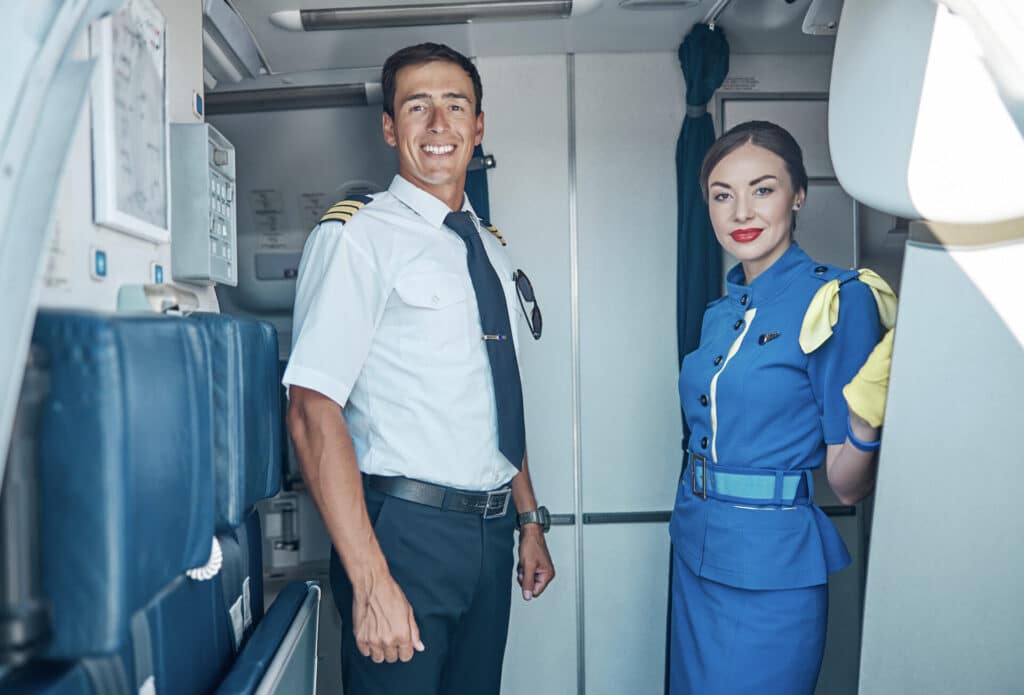
Cabin crew members serve as safety and security professionals first, with passenger service as secondary responsibility. Their primary role involves emergency preparedness, security vigilance, and safety compliance enforcement.
Core Responsibilities:
- Safety demonstrations: Ensuring all passengers understand emergency equipment and procedures
- Cabin security: Monitoring for suspicious behavior, preventing unauthorized cockpit access
- Emergency evacuation: Commanding evacuations and ensuring all passengers exit safely
- Medical response: Providing first aid and coordinating with ground medical services
- Compliance enforcement: Ensuring passengers follow safety regulations (seatbelts, smoking prohibitions, electronic device rules)
Cabin crew undergo extensive safety training including firefighting, emergency medical care, evacuation procedures, and survival training. Regulatory requirements mandate annual recurrent training maintaining these critical skills. The training emphasizes that passenger comfort never supersedes safety.
Critical situations requiring cabin crew expertise:
- Evacuations: Directing passenger egress during fires, ditching, or forced landings
- Medical emergencies: Treating heart attacks, allergic reactions, or injuries until landing
- Security threats: Managing disruptive passengers, preventing cockpit breaches
- In-flight fires: Locating and extinguishing fires in lavatories, galleys, or cargo areas
- Decompression events: Assisting passengers with oxygen masks and emergency descent procedures
The cabin crew-flight crew coordination operates through standardized communication protocols. Cabin crew report safety concerns directly to pilots, who possess final authority on safety decisions. During emergencies, cabin crew independently manage evacuations if communication with the flight deck fails.
7. Ground Handler – Time-Critical Ramp Operations

Ground handling teams manage aircraft servicing between flights, performing time-critical tasks that directly impact flight safety and schedule reliability. These professionals work under intense time pressure while maintaining rigorous safety standards.
Core Responsibilities:
- Aircraft marshaling: Guiding aircraft safely to and from parking positions
- Baggage handling: Loading and securing cargo, luggage, and mail correctly
- Aircraft servicing: Refueling, water servicing, lavatory servicing, cabin cleaning
- Load planning: Calculating weight distribution ensuring aircraft balance within limits
- Safety inspections: Conducting walk-around checks for visible damage or hazards
Ground operations follow strict procedures preventing damage to aircraft, ground equipment, or personnel. Teams use standardized hand signals for aircraft guidance, follow prescribed sequences for servicing operations, and maintain communication with flight crews throughout the turnaround process.
Critical situations requiring ground handler expertise:
- Foreign object detection: Identifying and removing debris that could damage engines or tires
- De-icing operations: Applying anti-ice fluids correctly and within holdover time limits
- Cargo loading errors: Detecting and correcting weight or balance problems before flight
- Fuel contamination: Testing fuel quality and preventing contaminated fuel from reaching aircraft
- Ground damage: Reporting impacts, door damage, or other incidents to maintenance
The ground handler-pilot relationship requires clear communication about aircraft status, fuel loaded, passenger counts, and cargo weight. Pilots depend on accurate load sheets for performance calculations. Ground handlers rely on pilot coordination for timing of engine start, pushback, and other operations.
8. Safety Inspector – Systemic Risk Prevention

Aviation safety inspectors monitor airline compliance with regulations, identify systemic risks before they cause accidents, and enforce safety standards across the industry. These regulatory professionals work for civil aviation authorities conducting oversight of airlines, airports, and maintenance organizations.
Core Responsibilities:
- Compliance audits: Inspecting airline operations, maintenance programs, and training curricula
- Ramp inspections: Spot-checking aircraft, crew qualifications, and operational procedures
- Investigation oversight: Reviewing airline internal investigations of incidents and accidents
- Regulatory enforcement: Issuing violations, fines, or operational restrictions for non-compliance
- Trend analysis: Identifying patterns in safety data suggesting emerging risks
Inspectors possess authority to ground aircraft, suspend pilot certificates, or shut down operations if safety deficiencies warrant immediate action. This authority operates independently of airline management, preventing commercial pressure from compromising safety standards. Airlines must maintain appropriate commercial aviation insurance coverage as part of regulatory compliance requirements.
Critical situations requiring inspector intervention:
- Systemic violations: Detecting patterns of regulatory non-compliance suggesting organizational safety culture problems
- Maintenance deficiencies: Identifying inadequate maintenance programs or record-keeping
- Training gaps: Finding insufficient pilot or maintenance engineer training
- Operational deviations: Discovering airlines operating beyond their approved limitations
The inspector-airline relationship balances oversight with operational understanding. Effective inspectors recognize that absolute compliance must not prevent safe operational flexibility. The goal involves ensuring systematic safety management, not punishing isolated errors.
9. Avionics Engineer – Aircraft Brain & Data Integrity

Avionics engineers maintain aircraft electronic systems including navigation, communication, flight controls, and automation. These specialists ensure the aircraft’s digital brain functions correctly, providing pilots with accurate information for safe decision-making.
Core Responsibilities:
- System testing: Verifying navigation, communication, and flight control systems meet performance standards
- Software updates: Installing manufacturer-approved software modifications and database updates
- Troubleshooting: Diagnosing complex electronic faults using specialized test equipment
- Calibration: Ensuring sensors, instruments, and navigation systems provide accurate data
- Integration verification: Confirming different avionics systems communicate and coordinate correctly
Modern aircraft depend on integrated avionics suites where flight management systems, autopilots, navigation systems, and engine controls share data continuously. These complex systems from leading aircraft manufacturers require specialized expertise to maintain. Avionics engineers ensure these systems maintain data integrity, preventing incorrect information from reaching pilots or automated systems.
Critical situations requiring avionics engineer expertise:
- Navigation failures: Restoring GPS, inertial navigation, or radio navigation capabilities
- Instrument malfunctions: Identifying whether pilot reports indicate actual failures or instrumentation errors
- Autopilot issues: Diagnosing automation problems affecting safety or operational capability
- Database updates: Ensuring navigation databases contain current airspace and procedure information
The avionics-pilot interface requires engineers understanding how pilots use systems operationally. Engineers must ensure repairs and modifications preserve intuitive interfaces preventing mode confusion or automation surprises that could compromise safety.
Why Aviation Relies on Redundancy, Not Individuals
Aviation safety philosophy rejects reliance on individual perfection. Instead, the industry builds multiple defensive layers assuming that humans will make errors and systems will fail. This approach, formalized in the Swiss Cheese Model, explains aviation’s extraordinary safety record.
The Swiss Cheese Model of Accident Causation
Developed by psychologist James Reason, the Swiss Cheese Model visualizes safety defenses as slices of Swiss cheese. Each slice represents a defensive layer: procedures, training, automation, oversight. Each layer contains holes representing weaknesses.
Accidents occur when holes align across multiple layers, allowing hazards to penetrate all defenses. A single error rarely causes accidents because other layers catch it. Multiple simultaneous failures across different defensive layers create accidents.
Aviation’s defensive layers include:
- Organizational barriers: Safety management systems, safety culture, operational policies
- Engineering defenses: Aircraft redundant systems, fail-safe designs, automation protection
- Administrative controls: Standard operating procedures, checklists, regulations
- Human barriers: Training, supervision, crew resource management
The nine roles described above create overlapping defensive layers. When maintenance engineers miss a defect, inspectors may catch it. When dispatchers create suboptimal flight plans, pilots can refuse them. When pilots make errors, first officers and air traffic controllers provide independent cross-checks.
Crew Resource Management (CRM)
Crew Resource Management revolutionized aviation safety culture by formalizing how aviation professionals work together. CRM training teaches that effective teams outperform even the most skilled individuals working independently.
Core CRM principles include:
- Authority gradient management: Junior crew members must speak up when they observe problems, regardless of rank differences
- Decision-making: Critical decisions benefit from crew input and consensus when time permits
- Communication: Clear, standardized communication prevents misunderstandings
- Workload management: Distributing tasks prevents individual overload during high-stress situations
- Situational awareness: Maintaining accurate understanding of aircraft status, environment, and future plans
CRM principles extend beyond flight decks to all aviation professionals. Maintenance teams use CRM preventing errors during complex repairs. Dispatchers and pilots employ CRM during collaborative flight planning. Air traffic controllers apply CRM when coordinating traffic during emergencies.
Research shows that most aviation accidents involve human factor breakdowns rather than technical failures. CRM addresses these human factors systematically, creating cultures where professionals expect and trap errors before they become accidents.
How These Roles Work Together During a Single Flight
Understanding how nine roles coordinate during a single flight illustrates the ecosystem in action. Consider a typical London to New York flight showing how professionals interact throughout the operational cycle.
Visual Overview: The Air Travel Ecosystem
Before we break down a flight minute-by-minute, here’s a visual snapshot of the nine critical roles that work together to keep every flight safe.

Pre-Flight (6-12 Hours Before Departure)
Flight dispatcher begins planning, analyzing weather forecasts for departure, enroute, and arrival conditions. They calculate optimal routing, fuel requirements accounting for headwinds, and select alternate airports meeting regulatory requirements.
Maintenance engineers complete overnight checks, resolving any defects from previous flights. They review maintenance logs, perform scheduled inspections, and certify the aircraft airworthy. Any unresolved items appear on deferred defects lists which pilots must review.
Ground handlers prepare the aircraft, cleaning cabins, servicing lavatories, and loading catering supplies. They coordinate cargo loading, ensuring weight distribution meets aircraft limitations.
Pre-Departure (90 Minutes Before Departure)
Pilots arrive and review the dispatcher’s flight plan, weather forecasts, aircraft status, and Notices to Airmen (NOTAMs) affecting the route. They conduct pre-flight inspections, walking around the aircraft checking for damage.
Cabin crew board early, checking emergency equipment, ensuring exits operate properly, and preparing for passenger boarding. They conduct safety briefings among themselves reviewing emergency procedures.
Ground handlers finalize loading, calculating final weight and balance figures. They provide load sheets to pilots showing passenger count, cargo weight, and center of gravity position.
Dispatcher coordinates final release, discussing any route changes or weather developments with the captain. Both professionals sign the flight release, accepting shared responsibility for the flight.
Taxi & Departure
Air traffic controllers issue pushback clearance, taxi instructions, and departure routing. They ensure adequate spacing between aircraft, managing the flow toward runways.
Pilots complete pre-takeoff checklists, with first officer reading items and captain performing actions (or vice versa). This cross-checking process ensures nothing is missed.
Cabin crew complete final cabin checks, ensuring passengers are seated with seatbelts fastened and carry-on items properly stowed. They verify cabin doors are armed for emergency evacuation.
Ground handlers monitor the departure, ensuring aircraft clears all ground equipment safely. They report any last-minute issues to pilots and controllers.
Cruise
Air traffic controllers across multiple centers coordinate handoffs, maintaining separation as the aircraft crosses international airspace. They provide weather updates and rerouting if needed.
Pilots monitor aircraft systems, navigation accuracy, and fuel consumption. They communicate position reports over oceanic areas lacking radar coverage, maintain required navigation performance, and manage passenger comfort.
Dispatcher tracks the flight’s progress, monitoring for weather changes at the destination or enroute. They prepare contingency plans if diversion becomes necessary.
Cabin crew provide service while maintaining safety vigilance. They monitor for smoke, unusual sounds, or passenger medical issues requiring pilot notification.
Arrival
Air traffic controllers sequence arriving aircraft, managing spacing to maximize runway capacity. They issue approach clearances and landing permissions.
Pilots conduct approach and landing checklists, brief approach procedures, and configure the aircraft for landing. The pilot flying flies while the pilot monitoring verifies correct configuration and clearances.
Cabin crew secure the cabin, ensuring passengers and items are properly stowed for landing. They position themselves for emergency response if landing goes wrong.
Turnaround
Ground handlers begin servicing immediately after arrival, unloading passengers, bags, and cargo while simultaneously preparing for the next flight.
Maintenance engineers address any defects reported by pilots, determining whether repairs can occur during the short turnaround or if specialist support is required.
Pilots complete post-flight checks, documenting any maintenance issues in the aircraft logbook. They review next flight planning if continuing with the same aircraft.
This coordinated operation repeats thousands of times daily across the globe, with nine professional roles working in synchronization to ensure safe, efficient flight operations. Major carriers like Southwest Airlines and international operators demonstrate how this ecosystem scales from regional to global operations.
Careers Inside the Air Travel Ecosystem
The air travel ecosystem offers diverse career paths with different entry requirements, training pathways, and progression opportunities. Understanding these paths helps aspiring aviation professionals choose appropriate career directions. Major airlines like American Airlines regularly recruit across all nine critical roles, demonstrating the continuous demand for aviation professionals.
Technical Roles
Pilots require extensive training through aviation schools worldwide, accumulating minimum 1,500 flight hours for airline transport pilot licenses. Training costs range $80,000 to $150,000, though some airlines offer sponsored cadet programs.
Maintenance engineers complete approved training programs combining academic study with practical experience. Certification requires passing regulatory examinations and demonstrating hands-on competency. The path typically requires 2-4 years.
Avionics engineers need electrical/electronic engineering backgrounds plus aviation-specific training. Specialization in aircraft systems requires understanding both hardware and software integration.
Operational Roles
Flight dispatchers complete dispatcher training programs covering meteorology, navigation, aircraft performance, and regulations. Certification requires passing written and practical examinations. Programs typically last 6-12 months.
Air traffic controllers undergo intensive training at aviation authorities’ dedicated facilities. Training programs combine classroom instruction with simulation and on-the-job mentoring, requiring 2-3 years to full certification.
Cabin crew complete airline-specific training programs lasting 4-8 weeks covering safety, emergency procedures, service, and first aid. Entry requires customer service experience and meeting physical requirements.
Regulatory Roles
Safety inspectors typically come from operational backgrounds—former pilots, mechanics, or dispatchers. Regulatory authorities recruit experienced professionals who understand practical operations and can identify realistic safety improvements.
Career Interconnection
Aviation careers often interconnect. Pilots transition to dispatching or safety inspection. Maintenance engineers specialize in avionics or engine systems. Controllers move into airspace planning or safety oversight. This interconnection creates cross-functional understanding strengthening the ecosystem.
The industry values professionals who understand multiple perspectives. A dispatcher who previously flew understands pilot challenges. A safety inspector with maintenance background recognizes practical maintenance constraints. This cross-pollination enhances system-wide coordination.
Final Thoughts: Aviation Is a System, Not a Cockpit
The extraordinary safety of modern commercial aviation stems from recognizing that no individual, however skilled, can ensure safety alone. Instead, interconnected professionals with specialized expertise create redundant safety nets catching errors before they become accidents.
The nine critical roles described here represent the foundation of this safety ecosystem. Pilots command aircraft but depend on dispatcher planning, maintenance engineers’ airworthiness certifications, controller separation services, and cabin crew emergency preparedness. Each role contributes unique capabilities while relying on others for information and support.
Understanding the air travel ecosystem reveals that aviation safety results from systematic organizational design, not individual heroism. The industry builds processes assuming humans will err and systems will fail, then creates multiple barriers preventing those failures from harming passengers.
This approach—distributed responsibility, standardized procedures, redundant verification, and collaborative decision-making—explains why commercial aviation achieves safety records unmatched in human transportation history. The system works because no single point of failure can compromise safety.
For aspiring aviation professionals, the ecosystem offers diverse career opportunities contributing to this safety mission. Whether interested in flying, engineering, operations, or oversight, multiple pathways exist for those committed to aviation safety excellence.
For passengers, understanding this ecosystem provides confidence that every flight benefits from dozens of professionals making safety-focused decisions. The visible pilots represent just one element of a sophisticated safety system operating largely unseen.
The air travel ecosystem demonstrates that complex, high-risk operations can achieve extraordinary safety through systematic design, professional training, and cultures valuing safety above all else. These principles, refined over a century of aviation development, offer lessons applicable beyond aviation to any field requiring reliable, safe operations.
Explore related aviation topics and career guides on The Flying Engineer to deepen your understanding of this fascinating industry.