
Standing near an airport runway during takeoff exposes you to noise levels rivaling rock concerts, yet the specific sound varies dramatically between aircraft types. An older Boeing 727 or McDonnell Douglas DC-10 generates ear-splitting roars that shake buildings miles away, while modern jets like the Boeing 787 produce noticeably quieter departures despite similar sizes.
Understanding why airplanes are loud requires examining multiple noise sources including engine design, aerodynamic effects, aircraft size, and operational requirements. Aircraft noise levels depend on engine type (turbofan, turboprop, turbojet), bypass ratio, thrust requirements, and hundreds of design details affecting how air flows around airframes and through propulsion systems.
Airplane engine noise dominates the acoustic signature most people associate with aircraft, but airframe noise from landing gear, flaps, and wing surfaces contributes significantly during approach and landing. Why some planes are louder than others ultimately reflects engineering tradeoffs between performance, efficiency, weight, cost, and acoustic optimization across different generations of aviation technology.
This comprehensive guide explores the physics of aircraft noise generation, compares different propulsion systems, examines why military jets produce extreme sound levels, and analyzes how modern aviation reduces noise impacts on communities surrounding airports worldwide.
What Causes Aircraft Noise?
Aircraft generate noise through three primary mechanisms, each contributing differently depending on flight phase and aircraft configuration.
Engine Noise
Jet engines create sound through high-velocity exhaust gases mixing turbulently with ambient air, combustion roar from burning fuel, and mechanical noise from rotating compressor and turbine blades. The exhaust jet noise increases dramatically with velocity, following roughly the eighth power of jet speed, meaning small speed increases create disproportionately larger noise.
Turbofan engines mixing slower bypass air with faster core exhaust produce less noise than pure turbojets expelling all gases at maximum velocity. This fundamental difference explains why modern high-bypass turbofans sound quieter than older low-bypass engines despite producing equal or greater thrust.
Aerodynamic Noise
Air flowing over wings, fuselage, and control surfaces creates noise through boundary layer turbulence and vortex shedding. During landing approaches with gear extended and flaps deployed, airframe noise often exceeds engine noise since pilots reduce thrust to idle while maintaining configurations creating maximum drag.
Landing gear produces particularly loud noise as airflow separates around wheels, struts, and brake assemblies, creating turbulent wakes. The distinctive high-pitched whine during approaches comes largely from these aerodynamic sources rather than engines.
Airflow and Turbulence
Propeller-driven aircraft generate noise through blade tip vortices and pressure pulses as props slice through air. The characteristic buzzing or drone of turboprops reflects blade passage frequency and harmonic resonances created by multiple blades rotating at high speeds.
Wing tip vortices, air conditioning system exhausts, and auxiliary power unit operations add to overall noise signatures, though these sources contribute minimally compared to engines and major aerodynamic components.

Engine Type Makes a Big Difference
Propulsion system design fundamentally determines aircraft acoustic characteristics, with dramatic noise differences between engine categories.
High-Bypass Turbofan Engines (Modern Jets)
Modern turbofan engines used on Boeing 737 MAX, Airbus A320neo, 787, and A350 feature bypass ratios of 9:1 to 12:1, meaning nine to twelve times more air flows around the engine core than through it. This bypass air moves slower than core exhaust, reducing jet noise substantially.
The large fan diameter also operates at lower rotational speeds, decreasing blade tip speeds and the associated noise. Acoustic liners inside engine nacelles absorb sound before it radiates outward, further reducing community noise exposure.
Low-Bypass Turbofan and Turbojet (Older Jets)
First-generation jets including 707s, DC-8s, and early 737s used low-bypass turbofans or pure turbojets with bypass ratios below 2:1. These engines expelled hot exhaust at extremely high velocities, creating the characteristic screaming roar that made airports unbearable for nearby residents.
Military fighters and older business jets continue using low-bypass engines or pure turbojets prioritizing thrust-to-weight ratio over noise reduction. The resulting sound levels can exceed 140 decibels at close range, approaching pain thresholds for human hearing.
Turboprop Engines
Regional aircraft like the Bombardier Q400 and ATR 72 use turboprop engines driving large propellers, creating distinctive droning noise different from jet whine. Propeller noise varies with blade count, tip speed, and rotational frequency, typically producing lower-frequency sounds easier for the human ear to tolerate than high-frequency jet noise.
Modern turboprops incorporate swept propeller blades and active noise cancellation in cabins, significantly reducing interior noise compared to earlier designs. However, external noise remains noticeable, particularly during ground operations near terminals.
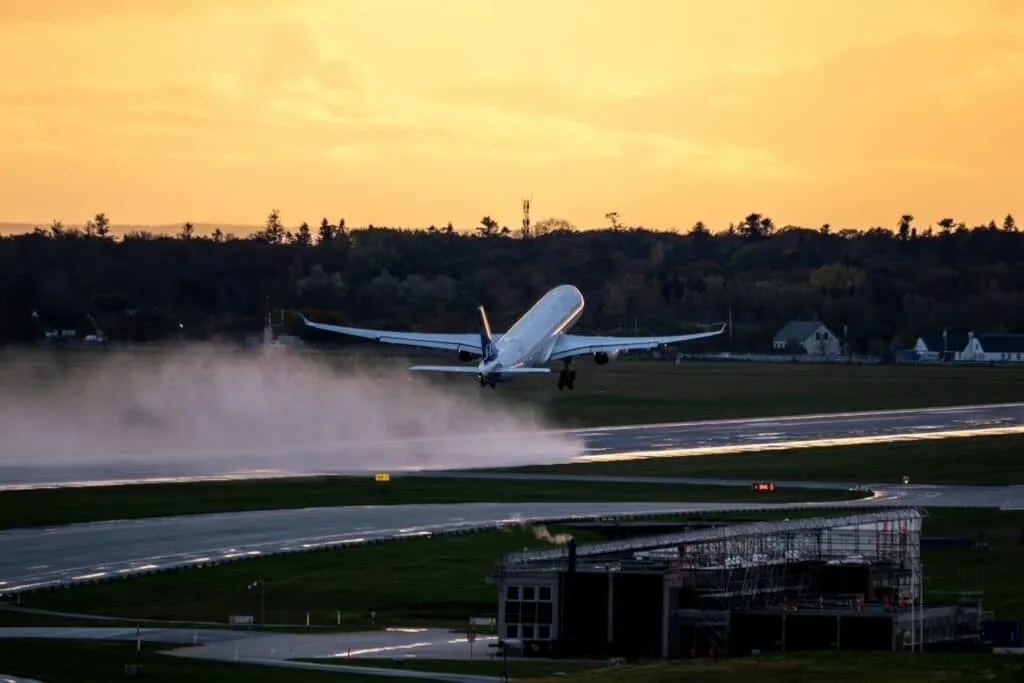
Why Takeoff Is the Loudest Phase
Aircraft generate maximum noise during takeoff when multiple factors combine to create peak sound levels affecting airport communities.
Maximum Thrust Requirements
Takeoff demands full or near-full engine power to accelerate heavy aircraft to flying speed within available runway length. Engines operate at maximum rated thrust, producing maximum exhaust velocity and consequently maximum jet noise.
Pilots may use reduced thrust takeoffs when runways provide excess length, but even these procedures employ substantially more power than cruise flight requires. The difference between takeoff and cruise thrust can exceed 2:1, creating proportionally larger noise signatures.
Proximity to Ground
During takeoff, aircraft remain close to the ground where sound propagates directly to observers without atmospheric attenuation. The ground surface reflects engine noise, effectively doubling perceived sound levels compared to free-air propagation.
As aircraft climb, increasing distance reduces noise exposure through geometric spreading and atmospheric absorption. A jet at 5,000 feet produces far less ground-level noise than the same aircraft 200 feet overhead during initial climb.
Low Airspeed Amplification
At slow takeoff speeds, engines work harder relative to forward motion, creating worse noise-to-thrust ratios than high-speed cruise. The acoustic efficiency improves dramatically at altitude where aircraft fly faster using less relative thrust.
Aircraft Size and Design Impact Noise
Larger aircraft don’t automatically mean louder operations, with design sophistication often mattering more than absolute size.
Engine Size and Count
Wide-body jets like the Boeing 787 and Airbus A350 use two massive high-bypass turbofans producing less total noise than four smaller older engines generating equivalent thrust. The advanced acoustics of latest-generation engines more than compensate for individual engine size.
Four-engine aircraft including 747s and A380s distribute thrust across more engines, theoretically allowing quieter individual engine operation. However, older four-engine designs predate modern noise reduction technology, often producing more total noise than efficient twin-engine jets.
Wing and Airframe Design
Modern wing designs incorporating raked wingtips, optimized flap systems, and smooth fuselage-wing junctions reduce airframe noise compared to older aircraft with blunt wing roots and less refined aerodynamics.
The Boeing 787’s composite construction allows thinner, more aerodynamically efficient wings producing less drag and consequently less aerodynamic noise during all flight phases. Advanced computational fluid dynamics during design stages optimizes every surface for minimum noise generation.
Landing Gear Configuration
Heavy aircraft require larger, more complex landing gear creating substantial airframe noise during approach. However, streamlined gear doors, fairings, and wheel well design minimize turbulence and noise compared to simpler older configurations.
Why Fighter Jets Are Extremely Loud
Military fighters represent the loudest aircraft category by design, prioritizing performance over community noise considerations.
Afterburners and Thrust Requirements
Supersonic fighters use afterburners injecting raw fuel into exhaust streams, creating dramatic thrust increases and correspondingly extreme noise levels. Afterburner operation can produce 150+ decibels at close range, louder than most industrial processes and sufficient to cause immediate hearing damage.
The raw power required for supersonic flight and high-performance maneuvers demands engines optimized for thrust-to-weight ratios rather than acoustic refinement. Military specifications accept noise penalties unavoidable when prioritizing combat capability.
Low-Bypass Engine Design
Fighter engines use low bypass ratios (often below 0.5:1) to minimize weight and diameter while maximizing thrust. This design philosophy directly opposes noise reduction strategies employed in commercial aviation, where large high-bypass fans dominate engine architecture.
The high exhaust velocities necessary for supersonic flight create jet noise fundamentally louder than subsonic commercial operations. Physics prevents significant noise reduction without compromising the core mission requirements driving fighter design.
Operational Requirements
Military operations occur from bases often located near communities, creating noise conflicts commercial aviation largely avoids through careful airport siting. Fighter training, alert scrambles, and demonstration flights generate intense noise exposure that civilian populations tolerate only near military installations.

Why Modern Aircraft Are Significantly Quieter
Technological advances and regulatory pressure drove dramatic noise reductions in commercial aviation over recent decades.
High-Bypass Turbofan Revolution
The transition from low-bypass turbojets and turbofans to modern high-bypass engines represents aviation’s single largest noise reduction achievement. A Boeing 787 or Airbus A350 produces roughly half the noise of comparably-sized aircraft from the 1970s-1980s despite carrying more passengers.
Bypass ratios approaching 12:1 on latest engines move enormous air volumes at moderate velocities rather than smaller volumes at extreme speeds. This fundamental shift in propulsion philosophy enables commercial aviation’s coexistence with dense urban development surrounding major airports.
Noise Regulations Driving Design
International Civil Aviation Organization (ICAO) noise standards progressively tightened since the 1970s, forcing manufacturers to prioritize acoustic performance. Chapter 4 and Chapter 14 noise standards eliminated the loudest aircraft from commercial service, accelerating fleet modernization.
Airlines operating noncompliant aircraft face operational restrictions, noise surcharges, and outright bans from noise-sensitive airports including many in Europe. These economic pressures ensure older loud aircraft retire rather than continuing indefinitely in service.
Improved Aerodynamics
Computational fluid dynamics and wind tunnel testing optimize modern aircraft shapes to minimize turbulent airflow creating noise. Smooth contours, carefully designed junctions between components, and streamlined landing gear all contribute to quieter operations.
Active noise control systems in cabins reduce interior noise for passengers, while external modifications including serrated nacelle edges (chevrons) on engine cowlings reduce jet noise propagation to communities. These refinements accumulate to measurable noise reductions without compromising performance.
How Airports Manage Aircraft Noise
Airport authorities implement multiple strategies balancing aviation operations with community noise exposure concerns.
Noise Abatement Procedures
Airports establish preferential runways, flight paths avoiding densely populated areas, and altitude restrictions minimizing noise exposure. Continuous descent approaches allow aircraft to reduce thrust earlier during landing, decreasing community noise compared to traditional stepped descents.
Departure procedures may require specific thrust reduction altitudes, turn points avoiding neighborhoods, or runway assignments based on wind and noise considerations. Pilots receive detailed noise abatement instructions through airport publications and air traffic control coordination.
Operating Restrictions and Curfews
Many airports worldwide implement nighttime curfews prohibiting or restricting operations during hours when communities require quiet. These curfews can ban all flights, limit operations to quieter aircraft, or impose severe financial penalties for loud late-night movements.
London Heathrow, Frankfurt, Sydney, and dozens of other major airports enforce strict noise rules that airlines must accommodate through schedule planning and aircraft assignment. Violations trigger substantial fines and potential loss of operating privileges.
Noise Monitoring Systems
Permanent noise monitors surrounding airports measure actual sound levels from operations, ensuring compliance with local regulations and identifying problem aircraft or procedures. This data informs enforcement actions, procedure modifications, and long-term planning balancing capacity growth against noise impacts.
Impact of Aircraft Noise on People
Aircraft noise affects communities and passengers differently, creating challenges aviation continually works to address.
Community Health Concerns
Chronic exposure to aircraft noise correlates with sleep disturbance, cardiovascular issues, and reduced cognitive performance in studies of airport-adjacent populations. Children attending schools under flight paths show measurable learning delays compared to peers in quieter environments.
Property values near airports suffer from noise exposure, creating economic impacts that motivate opposition to airport expansion and drive demand for quieter aircraft technology. Noise complaints often represent the primary friction point between aviation and local communities.
Passenger Comfort Considerations
Interior cabin noise affects passenger comfort and willingness to pay premium fares. Modern aircraft incorporate advanced sound insulation, active noise cancellation, and engine placement optimizing for quiet cabins that enable conversation without raised voices.
The perceived luxury and quality of airline products directly relates to cabin quietness, with premium carriers marketing their quiet cabins as competitive advantages. Turboprop regional aircraft face passenger resistance partly due to higher cabin noise despite improving technology.
Regulatory Response
Governments worldwide strengthen noise regulations balancing aviation economic benefits against community quality of life. Stage 5 noise standards under discussion would further restrict aircraft operations, accelerating the retirement of marginally compliant aircraft and incentivizing next-generation quiet technology.
Future of Aircraft Noise Reduction
Emerging technologies promise continued noise reduction even as global aviation expands to accommodate growing passenger demand.
Electric and Hybrid-Electric Propulsion
Battery-electric and hybrid-electric aircraft eliminate combustion noise and dramatically reduce mechanical noise from simpler propulsion systems. Early electric aircraft demonstrate noise levels 60-70% lower than conventional equivalents, enabling operations from urban locations currently unsuitable for aviation.
NASA’s X-57 Maxwell and various electric vertical takeoff and landing (eVTOL) prototypes validate electric propulsion’s noise advantages. Commercial deployment by 2030 could revolutionize short-haul regional aviation acoustics, though battery energy density limitations prevent long-haul electric flight with current technology.
Advanced Engine Technologies
Geared turbofan engines like the Pratt & Whitney PW1000G already demonstrate noise reductions through slower fan speeds enabled by reduction gearboxes. Ultra-high bypass ratio engines under development promise further improvements approaching theoretical limits for turbofan acoustics.
Open rotor and unducted fan concepts trade some noise performance for dramatic fuel efficiency gains, with engineers working to minimize acoustic penalties through blade design, rotational speeds, and active noise control.
Urban Air Mobility Considerations
Proposed urban air mobility services using eVTOL aircraft face strict noise requirements for city operations. Distributed electric propulsion, multiple small rotors instead of large ones, and advanced flight control enabling quiet approach profiles may enable aviation in noise-sensitive urban cores.
However, public acceptance remains uncertain, with communities already resistant to conventional helicopter noise unlikely to embrace new aviation operations regardless of acoustic improvements. Technology must deliver near-silent operations to gain urban deployment approval.
Frequently Asked Questions
Why are airplanes so loud during takeoff?
Aircraft produce maximum noise during takeoff because engines operate at full or near-full thrust to accelerate heavy loads to flying speed within available runway length. This maximum power setting creates maximum exhaust velocity and consequently maximum jet noise. Additionally, aircraft remain close to the ground during takeoff where sound propagates directly to observers without atmospheric attenuation, and ground surfaces reflect engine noise effectively doubling perceived loudness. As aircraft climb to cruising altitude, they reduce thrust substantially and gain distance from ground observers, dramatically decreasing perceived noise levels.
Are newer planes actually quieter than older ones?
Yes, modern aircraft are dramatically quieter than older equivalents due to high-bypass turbofan engines, improved aerodynamics, and acoustic treatments. A Boeing 787 or Airbus A350 produces roughly 50% less noise than comparably-sized aircraft from the 1970s-1980s. High-bypass engines move large air volumes at moderate velocities rather than smaller volumes at extreme speeds, fundamentally reducing jet noise. International noise regulations progressively tightened since the 1970s, forcing manufacturers to prioritize acoustic performance. The quietest new aircraft meet Chapter 14 noise standards, significantly stricter than older Chapter 3 requirements.
Why are fighter jets so much louder than commercial aircraft?
Military fighters prioritize performance over noise reduction, using afterburners and low-bypass engines optimized for thrust-to-weight ratio rather than acoustics. Afterburner operation can produce 150+ decibels, louder than most industrial processes. Fighter engines use bypass ratios below 0.5:1 to minimize weight and diameter while maximizing thrust, the opposite of commercial aviation’s large high-bypass fans. The high exhaust velocities necessary for supersonic flight create jet noise fundamentally louder than subsonic operations. Military specifications accept noise penalties unavoidable when prioritizing combat capability, making fighters the loudest aircraft category by design.
How is aircraft noise measured?
Aircraft noise is measured using sound level meters positioned at specific locations around airports, recording decibel levels (dB) weighted for human hearing sensitivity. The most common metric is A-weighted decibels (dBA), which emphasizes frequencies the human ear perceives most readily while de-emphasizing very low and very high frequencies. Regulatory standards use Effective Perceived Noise Level (EPNL) incorporating duration, frequency content, and tone corrections to represent human annoyance. Measurements occur at standardized positions during takeoff, landing, and sideline operations. A 10 dB reduction represents roughly a 50% decrease in perceived loudness to human hearing.
Do turboprop planes sound different from jets?
Yes, turboprops produce distinctive droning noise fundamentally different from jet engine whine. Propeller-driven aircraft create sound through blade tip vortices and pressure pulses as props slice through air, with characteristic buzzing reflecting blade passage frequency. Turboprops typically generate lower-frequency sounds easier for human ears to tolerate than high-frequency jet noise, though external noise remains noticeable. Modern turboprops like the Bombardier Q400 incorporate swept propeller blades and active cabin noise cancellation, significantly improving comfort. Jets produce higher-frequency whine from turbulent exhaust mixing and fan blade passage, creating different acoustic signatures despite potentially similar decibel levels.
Will electric aircraft be silent?
Electric aircraft will be significantly quieter but not completely silent. Battery-electric propulsion eliminates combustion noise and reduces mechanical noise from simpler systems, demonstrating noise levels 60-70% lower than conventional equivalents in early prototypes. However, propeller or fan blade noise persists regardless of power source, and aerodynamic noise from airflow over wings and fuselage remains. Electric vertical takeoff and landing (eVTOL) aircraft for urban air mobility must achieve near-silent operation for public acceptance, driving aggressive acoustic optimization. While electric propulsion enables dramatic noise reduction, physics prevents truly silent flight at practical speeds and vehicle sizes.
Conclusion
Aircraft noise reflects fundamental physics of propulsion, aerodynamics, and the operational requirements of flight. Modern aviation achieved remarkable noise reductions through high-bypass turbofan engines, refined aerodynamics, and regulatory pressure, making today’s jets roughly half as loud as equivalents from decades past.
The differences between aircraft types – from whisper-quiet gliders to thundering fighters – demonstrate how mission requirements dictate acceptable noise levels. Commercial aviation prioritizes community compatibility and passenger comfort, while military operations accept extreme noise as unavoidable for combat performance.
Future technologies including electric propulsion and advanced engine designs promise continued progress toward quieter skies. However, growth in global aviation means absolute noise exposure may not decrease proportionally to per-aircraft improvements. Balancing aviation’s economic and social benefits against noise impacts on communities remains an ongoing challenge requiring continued innovation, thoughtful regulation, and operational discipline from an industry connecting our increasingly interdependent world.