Industry
Brazil's ANAC Publishes Final Airworthiness Criteria for Eve's eVTOL
On 4 November 2024 Brazil's ANAC published the final airworthiness criteria for Eve Air Mobility's eVTOL, letting Eve move on to agreeing means of compliance.
Updated 3 min read
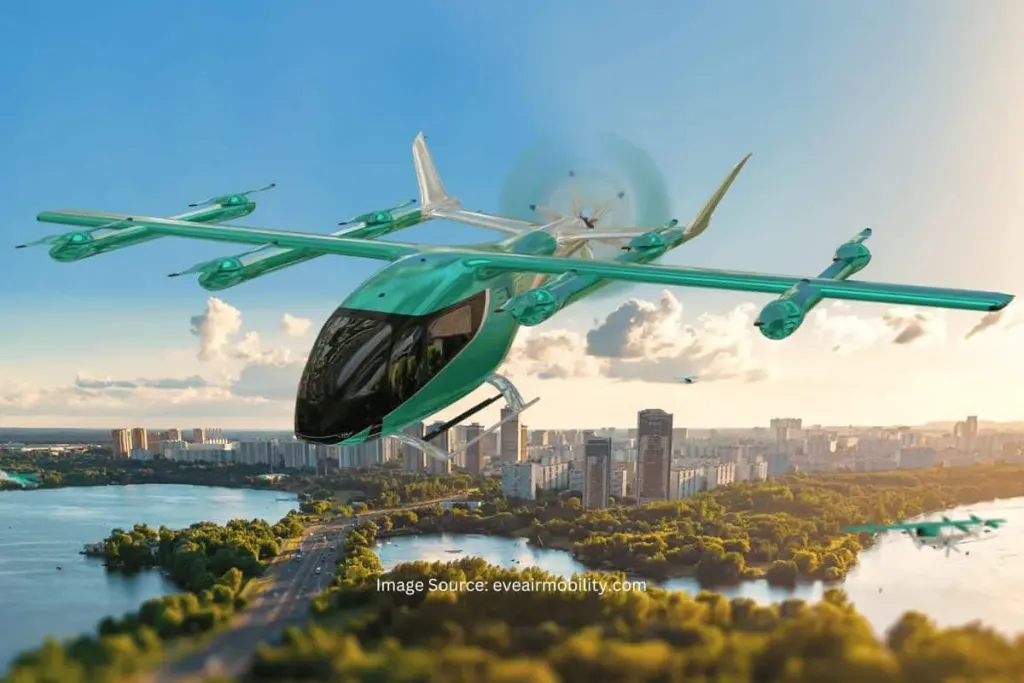
Brazil's National Civil Aviation Agency (ANAC) published the final airworthiness criteria for Eve Air Mobility's electric vertical take-off and landing (eVTOL) aircraft on 4 November 2024, following a period of public consultation on a draft version. The criteria set out the safety and performance requirements the aircraft must meet to receive a type certificate, and their publication allows Eve to move to the next stage: agreeing with ANAC exactly how it will show compliance.
Luiz Valentini, Eve's chief technology officer, described the publication as an important step towards certification and said comments received during the consultation had helped refine the requirements. He added that Eve would keep working with ANAC on the type certificate and with the US Federal Aviation Administration (FAA) on validating it in parallel.
Where this sits in the certification process
Eve formally applied to ANAC for a type certificate in February 2022. Because eVTOL aircraft do not fit the existing categories for aeroplanes or helicopters, ANAC is treating the aircraft as a "special class" product. Under this route the regulator builds a bespoke certification basis by drawing on existing Brazilian civil aviation regulations and adding new criteria where the technology demands it, for example for distributed electric propulsion, high-voltage batteries and the transition between hover and wing-borne flight. The FAA follows a similar approach for eVTOL designs in the United States.
In broad terms, certification follows four steps:
- Certification basis: the regulator decides which requirements apply. The final airworthiness criteria published in November 2024 complete most of this step.
- Means of compliance: the applicant and regulator agree the specific tests, analyses, simulations and inspections that will demonstrate each requirement is met. This was Eve's next task.
- Compliance demonstration: the applicant carries out those tests, including flight testing on conforming prototypes built to the final design.
- Type certificate: once every requirement has been shown, the regulator issues the certificate, and other authorities can validate it.
Seeking FAA validation at the same time as the Brazilian approval is intended to avoid a long gap between certification at home and access to the US market, where Eve has several prospective customers.
The company and the aircraft
Eve was created by Embraer and became a separately listed company on the New York Stock Exchange in 2022, with Embraer remaining its largest shareholder. It draws on Embraer's engineering staff, test facilities and supplier relationships, which sets it apart from most eVTOL start-ups.
The aircraft uses a lift-and-cruise layout. Eight electric rotors provide lift for vertical take-off and landing, and a rear pusher propeller, driven by two electric motors for redundancy, provides thrust in cruise, when a fixed wing carries the weight. It is designed to carry a pilot and four passengers over a range of about 100 km, targeting short urban and regional trips. Eve plans to build production aircraft at Taubaté in São Paulo state.
At the time of the ANAC decision, Eve was aiming for entry into service in 2027, a year later than its earlier target.
Why it matters
Final airworthiness criteria give a manufacturer a fixed set of requirements to design and test against, which reduces the risk of late design changes. For ANAC, Eve's aircraft is one of the first eVTOL programmes it has taken through this process, and the approach it settles on is likely to shape how it handles similar aircraft later. For prospective operators, it is a step towards knowing when the aircraft may actually be available.
What has happened since
- December 2025: Eve's uncrewed full-scale engineering prototype made its first hover flight at Embraer's test centre in Gavião Peixoto, São Paulo state, starting the flight test campaign.
- March 2026: The prototype was flown in front of Brazilian government officials, including President Luiz Inácio Lula da Silva.
- July 2026: At the Farnborough Airshow, Eve named the aircraft the Eve 100 and announced non-binding letters of intent for up to 46 aircraft from Moov, for operations in Cape Verde, and leasing company Shearwater. ANAC published proposed noise certification requirements for the aircraft for consultation.
- August 2026: In its second-quarter results, Eve said the prototype had made 66 flights and begun partial transition flights at up to 30 knots, with full transition targeted for the end of 2026. The company said it planned to build six conforming prototypes in 2027, start crewed flights on them late that year, and now expected certification and entry into service in 2028. It reported cash of about $403 million.
Entry into service has therefore moved from 2026 to 2027 and then to 2028, which is in line with delays across the eVTOL sector as manufacturers move from prototypes to certification testing.

About the author
Cristina Gabriela
Marketing Strategy Manager
View author profile Editorial policy and corrections