
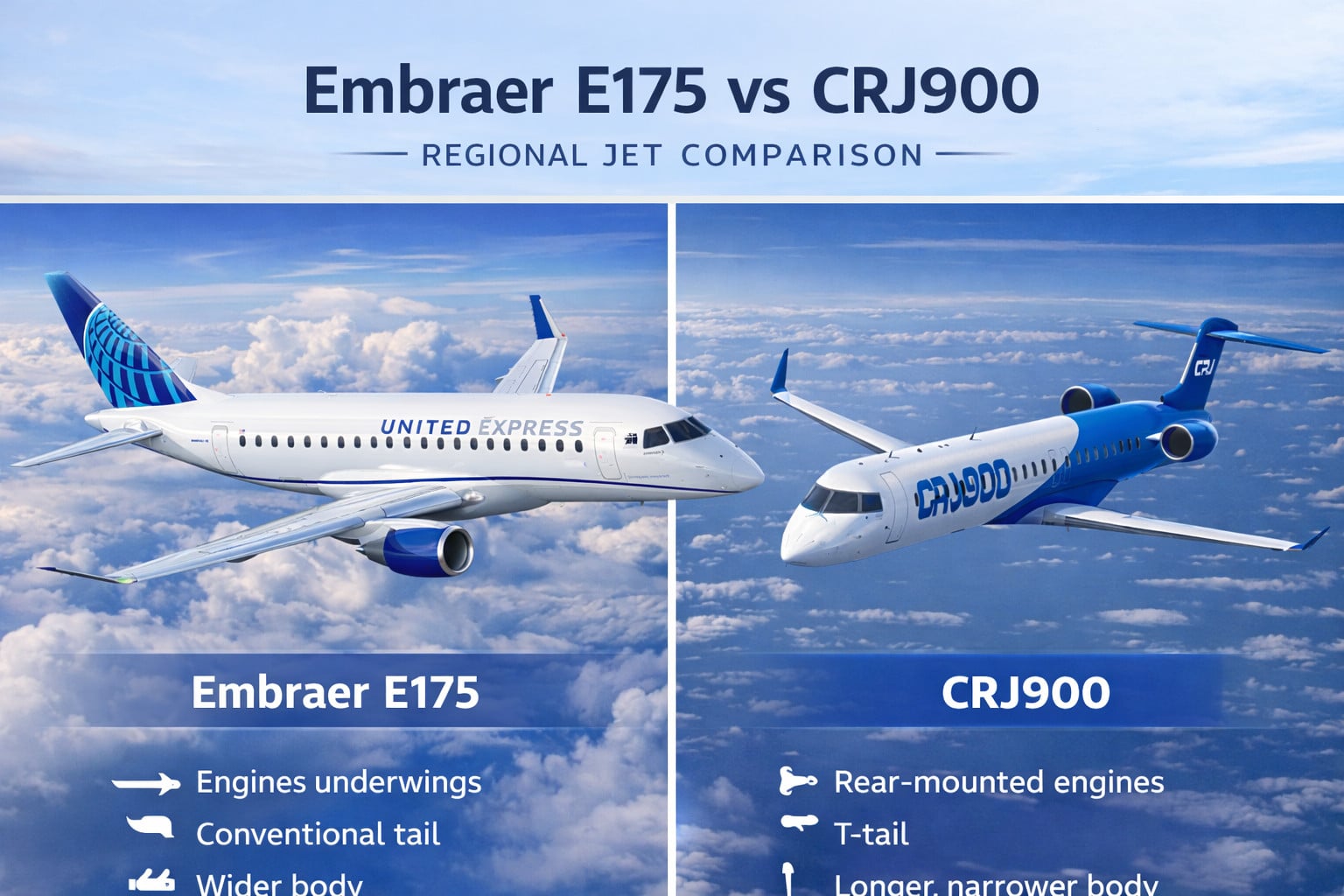
Walk through any U.S. airport terminal and you’ll board one of these aircraft dozens of times yearly without realizing it. The Embraer E175 and Bombardier CRJ900 dominate American regional aviation, operating thousands of daily flights under major airline brands.
Yet these regional jets deliver dramatically different passenger experiences despite similar missions. One aircraft consistently ranks higher in passenger satisfaction surveys. The other faces retirement across multiple airline fleets.
Understanding regional aircraft matters because geography and airline economics make these jets unavoidable on routes under 1,500 miles across North America.
Quick Comparison: Embraer E175 vs CRJ900 at a Glance
| Specification | Embraer E175 | Bombardier CRJ900 |
|---|---|---|
| PASSENGER COMFORT | ||
| Seat Width | 18.25 inches | 17.0 inches |
| Cabin Height | 6 feet 7 inches | 6 feet 1 inch |
| Seating Configuration | 2-2 (no middle seats) | 2-2 (no middle seats) |
| Typical Seat Pitch | 31-32 inches (economy) 37 inches (first class) |
31-32 inches (economy) 37 inches (first class) |
| Overhead Bin Size | Larger capacity | Smaller, fills quickly |
| Cabin Noise Level | Quieter | Moderate |
| Boarding Experience | Wider aisles, easier | Narrower, more crowded |
| PERFORMANCE & RANGE | ||
| Maximum Range | 2,200 nautical miles | 1,550 nautical miles |
| Cruise Speed | Mach 0.78 (~450 knots) | Mach 0.78 (~450 knots) |
| Service Ceiling | 41,000 feet | 41,000 feet |
| Short-Runway Performance | Good | Superior |
| Dispatch Reliability | Higher (newer fleet) | Lower (aging fleet) |
| CAPACITY & DIMENSIONS | ||
| Typical Seating | 76 passengers (12F + 64Y) | 76 passengers (12F + 64Y) |
| Maximum Capacity | 88 passengers (high-density) | 90 passengers (high-density) |
| Length | 103 feet 11 inches | 119 feet 4 inches |
| Wingspan | 85 feet 4 inches | 81 feet 6 inches |
| Height | 31 feet 9 inches | 24 feet 7 inches |
| OPERATING ECONOMICS | ||
| Fuel Burn (Cruise) | ~2,400 lbs/hour | ~2,100 lbs/hour |
| Maintenance Costs | Lower lifecycle costs | Higher (aging + support issues) |
| Training Costs | Moderate (ERJ family commonality) | Moderate (CRJ family commonality) |
| Residual Value | Higher | Lower |
| Production Status | In production (strong orders) | Discontinued (2020) |
| AIRLINE FLEET STATUS | ||
| U.S. Fleet Trend | Expanding | Retiring |
| Delta Air Lines | Primary regional jet | Fully retired (2023) |
| American Airlines | Expanding allocation | Declining through attrition |
| United Airlines | Preferred for competitive routes | Captive markets only |
| Passenger Preference | Strongly preferred | Complaints common |
| REGULATORY & MARKET | ||
| Scope Clause Compliance | 76-seat sweet spot | 76-seat capable |
| Entry into Service | 2005 | 2003 |
| Manufacturer | Embraer (Brazil) | Bombardier (Canada) Program sold to Mitsubishi |
| Global Fleet Size | ~600+ aircraft (growing) | ~500 aircraft (shrinking) |
Note: Green checkmarks (✓) indicate superior specification. All measurements based on typical U.S. regional carrier configurations.
Why the E175 and CRJ900 Are Often Compared
Both aircraft serve identical missions: transporting 76-88 passengers on regional routes feeding major airline hubs. This seating capacity isn’t coincidental—it’s mandated by U.S. airline scope clause agreements limiting regional carrier aircraft size.
The Embraer E175 entered service in 2005, while the CRJ900 debuted in 2003. Both represent stretched versions of smaller regional jet families—the ERJ-170 and CRJ700 respectively.

American Airlines, Delta Air Lines, and United Airlines operate hundreds of these aircraft through regional partners. When booking flights on “American Eagle,” “Delta Connection,” or “United Express,” passengers most frequently encounter E175 or CRJ900 aircraft.

The comparison matters because passenger experience differs significantly between these jets despite similar capacity. Airlines choose between them based on operating economics, maintenance complexity, and passenger satisfaction metrics that influence brand reputation.
Fleet commonality drives airline decisions too. Carriers already operating Embraer regional jets favor the E175. Airlines with existing CRJ fleets historically preferred the CRJ900 to minimize training and maintenance costs.
Cabin Comfort & Passenger Experience
Passenger preference strongly favors the Embraer E175 over the CRJ900 for reasons immediately apparent upon boarding.

Seat Width: The Crucial Difference
The E175 offers 18.25-inch seat width in a 2-2 seating configuration. Every passenger gets either a window or aisle seat—no middle seats exist on this aircraft.
The CRJ900 provides 17-inch seat width, also in 2-2 configuration. That 1.25-inch difference feels substantial during flights, particularly for passengers of larger stature or those traveling in business attire.
Both aircraft avoid the dreaded middle seat, but E175 seats approach narrowbody comfort levels while CRJ900 seats feel noticeably narrower and more constraining.
Legroom and Seat Pitch
Seat pitch varies by airline and cabin configuration, not aircraft type. Most U.S. carriers configure both jets with 31-32 inches of pitch in economy, with slightly more in first class seating.
The E175 first class typically offers 37 inches of pitch, while CRJ900 first class provides similar spacing. Legroom remains comparable between aircraft—the width difference matters more for passenger comfort.
Cabin Height and Overhead Bins
The Embraer E175 cabin height measures 6 feet 7 inches, allowing most passengers to stand comfortably in the aisle. The CRJ900 cabin height reaches approximately 6 feet 1 inch, requiring taller passengers to duck or stoop when moving through the aircraft.
Overhead bin capacity represents another E175 advantage. Larger bins accommodate more carry-on bags, reducing gate-checking frequency and boarding delays that frustrate passengers.
The CRJ900’s smaller overhead bins fill quickly, forcing flight attendants to gate-check bags more frequently. This adds time to boarding and deplaning while increasing passenger anxiety about separated luggage.
Noise Levels and Ride Quality
Both aircraft mount engines on the rear fuselage, reducing cabin noise compared to wing-mounted engine designs. However, the E175 generally delivers quieter cabin experience based on passenger surveys and acoustic measurements.
Engine technology in both jets uses similar turbofan designs, but the E175’s newer-generation engines and improved cabin insulation create measurably quieter environments.
Ride smoothness depends more on weather and turbulence than aircraft type. Both jets handle turbulence comparably, though the E175’s slightly larger size sometimes provides marginally smoother rides in choppy conditions.
Boarding Experience
The E175 features wider aisles and better spatial arrangement that facilitates faster boarding. Passengers carrying larger carry-on bags navigate the cabin more easily without bumping into seated passengers.
CRJ900 boarding feels more constrained and crowded, particularly when flights run full. The narrower aisle combined with smaller overhead bins creates boarding bottlenecks that delay departures.
Performance, Range & Operational Capability
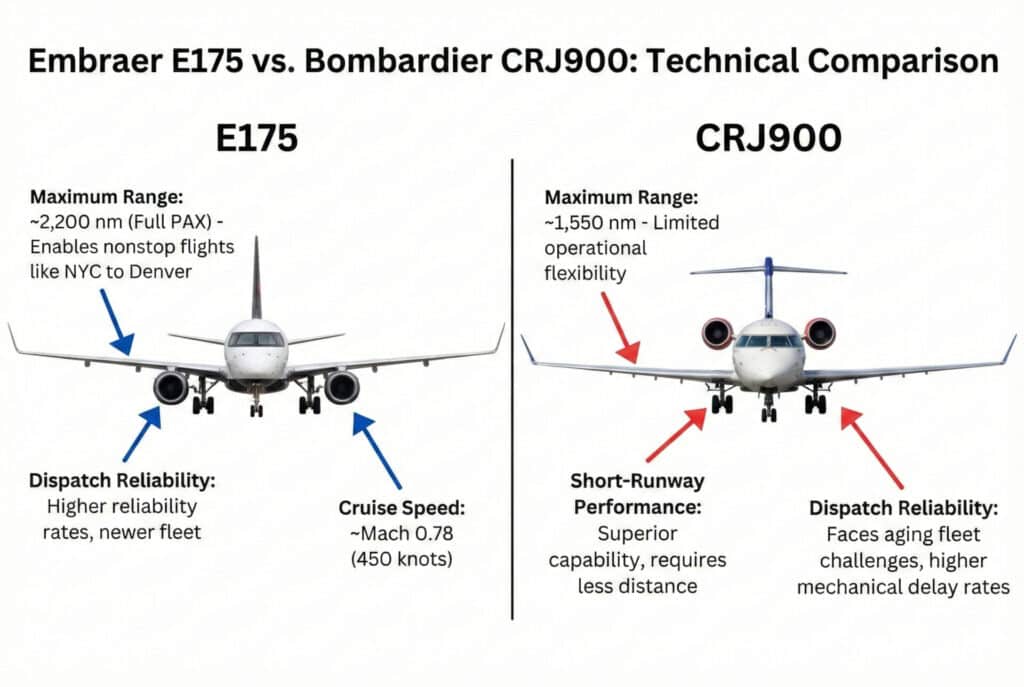
Range capabilities differ significantly between these regional jets, with the E175 offering substantial advantages for longer routes.
Maximum Range
The Embraer E175 achieves approximately 2,200 nautical miles maximum range with full passenger load. This enables nonstop flights connecting cities like New York to Denver or Los Angeles to Chicago.
The CRJ900 reaches approximately 1,550 nautical miles maximum range, limiting operational flexibility compared to the E175. Airlines operating longer regional routes favor the E175’s extended range capability.
In practice, most regional routes span 300-800 miles, where both aircraft operate comfortably within range limitations. The E175’s advantage emerges on transcon regional routes that CRJ900s cannot operate efficiently.
Cruise Speed
Both jets cruise at similar speeds around Mach 0.78 (approximately 450 knots). Cruise performance differences don’t meaningfully impact passenger experience or airline scheduling on typical regional routes.
Short-Runway Performance
The CRJ900 demonstrates superior short-runway capability, requiring less distance for takeoff and landing than the E175. This advantage matters for smaller regional airports with shorter runways serving limited markets.
However, most major U.S. airports feature runways exceeding both aircraft requirements. The CRJ900’s short-field performance provides minimal practical advantage on routes connecting larger cities.
Dispatch Reliability
Dispatch reliability—percentage of flights departing on-time without mechanical delays—favors the E175 based on airline operational data. The Embraer aircraft demonstrates higher reliability rates across multiple U.S. carriers.
The CRJ900 faces aging fleet challenges as aircraft accumulate flight cycles. Older CRJ900s require more frequent maintenance and experience higher mechanical delay rates than newer E175s.
Airline Economics & Operating Costs
Operating cost per seat influences airline fleet decisions as profoundly as passenger preferences.

Fuel Efficiency
The Embraer E175 burns approximately 2,400 pounds of fuel hourly during cruise, while the CRJ900 consumes around 2,100 pounds per hour. On a per-seat basis, fuel efficiency remains relatively comparable between the aircraft.
Newer E175 variants with upgraded engines demonstrate improved fuel efficiency that narrows or eliminates the CRJ900’s historical advantage. Fuel costs represent 30-40% of regional airline operating expenses, making even small efficiency gains meaningful.
Maintenance Complexity and Cost
The E175 maintenance costs run lower than CRJ900 over the aircraft lifecycle based on airline fleet data. Embraer’s support network and parts availability reduce maintenance delays and associated costs.
Bombardier’s regional aircraft division (now owned by Mitsubishi Heavy Industries) faced challenges maintaining comprehensive support networks across all CRJ variants. This created parts availability issues and increased airline maintenance costs over time.
Airlines operating mixed fleets incur additional training and parts inventory costs. Carriers standardizing on E175 fleets eliminate complexity that mixed-fleet operations create.
Pilot Training Costs
Type rating requirements for E175 and CRJ900 differ, necessitating separate training programs. Airlines transitioning between aircraft types face substantial training costs for flight crews.
The E175 flight deck design shares commonality with other Embraer regional jets, potentially reducing training time for pilots already rated on ERJ-145 or E170 aircraft.
CRJ900 pilots trained on smaller CRJ variants transition more easily, but the shrinking CRJ fleet reduces long-term value of maintaining CRJ-specific training programs.
Lifecycle Cost Advantage
Total lifecycle costs favor the E175 when accounting for fuel, maintenance, training, and residual value. Airlines replacing aging CRJ900 fleets overwhelmingly choose E175 aircraft rather than new CRJ900s.
This market preference creates residual value advantages for E175 owners. Used E175s command higher prices and lease rates than comparable CRJ900s, reducing fleet ownership costs for airlines.
Scope Clause Impact on Regional Jet Selection
U.S. airline scope clauses fundamentally shaped the E175 vs CRJ900 competitive landscape in ways technical specifications never could.
What Are Scope Clauses?
Scope clauses are labor agreement provisions limiting regional airline operations on behalf of major carriers. Pilot unions at American, Delta, and United negotiate these clauses to protect mainline pilot jobs from regional carrier expansion.
These agreements specify maximum aircraft size, passenger capacity, and fleet numbers that regional partners can operate. The clauses prevented regional airlines from deploying larger aircraft that might threaten mainline flying.
76-Seat Limit and Its Impact
For years, scope clauses limited regional aircraft to 70-76 seats maximum. This created enormous demand for aircraft sized precisely at that limit, driving E175 and CRJ900 development.
The Embraer E175 configures perfectly at 76 seats in standard two-class layout (12 first class, 64 economy). The CRJ900 reaches 76 seats in similar configuration, though some airlines configure to higher densities.
Both manufacturers designed these aircraft specifically to maximize capacity within scope clause limits. The 76-seat configuration became the sweet spot for U.S. regional aviation economics.
Why E175 Won the Scope Clause Battle
When scope clause relaxations allowed limited numbers of larger regional jets, airlines faced strategic decisions about fleet deployment.
The E175’s superior passenger experience mattered enormously once airlines could choose freely. Passenger complaints about CRJ900 comfort reached levels where brand reputation concerns influenced fleet decisions.
Delta Air Lines explicitly cited passenger satisfaction when standardizing regional fleets around E175 aircraft. The airline retired CRJ900s early despite serviceable airframe life remaining, replacing them with more passenger-friendly E175s.
American Airlines followed similar strategies, maximizing E175 allocations within scope clause limits while allowing CRJ900 numbers to decline through natural attrition.
Current Scope Clause Status
Scope clause agreements continue evolving through labor negotiations. Recent agreements at major carriers allow more large regional jets (76+ seats) but maintain strict limits on total regional fleet size.
This benefits the Embraer E175 disproportionately because airlines choose it when adding allowed large regional jets. The CRJ900 faces retirement rather than expansion across most U.S. carriers.
Why Airlines Are Phasing Out the CRJ900
Fleet retirement trends tell the story: multiple major U.S. airlines actively reduce CRJ900 operations while expanding E175 fleets.

Delta Air Lines CRJ900 Retirement
Delta completely eliminated CRJ900 aircraft from regional partner fleets by 2023. The airline cited passenger experience concerns and operational efficiency when announcing retirement plans years earlier.
Replacement aircraft? Embraer E175s exclusively. Delta’s regional partners now operate standardized E175 fleets alongside smaller CRJ-700 aircraft for thinner markets.
American Airlines Fleet Evolution
American Airlines maintains shrinking CRJ900 numbers while expanding E175 allocations within scope clause limits. The carrier hasn’t ordered new CRJ900s in over a decade.
As existing CRJ900s reach retirement age, American replaces them with E175 aircraft from Embraer or acquires used E175s from aircraft leasing companies.
United Airlines Strategy
United operates both aircraft types through regional partners but strongly favors E175 deployment on competitive routes where passenger experience influences booking decisions.
The airline assigns CRJ900s primarily to captive markets with limited competition, while deploying E175s on routes where passengers choose between multiple carriers.
Manufacturing Discontinuation
Bombardier stopped CRJ900 production and sold the program to Mitsubishi Heavy Industries, which subsequently discontinued the entire CRJ program. No new CRJ900s enter service anywhere globally.
Embraer continues producing E175s with strong order backlogs from U.S. regional carriers. New aircraft availability alone drives fleet decisions toward E175s when CRJ900s require replacement.
Passenger Backlash Influence
Social media complaints about CRJ900 comfort reached levels where airlines recognized brand damage from operating these aircraft. Passengers specifically requested E175 flights when booking, avoiding CRJ900s when possible.
This passenger preference created revenue implications beyond operating costs. Airlines discovered that deploying E175s on competitive routes generated higher load factors and yielded better passenger revenue than CRJ900 operations.
Embraer E175 vs CRJ900: Which Aircraft Is Better?
Aircraft superiority depends on perspective—passenger experience versus pure operating economics.
From the Passenger Perspective
The Embraer E175 wins decisively on passenger comfort metrics:

Wider seats (18.25 inches vs 17 inches), taller cabin (6’7″ vs 6’1″), larger overhead bins, and generally quieter cabin create measurably better flying experience.
Passengers notice these differences immediately upon boarding. The E175 feels more spacious and comfortable, while the CRJ900 feels cramped and constrained.

For flights exceeding 90 minutes, comfort differences become pronounced. Three-hour regional flights on CRJ900s generate passenger complaints that E175 operations avoid.
From the Airline Economic Perspective
The E175 also wins economically when considering lifecycle costs, passenger satisfaction impacts, and fleet residual values.
While CRJ900 might show marginally lower fuel burn, the E175’s advantages in maintenance costs, reliability, residual value, and passenger revenue generation outweigh fuel economy benefits.
Airlines operating both aircraft types consistently allocate E175s to revenue-critical routes while relegating CRJ900s to less competitive markets—demonstrating revealed preference for E175 economics.
The Market Has Decided
Fleet orders and retirement decisions reveal market verdict: the E175 represents the superior regional jet for U.S. airline operations.
U.S. carriers ordered hundreds of E175s in recent years while CRJ900 orders stagnated then ceased entirely. Production discontinuation of the CRJ900 confirms market rejection of the Bombardier design.
The only scenario favoring CRJ900 operation involves existing fleet commonality where an airline already operates many CRJ variants. Even then, carriers choose natural attrition retirement over fleet expansion.
Future of Regional Jets: What Comes Next?
Regional aviation faces transformation as scope clauses evolve and new aircraft enter the market.
The Airbus A220 (formerly Bombardier CSeries) represents potential regional jet replacement, though 100+ seat capacity exceeds most current scope clause limits. If clauses relax further, A220s could replace both E175s and remaining CRJ900s.
Embraer developed the E175-E2 with improved efficiency, but U.S. scope clauses limit deployment because the aircraft weighs more than current agreements allow despite similar seating capacity.
Technology improvements in engines, aerodynamics, and systems will make future regional jets more efficient and comfortable. But scope clause politics will likely determine which aircraft U.S. carriers actually operate.
For the foreseeable future, the Embraer E175 dominates U.S. regional aviation as the preferred 76-seat jet. The CRJ900 gradually disappears from American skies as existing aircraft reach retirement age.
Frequently Asked Questions
Which is better, Embraer E175 or CRJ900?
The Embraer E175 is better for passengers due to wider seats (18.25 inches vs 17 inches), taller cabin height, and larger overhead bins. Airlines also prefer E175 for superior passenger satisfaction, lower lifecycle costs, and better residual values. Market evidence confirms this: U.S. carriers retire CRJ900s while expanding E175 fleets.
Is the Embraer E175 more comfortable than the CRJ900?
Yes, significantly. The E175 offers 1.25 inches more seat width, 6 inches additional cabin height, and roomier overhead bins. Passengers consistently rate E175 comfort higher in surveys. The difference becomes particularly noticeable on flights exceeding 90 minutes.
Why do passengers prefer the Embraer E175?
Passengers prefer the E175 for comfort reasons: wider seats, no middle seats, better overhead storage, quieter cabin, and easier boarding. The aircraft feels more spacious despite similar capacity. Social media discussions frequently show passengers specifically requesting E175 flights when booking regional routes.
Why is the CRJ900 being phased out?
Airlines phase out CRJ900s due to passenger comfort complaints, higher maintenance costs as fleets age, and Bombardier’s production discontinuation. Delta completely eliminated CRJ900s, citing passenger experience. No new CRJ900s are manufactured, forcing airlines toward E175s for fleet replacement.
What is the seat width difference between E175 and CRJ900?
The E175 seats measure 18.25 inches wide, while CRJ900 seats are 17 inches wide—a 1.25-inch difference. This may seem small but feels significant during flights, particularly for larger passengers or those in business attire. The E175 approaches narrowbody seat comfort while the CRJ900 feels noticeably cramped.
How does scope clause impact regional jet operations?
Scope clauses in U.S. airline pilot contracts limit regional aircraft size and fleet numbers. These agreements historically capped regional jets at 70-76 seats maximum, creating demand for aircraft like E175 and CRJ900 designed specifically to maximize capacity within limits. Scope clause relaxations favor E175 deployment because airlines prefer superior passenger experience when allowed larger regional jets.
What regional jet do U.S. airlines use most?
The Embraer E175 dominates U.S. regional fleets at major carriers. American, Delta, and United operate hundreds of E175s through regional partners. The CRJ900 fleet shrinks through retirements while E175 numbers grow. Smaller regional jets like CRJ-700 and ERJ-145 serve thinner routes, but E175 is the standard 76-seat aircraft.
Is the CRJ900 still in service?
Yes, CRJ900s remain in service but in declining numbers. Airlines retire these aircraft as they reach lifecycle limits or when scope clause allocations allow E175 replacements. Delta eliminated all CRJ900s. American and United maintain shrinking CRJ900 fleets but deploy them on less competitive routes. No new CRJ900s are manufactured.
Which has better range, E175 or CRJ900?
The Embraer E175 offers superior range at approximately 2,200 nautical miles versus CRJ900’s 1,550 nautical miles. This enables E175 to operate longer regional routes that CRJ900 cannot serve nonstop. Airlines use this advantage for transcon regional flights like New York to Denver or Los Angeles to Chicago.
What are the operating cost differences between E175 and CRJ900?
The CRJ900 burns slightly less fuel (2,100 lbs/hour vs 2,400 lbs/hour), but the E175 offers lower lifecycle costs through reduced maintenance expenses, better residual values, and higher passenger revenue generation. Total operating cost per seat favors the E175 when accounting for all factors beyond fuel burn alone.