
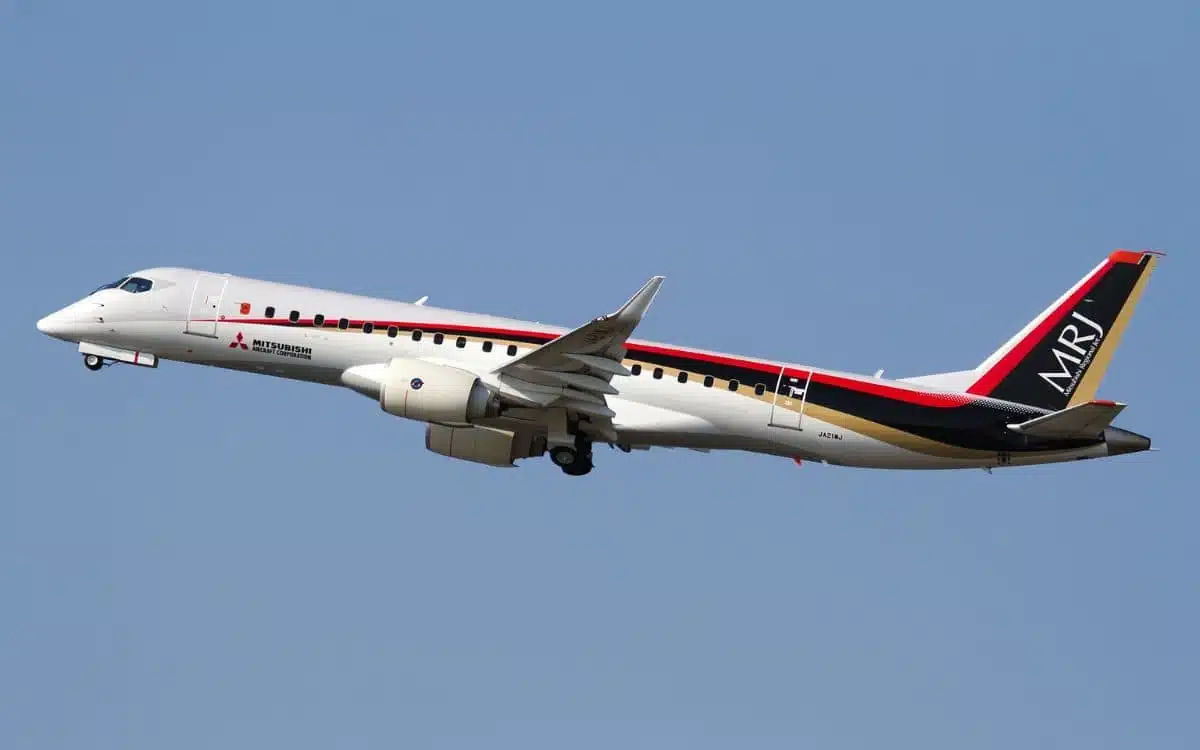
Japan’s aviation industry has made a significant leap with the first flight of the Mitsubishi Regional Jet (MRJ) 90. On November 11, 2015, the MRJ 90 soared from Japan’s Nagoya airfield, marking a monumental moment for Mitsubishi and the entire Japanese aviation sector. This flight lasted nearly 85 minutes, showcasing the aircraft’s capabilities and bringing Japan back into the commercial jetliner market after a hiatus of nearly 60 years.
A Historic First Flight
The MRJ 90’s inaugural flight was conducted with the aircraft registered as JA21MJ. Throughout the flight, the plane maintained a constant flap setting, had its landing gear down and locked, and kept thrust reversers deactivated. This cautious approach is typical for first flights to ensure safety and gather essential data.
This first flight was long overdue, as initial plans aimed for a 2012 debut. Despite delays, the MRJ 90’s successful flight was a pivotal achievement, signaling Mitsubishi’s re-entry into the regional jet market.
Competing in the Regional Jet Market
The 92 seat MRJ 90 directly competes with the 88 seat Embraer E175 and the 90 seat Bombardier CRJ 900. However, Mitsubishi’s new jetliner stands out with its Pratt & Whitney high bypass Geared Turbofan Engines (GTF). These engines provide superior fuel efficiency, making the MRJ 90 a strong contender in the sub-100 seat regional jet category.
Comparison of Key Performance Metrics
| Feature | Mitsubishi MRJ 90 | Bombardier CRJ 900 | Embraer E175 |
|---|---|---|---|
| Seating Capacity | 92 seats | 90 seats | 88 seats |
| Engine | GTF Engines | General Electric | General Electric |
| Max Takeoff Weight | 39.6 tonnes | 39.0 tonnes | 37.9 tonnes |
| Range | 2,020 nautical miles | 1,553 nautical miles | 2,000 nautical miles |
The MRJ 90’s superior fuel efficiency is its unique selling point, making it attractive to airlines looking to reduce operational costs and environmental impact.
Return of Japanese Commercial Aviation
Japan’s last commercial airliner was the YS-11 turboprop, introduced in 1960. The MRJ program marks Japan’s return to the commercial aircraft market, adding a new competitor to the regional jet segment, which is currently dominated by Embraer and Bombardier. Mitsubishi aims to capture a significant share of this market, particularly in the United States, where 76% of the MRJ 90’s firm orders come from.
Three major US regional airlines-Trans States Holdings, Sky West, and Eastern Airlines-have collectively ordered 170 MRJ 90s. This strong interest from the US market bodes well for Mitsubishi, despite the challenges of entering a market with established players.
Challenges and Opportunities
New aircraft models often face reliability issues until they mature. The MRJ 90 is expected to follow this trend, similar to the Boeing 787 and the Airbus A380. Mitsubishi has partnered with Boeing Commercial Aviation Services to provide 24/7 customer support, including spare parts provisioning and field services. This collaboration aims to ensure a smooth entry into service and build customer confidence.
Another critical factor is the aircraft’s residual value. Investors and lessors prefer aircraft with high residual values to maximize their returns. Mitsubishi’s ability to establish a strong market presence and maintain high residual values will be crucial for long-term success.
Is the MRJ 90 in a Good Segment?
The regional jet market has seen varying success across different seat capacities. Since 2009, Embraer has received 443 orders for the 88 seat E175 and E175E2, while Bombardier has secured 139 orders for the 90 seat CRJ 900. In contrast, smaller jets like the 78 seat EMB170 and CRJ 700 have seen minimal orders. This trend suggests a strong market for 90 seat regional jets, positioning the MRJ 90 favorably.
Order Trends for Regional Jets
| Aircraft Model | Orders Since 2009 |
|---|---|
| Embraer E175/E175E2 | 443 |
| Bombardier CRJ 900 | 139 |
| Embraer EMB170 | 0 |
| Bombardier CRJ 700 | 28 |
The MRJ 90 also benefits from Bombardier’s decision not to develop or re-engine aircraft below 100 seats, narrowing the competition to Embraer and Mitsubishi.
Maintenance Considerations
For more detailed insights into the maintenance requirements of regional jets, including the MRJ 90, check out our comprehensive article on Cirrus maintenance.
Conclusion
The Mitsubishi MRJ 90 represents a significant milestone in Japan’s aviation history and offers promising prospects in the regional jet market. With its advanced fuel-efficient engines and a strong focus on customer support, the MRJ 90 is well-positioned to compete with established players like Embraer and Bombardier.
However, Mitsubishi faces challenges such as establishing reliability, ensuring robust customer support, and maintaining high residual values. If successful, the MRJ 90 could redefine the regional jet market and solidify Mitsubishi’s place in commercial aviation.
Final Comparison Table
| Feature | Mitsubishi MRJ 90 | Bombardier CRJ 900 | Embraer E175 |
|---|---|---|---|
| Seating Capacity | 92 seats | 90 seats | 88 seats |
| Engine | GTF Engines | General Electric | General Electric |
| Max Takeoff Weight | 39.6 tonnes | 39.0 tonnes | 37.9 tonnes |
| Range | 2,020 nautical miles | 1,553 nautical miles | 2,000 nautical miles |
| Fuel Efficiency | Superior | Standard | Standard |
This comprehensive look at the Mitsubishi MRJ 90 highlights its strengths and potential in the competitive regional jet market.