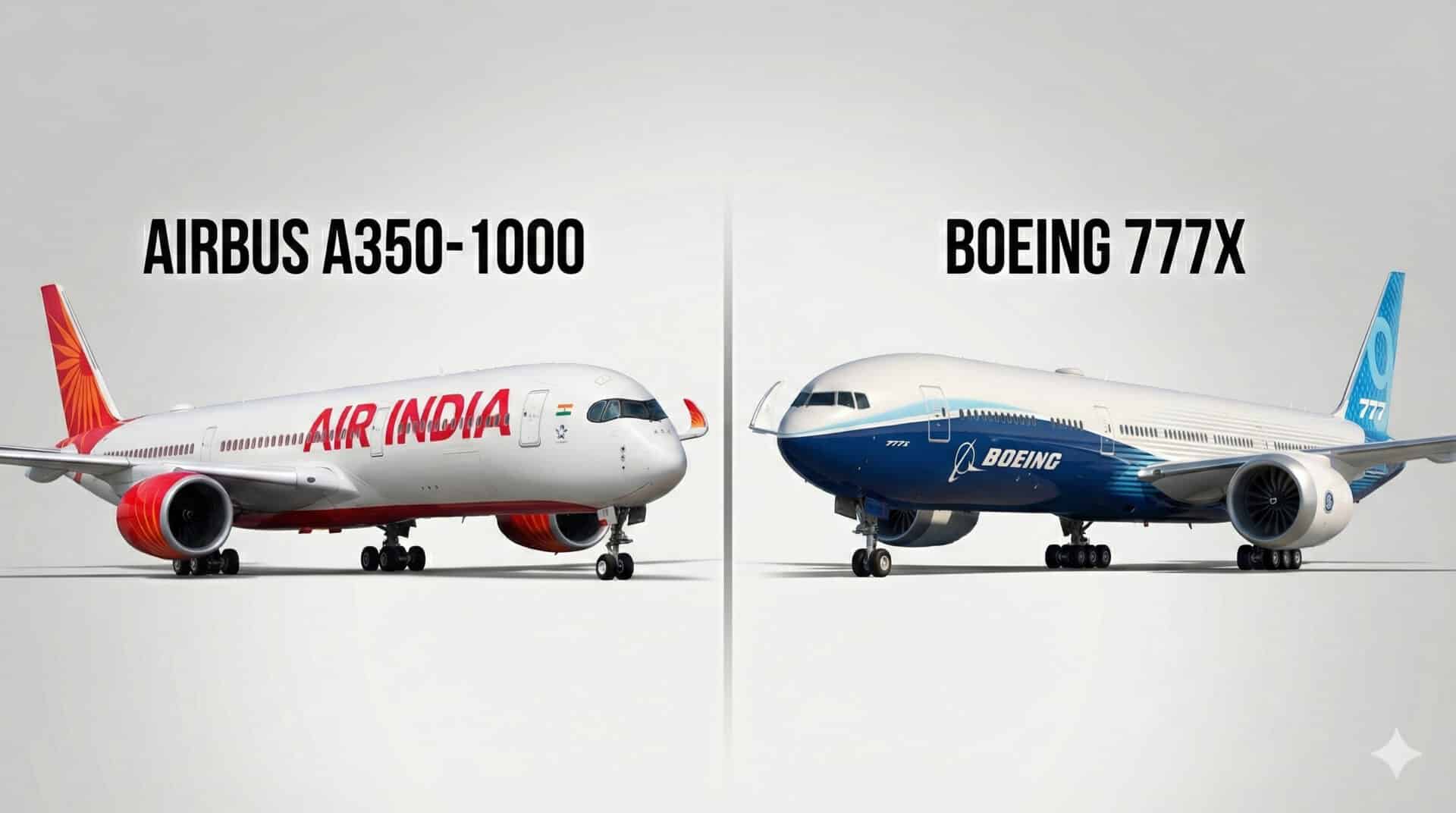

The long-haul widebody market hinges on two aircraft competing for airline orders worth billions: the Boeing 777-300ER and the Airbus A350-1000. These jets transport hundreds of passengers across oceans, connecting continents on routes spanning 8,000+ miles.
Yet these flagship widebodies represent fundamentally different design philosophies. One aircraft relies on proven technology and operational maturity. The other leverages composite construction and next-generation systems promising fuel efficiency gains airlines desperately need.
Understanding widebody aircraft matters because these jets define premium international travel and determine airline profitability on competitive long-haul routes generating billions in annual revenue.
Quick Comparison: Boeing 777-300ER vs Airbus A350-1000 at a Glance
| Specification | Boeing 777-300ER | Airbus A350-1000 |
|---|---|---|
| PASSENGER COMFORT | ||
| Standard Seat Width (Economy) | 17.2 inches (9-abreast) | 18.0 inches (9-abreast) |
| Cabin Width (Interior) | 19 feet 3 inches | 19 feet 8 inches |
| Cabin Height | 7 feet 9 inches | 8 feet 0 inches |
| Cabin Pressure (ft altitude) | 6,500 feet | 6,000 feet |
| Humidity Control | Standard (low humidity) | Enhanced (higher humidity) |
| Window Size | Standard | Larger (15% bigger) |
| Cabin Noise Level | Moderate | Quieter (composite dampening) |
| Air Quality | Standard HEPA filtration | Advanced filtration + ionization |
| PERFORMANCE & RANGE | ||
| Maximum Range | 7,370 nautical miles | 8,700 nautical miles |
| Typical Range (with payload) | 7,200 nautical miles | 8,400 nautical miles |
| Cruise Speed | Mach 0.84 | Mach 0.85 |
| Service Ceiling | 43,100 feet | 43,100 feet |
| Takeoff Distance | 10,800 feet | 9,350 feet |
| Landing Distance | 6,100 feet | 5,250 feet |
| CAPACITY & DIMENSIONS | ||
| Typical Seating (3-class) | 365 passengers | 350 passengers |
| Maximum Seating | 550 passengers | 440 passengers |
| Cargo Capacity | 5,720 cubic feet | 5,100 cubic feet |
| Length | 242 feet 4 inches | 242 feet 1 inch |
| Wingspan | 212 feet 7 inches | 212 feet 5 inches |
| Height | 60 feet 9 inches | 56 feet 11 inches |
| Maximum Takeoff Weight | 775,000 lbs | 693,000 lbs |
| OPERATING ECONOMICS | ||
| Fuel Burn (per hour) | ~11,000 lbs | ~8,800 lbs |
| Fuel Efficiency (per seat) | Standard | 20-25% better |
| Maintenance Costs | Lower (mature design) | Lower (fewer checks) |
| Operating Cost per Seat | Higher | 12-15% lower |
| Purchase Price (list) | ~$375 million | ~$366 million |
| Production Status | Discontinued (2021) | In production |
| TECHNOLOGY & INNOVATION | ||
| Airframe Material | Aluminum alloy | 53% carbon composite |
| Engines | GE90-115B (777X: GE9X) | Rolls-Royce Trent XWB |
| Cockpit | Advanced glass cockpit | Next-gen touchscreen HMI |
| Flight Control | Fly-by-wire | Advanced fly-by-wire |
| Wing Design | Conventional raked wingtips | Carbon fiber winglets |
| APU Efficiency | Standard | More efficient |
| AIRLINE FLEET STATUS | ||
| Global Fleet Size | ~800+ aircraft | ~300+ aircraft (growing) |
| Entry into Service | 2004 | 2018 |
| Production Run | 2004-2021 (17 years) | 2017-present |
| Major Operators | Emirates (218), Air France, Cathay Pacific, British Airways | Qatar Airways (24), Singapore Airlines, Cathay Pacific, Lufthansa |
| Airline Preference (New Orders) | Legacy choice | Strong order book |
| Resale Value | Declining (mature) | Strong (newer) |
| OPERATIONAL FLEXIBILITY | ||
| Airport Compatibility | Excellent (mature infrastructure) | Good (newer support needed) |
| Route Network Flexibility | Proven on 1,000+ routes | Expanding network |
| Pilot Training Base | Large existing pool | Growing pool |
| Maintenance Support | Global network established | Building network |
| Parts Availability | Excellent | Good (improving) |
Note: Green checkmarks (✓) indicate superior specification. Performance varies by configuration and operating conditions.
Why Airlines Compare the 777-300ER and A350-1000
Both aircraft target identical market segments: long-haul international routes requiring 350-400 seats with ranges exceeding 7,000 nautical miles. This overlap creates direct competition for airline fleet planners selecting widebodies costing $300-400 million each.
The Boeing 777-300ER entered service in 2004, establishing itself as the workhorse of long-haul aviation. Emirates alone operates 218 aircraft, demonstrating the type’s commercial success and operational reliability.

The Airbus A350-1000 launched in 2018 as a direct competitor leveraging advanced materials and next-generation technology. Airbus designed the aircraft specifically to challenge 777-300ER dominance with promises of 25% better fuel efficiency.

Airlines choose between proven operational maturity (777-300ER) versus fuel efficiency gains (A350-1000) that could save millions annually on routes like London to Singapore or New York to Hong Kong.
Fleet replacement decisions involve more than specifications. Airlines consider existing pilot bases, maintenance infrastructure, financing terms, and manufacturer political relationships worth billions in future aircraft orders.
Passenger Comfort: Cabin Experience Comparison

Long-haul passengers spending 12-16 hours aboard aircraft notice comfort differences immediately, influencing airline brand perception and premium ticket pricing power.
Seat Width and Cabin Dimensions
The Airbus A350-1000 offers superior seat width in standard 9-abreast economy configuration: 18.0 inches versus 17.2 inches on 777-300ER. That 0.8-inch advantage feels substantial on overnight flights.
Cabin width drives seat dimensions. The A350-1000’s 19 feet 8 inches interior width versus 777-300ER’s 19 feet 3 inches provides critical extra space. Airlines configuring 10-abreast economy (some 777-300ERs) reduce seat width to 16.5 inches—approaching regional jet dimensions.
The A350-1000 cabin height reaches 8 feet, allowing taller passengers to stand comfortably. The 777-300ER measures 7 feet 9 inches, adequate but noticeably lower when moving through premium cabins.
Cabin Pressure and Air Quality
Composite construction enables the A350-1000 to maintain 6,000-foot cabin altitude at cruise, reducing passenger fatigue compared to the 777-300ER’s 6,500-foot pressure. This 500-foot difference measurably affects sleep quality and jet lag on ultra-long-haul routes.
The A350-1000 maintains higher cabin humidity (20-25% versus 10-15%) thanks to composite materials resisting corrosion from moisture. Passengers experience less dehydration and dry skin on long-haul flights.
Air quality systems differ significantly. The A350-1000 features advanced HEPA filtration combined with ionization technology removing odors and airborne particles. The 777-300ER uses standard HEPA filters effective but less sophisticated.
Windows and Lighting

The A350-1000 windows measure 15% larger than 777-300ER windows, providing better views and natural light. The electronic dimming system allows passengers to adjust brightness without physical shades.
LED mood lighting on both aircraft creates ambient environments, though the A350-1000 system offers 16.7 million color combinations versus the 777-300ER’s more limited palette.
Noise Levels
The A350-1000 operates quieter than the 777-300ER due to composite fuselage construction dampening engine and airframe noise. Passengers report noticeably quieter cabins, particularly in seats near the wings.
The Rolls-Royce Trent XWB engines on the A350-1000 generate less noise than the GE90-115B engines powering the 777-300ER, contributing to reduced cabin sound levels.
Performance and Range: Operational Capabilities
Range performance determines which city pairs airlines can serve nonstop, directly impacting route profitability and competitive positioning.
Maximum Range Comparison
The Airbus A350-1000 achieves 8,700 nautical miles maximum range, exceeding the 777-300ER’s 7,370 nautical miles by more than 1,300 miles. This enables routes like Singapore to New York (8,285 nm) that 777-300ERs cannot operate nonstop with full passenger loads.
Typical operational range with realistic passenger and cargo loads narrows the gap somewhat. The A350-1000 operates 8,400 nautical miles versus the 777-300ER’s 7,200 nm—still a substantial 1,200-mile advantage.
This range superiority allows airlines to serve ultra-long-haul routes bypassing traditional hub connections. Singapore Airlines operates A350-1000s on 19-hour flights to New York—impossible for 777-300ER operations.
Speed and Efficiency
Both aircraft cruise at similar speeds: Mach 0.84 for the 777-300ER and Mach 0.85 for the A350-1000. Speed differences don’t meaningfully impact block times on long-haul routes.
The 777-300ER’s slightly faster cruise helps on time-sensitive routes, but fuel burn penalties at higher speeds often negate schedule benefits. Airlines typically operate both jets at economical cruise speeds around Mach 0.83-0.84.
Takeoff and Landing Performance
The Airbus A350-1000 requires shorter runways: 9,350 feet takeoff distance versus 10,800 feet for the 777-300ER. This enables operations at airports with runway length limitations.
Landing distance advantages also favor the A350-1000 (5,250 feet versus 6,100 feet), important for operations into airports like London City or challenging destinations with shorter runways.
These field performance advantages expand the A350-1000’s operational flexibility, allowing service to airports the heavier 777-300ER cannot access at maximum weight.
Operating Economics: The Critical Difference
Fuel costs represent 30-40% of long-haul operating expenses, making efficiency differences worth millions annually per aircraft.
Fuel Burn Comparison
The Airbus A350-1000 burns approximately 8,800 pounds of fuel hourly during cruise, compared to the 777-300ER’s 11,000 pounds per hour. That 2,200-pound hourly advantage accumulates dramatically over long flights.
On a 14-hour flight from Los Angeles to Sydney, the A350-1000 saves roughly 30,800 pounds of fuel (4,400 gallons). At $3 per gallon, that’s $13,200 per flight or nearly $5 million annually on daily service.
This 20-25% fuel efficiency advantage derives from composite construction, advanced aerodynamics, and next-generation Trent XWB engines designed specifically for optimal performance.
Maintenance Cost Differences
The 777-300ER benefits from mature maintenance programs and extensive global support networks. Airlines operating these aircraft for 15+ years have optimized maintenance procedures minimizing costs.
The A350-1000’s composite airframe requires less maintenance than aluminum structures. Corrosion inspections largely disappear, and structural checks occur less frequently. However, composite repair capabilities remain less widespread than traditional aluminum expertise.
Engine maintenance costs favor the A350-1000’s Trent XWB engines, which operate cooler and require longer intervals between overhauls compared to the 777-300ER’s GE90-115B engines demanding more frequent heavy maintenance.
Total Operating Cost Analysis
Industry analyses show the A350-1000 operating costs run 12-15% lower per seat than 777-300ER on equivalent routes. This advantage comes primarily from fuel efficiency, with maintenance savings contributing smaller benefits.
The 777-300ER’s higher capacity (365 vs 350 passengers typical) provides cost advantages on high-demand routes where airlines fill every seat. Lower per-seat costs materialize when load factors exceed 85% consistently.
Airlines also consider acquisition costs. The A350-1000’s $366 million list price undercuts the 777-300ER’s $375 million (when in production), though actual purchase prices reflect substantial negotiated discounts.
Technology and Innovation: Design Philosophy Comparison
Technology differences between these aircraft reflect fundamentally different development timelines and design approaches.
Composite vs Aluminum Construction

The Airbus A350-1000 features 53% carbon composite construction by weight, including the entire fuselage and wing structure. This reduces weight by approximately 20% versus aluminum equivalents while improving fatigue resistance.
The Boeing 777-300ER uses traditional aluminum alloy construction with minimal composites. This proven approach offers excellent repairability and relies on mature manufacturing techniques airlines and MRO facilities understand thoroughly.
Composite advantages extend beyond weight savings. The material enables higher cabin pressure without corrosion concerns, allows complex aerodynamic shapes difficult in aluminum, and reduces long-term maintenance substantially.
Engine Technology
The GE90-115B engines powering the 777-300ER represent the world’s most powerful commercial engines, producing 115,000 pounds thrust each. These engines set records for reliability and performance but consume fuel at higher rates than newer designs.

The Rolls-Royce Trent XWB engines on the A350-1000 incorporate advanced materials and design achieving 20% better fuel efficiency than previous-generation engines. The Trent XWB runs cooler, lasts longer between overhauls, and operates significantly quieter.

Engine commonality with the smaller A350-900 provides Airbus customers fleet flexibility and maintenance synergies unavailable to 777-300ER operators using unique powerplants.
Cockpit and Avionics
Both aircraft feature advanced glass cockpits, but the A350-1000’s touchscreen interfaces and next-generation flight management systems offer improved pilot ergonomics.
The 777-300ER cockpit uses more traditional switch panels and cursor control devices. Pilots familiar with these systems appreciate the tactile feedback and proven reliability, though the interface feels dated compared to newer designs.
Aerodynamic Refinements
The A350-1000’s wing design incorporates advanced carbon fiber construction enabling optimal aerodynamic shaping impossible with aluminum. The curved winglets reduce drag more effectively than the 777-300ER’s raked wingtips.
Laminar flow technology on the A350-1000 maintains smooth airflow over more wing surface area, reducing drag and improving fuel efficiency by 2-3% beyond engine and weight advantages.
Fleet Status and Airline Preferences
Market acceptance reveals airline confidence in these competing aircraft, with order books and operational deployments telling the competitive story.
Production and Fleet Size
Boeing built approximately 810 777-300ER aircraft between 2004 and 2021, when production ended in favor of the 777X program. These aircraft dominate long-haul fleets at Emirates, Air France, Cathay Pacific, and British Airways.
Airbus delivered over 300 A350-1000s since 2018, with strong order backlogs extending production for years. Qatar Airways, Singapore Airlines, Cathay Pacific, and Lufthansa operate substantial A350-1000 fleets.
The 777-300ER’s production end doesn’t signal market rejection—Boeing’s 777X program represents the next-generation replacement featuring composite wings and even greater efficiency. Airlines needing immediate widebody deliveries choose A350-1000s unavoidably.
Airline Deployment Strategies
Emirates operates 218 777-300ERs—the world’s largest operator demonstrating extraordinary confidence in the type’s economics and reliability. The airline built its global network around 777-300ER capabilities.
Qatar Airways chose the A350-1000 as its premium long-haul flagship, deploying the aircraft on prestige routes like Doha to New York and London. The airline cited passenger comfort and operating economics as decisive factors.
Singapore Airlines operates both types strategically: A350-1000s on ultra-long-haul routes requiring maximum range (Singapore to New York, Los Angeles), and 777-300ERs on shorter sectors where capacity matters more than fuel efficiency.
Residual Values and Investment
The A350-1000’s newer design commands stronger residual values than aging 777-300ERs approaching 15-20 years old. Lessors favor A350-1000s for portfolio value retention over decades.
777-300ER values decline as the fleet ages, though well-maintained examples from premium operators retain substantial worth due to proven reliability and global maintenance support.
Which Aircraft Is Better: Perspective Matters
Aircraft superiority depends entirely on priorities—fuel efficiency versus capacity, range versus maturity, technology versus proven performance.
For Airlines Prioritizing Fuel Efficiency
The Airbus A350-1000 wins decisively on fuel efficiency, burning 20-25% less fuel per flight than the 777-300ER. On long-haul routes operating daily, this translates to millions in annual savings.
Airlines facing environmental regulations or carbon pricing find the A350-1000’s lower emissions attractive. European carriers pay carbon taxes making fuel efficiency directly profitable.
For Airlines Maximizing Capacity
The 777-300ER carries 15 more passengers in typical three-class configuration (365 vs 350), generating additional revenue without proportionally higher costs on high-demand routes.
Airlines operating slot-constrained airports (London Heathrow, Tokyo Haneda) benefit from 777-300ER capacity maximizing revenue per departure slot—a crucial competitive advantage.
For Airlines Requiring Maximum Range
The A350-1000’s 8,700-nautical-mile range enables ultra-long-haul routes impossible for 777-300ER operations. Singapore to New York, Perth to London, and similar routes require A350-1000 performance.
Airlines building point-to-point networks bypassing traditional hubs need A350-1000 range capabilities connecting secondary cities nonstop across continents.
For Airlines Valuing Operational Maturity
The 777-300ER’s 20-year operational history provides unmatched reliability data and proven performance. Airlines confident in Boeing support networks and existing pilot bases favor 777-300ER acquisitions.
Global maintenance infrastructure for 777-300ERs exceeds A350-1000 capabilities currently. Airlines operating remote destinations appreciate widespread parts availability and technician expertise for quick turnarounds.
The Market Verdict
Both aircraft succeed commercially, proving sufficient market demand for competing approaches. The 777-300ER’s 810-aircraft production run demonstrates massive commercial success, while the A350-1000’s strong order book confirms market confidence in Airbus technology.
Airlines increasingly choose A350-1000s for new orders, recognizing fuel efficiency advantages outweigh capacity and maturity benefits over 20-30 year operational lifespans.
Future of Long-Haul Widebodies
Neither aircraft represents the final word in long-haul widebody design, with next-generation successors already under development.
Boeing’s 777X program (777-8 and 777-9) incorporates composite wings, new GE9X engines, and advanced systems promising 777-300ER capacity with A350-1000 efficiency. Certification delays push deliveries toward 2025-2026.
Airbus considers A350 variants and potential all-new designs for the 2030s. Sustainable aviation fuel compatibility and hydrogen propulsion research influence future development.
Environmental pressures accelerate efficiency requirements. Both manufacturers face mandates to reduce carbon emissions 50% by 2050, driving continued innovation in propulsion and airframe technology.
Frequently Asked Questions
Which is better, Boeing 777-300ER or Airbus A350-1000?
The Airbus A350-1000 is better for fuel efficiency, burning 20-25% less fuel per flight with 8,700-nautical-mile range and superior passenger comfort. The 777-300ER offers 15 more seats and proven 20-year operational maturity. Choice depends on airline priorities: efficiency versus capacity, range versus established support networks.
Is the A350-1000 more comfortable than the 777-300ER?
Yes, significantly. The A350-1000 offers wider seats (18.0 inches vs 17.2 inches), lower cabin altitude (6,000 feet vs 6,500 feet), higher humidity, larger windows, and quieter cabins. Passengers report better sleep quality and less fatigue on ultra-long-haul flights in A350-1000 cabins.
Why do airlines prefer the A350-1000 over the 777-300ER?
Airlines choose A350-1000s for fuel savings worth millions annually per aircraft. The 20-25% efficiency advantage reduces operating costs 12-15% per seat while offering superior range (8,700nm vs 7,370nm) enabling ultra-long-haul routes. Environmental regulations and carbon pricing make fuel efficiency increasingly valuable.
Which has better range, 777-300ER or A350-1000?
The Airbus A350-1000 offers superior range at 8,700 nautical miles versus the 777-300ER’s 7,370 nautical miles. This 1,330-mile advantage enables routes like Singapore to New York (8,285nm) that 777-300ERs cannot operate nonstop with full passenger and cargo loads.
Is the 777-300ER still in production?
No, Boeing ended 777-300ER production in 2021 after building approximately 810 aircraft. The 777X program (777-8 and 777-9) represents the next-generation replacement featuring composite wings and GE9X engines. Airlines needing immediate widebody deliveries choose A350-1000s or 787s.
What is the fuel burn difference between 777-300ER and A350-1000?
The A350-1000 burns approximately 8,800 pounds per hour during cruise versus the 777-300ER’s 11,000 pounds per hour. That 2,200-pound hourly difference accumulates to 30,800 pounds saved on a 14-hour flight—nearly 4,400 gallons or $13,200 at $3/gallon.
Which aircraft has lower operating costs?
The A350-1000 operating costs run 12-15% lower per seat than the 777-300ER primarily due to fuel efficiency advantages. Maintenance costs favor the A350-1000’s composite airframe requiring fewer corrosion inspections, though the 777-300ER benefits from mature global support networks.
Can the 777-300ER fly as far as the A350-1000?
No, the 777-300ER maximum range of 7,370 nautical miles falls 1,330 miles short of the A350-1000’s 8,700nm capability. Ultra-long-haul routes like Singapore to New York (8,285nm) require A350-1000 performance. The 777-300ER operates excellently on routes under 7,200 nautical miles.
Which aircraft is quieter for passengers?
The Airbus A350-1000 operates significantly quieter due to composite fuselage construction dampening noise and quieter Rolls-Royce Trent XWB engines. Passengers report noticeably quieter cabins, particularly in seats near wings where the 777-300ER’s aluminum structure transmits more sound.
Why did Boeing stop making the 777-300ER?
Boeing ended 777-300ER production to focus resources on the 777X program offering similar capacity with 20-25% better fuel efficiency through composite wings and GE9X engines. The 777-300ER achieved commercial success with 810 deliveries but could not match A350-1000 operating economics long-term.