
The long-range narrowbody market represents aviation’s fastest-growing segment, with airlines seeking aircraft that combine single-aisle economics with widebody range capabilities. The Airbus A321XLR and Boeing 737 MAX 10 compete directly for these routes, though one aircraft dramatically outperforms the other in range.
These single-aisle jets enable airlines to operate long-thin routes profitably—city pairs with sufficient demand for narrowbody capacity but insufficient traffic to justify widebody aircraft. Think Boston to Reykjavik or Los Angeles to Kona: routes requiring 6-9 hour endurance at narrowbody operating costs.
Yet the A321XLR and 737 MAX 10 represent fundamentally different design priorities. One aircraft specifically targets ultra-long narrowbody operations with auxiliary fuel tanks. The other focuses on capacity expansion rather than range extension.
Quick Comparison: Airbus A321XLR vs Boeing 737 MAX 10 at a Glance
| Specification | Airbus A321XLR | Boeing 737 MAX 10 |
|---|---|---|
| RANGE & PERFORMANCE | ||
| Maximum Range | 4,700 nautical miles | 3,300 nautical miles |
| Range Advantage | +1,400 nautical miles | Limited long-haul capability |
| Auxiliary Fuel Tanks | Yes (Rear Center Tank) | No |
| Transatlantic Capable | Yes (full routes) | Limited (East Coast only) |
| Cruise Speed | Mach 0.78 | Mach 0.79 |
| Service Ceiling | 39,800 feet | 41,000 feet |
| Takeoff Distance | 7,750 feet | 8,300 feet |
| CAPACITY & DIMENSIONS | ||
| Typical Seating (2-class) | 182-220 passengers | 188-230 passengers |
| Maximum Capacity | 244 passengers | 230 passengers |
| Cabin Width (interior) | 12 feet 1 inch | 11 feet 7 inches |
| Standard Seat Width (6-abreast) | 18 inches | 17.2 inches |
| Overhead Bin Volume | 60% larger (Airspace XL) | Standard MAX bins |
| Length | 146 feet | 143 feet 8 inches |
| Wingspan | 115 feet 10 inches | 117 feet 10 inches |
| Maximum Takeoff Weight | 223,000 lbs | 194,700 lbs |
| OPERATING ECONOMICS | ||
| Fuel Capacity | 33,000 liters (with RCT) | 25,800 liters |
| Fuel Efficiency (per seat) | 30% better on long routes | Better on short routes |
| Cost per Available Seat Mile | Lower on routes >3,000nm | Lower on routes <2,500nm |
| Optimal Route Length | 2,500-4,700 nautical miles | 500-3,000 nautical miles |
| Purchase Price (list) | ~$142 million | ~$135 million |
| Cargo Capacity | Limited (fuel tanks reduce hold) | Better belly cargo volume |
| TECHNOLOGY & FEATURES | ||
| Engine Type | Pratt & Whitney PW1100G | CFM LEAP-1B |
| Rear Center Tank (RCT) | Yes (enables long range) | No |
| Cabin Altitude | 6,500 feet | 7,000 feet |
| Cabin Technology | Airspace cabin with mood lighting | Sky Interior |
| Winglets | Sharklets | Split scimitar winglets |
| Airframe Family | A320neo family | 737 MAX family |
| CERTIFICATION & DELIVERY STATUS | ||
| Certification Status | Certified (2024) | Delayed (late 2025 expected) |
| Entry into Service | 2024 (Iberia first operator) | Not yet in service |
| Development Timeline | On schedule | Multiple delays |
| Order Book | 500+ orders | 200+ orders |
| Production Rate | Ramping up | Awaiting certification |
| AIRLINE NETWORK STRATEGY | ||
| Long-Thin Routes | Purpose-built for this mission | Limited capability |
| Hub-Bypass Strategy | Enables secondary city pairs | Short/medium-haul focus |
| Widebody Replacement | Yes (thin intercontinental routes) | No |
| Fleet Commonality | A320neo family (high) | 737 family (high) |
| Pilot Type Rating | A320 type rating | 737 type rating |
| Primary Use Case | Transatlantic, transpacific, long regional | Domestic, short international |
| LIMITATIONS & TRADE-OFFS | ||
| Payload Restriction | Reduced cargo with full fuel | Better payload flexibility |
| Turnaround Time | Longer (more fuel, fewer pax) | Faster (higher throughput) |
| Passenger Fatigue | 9+ hour flights in narrowbody | Shorter typical missions |
| Airport Infrastructure | Requires Category II capability | Standard requirements |
Note: Green checkmarks (✓) indicate superior specification. A321XLR dominates long-range capability, while 737 MAX 10 excels at high-capacity short/medium-haul operations.
Why the A321XLR and 737 MAX 10 Are Compared
Both aircraft compete in the narrowbody market, but their design missions differ substantially. The Airbus A321XLR (Extra Long Range) specifically targets long-thin routes requiring 4,000+ nautical mile capability. The Boeing 737 MAX 10 prioritizes capacity on existing MAX routes.

Airlines compare these aircraft when replacing aging widebodies on thin international routes or expanding point-to-point networks bypassing traditional hubs. A route like Boston to Lisbon (2,700 nm) makes sense for both jets. Boston to Athens (4,200 nm) requires the A321XLR exclusively.
The 737 MAX 10 entered development as Boeing’s answer to the Airbus A321neo, not specifically the XLR variant. Boeing stretched the MAX 9 to create a 230-seat aircraft competing on high-capacity domestic routes and short international sectors.

Fleet commonality drives comparison relevance. Airlines operating A320neo family aircraft naturally consider the A321XLR. Carriers with 737 fleets evaluate whether MAX 10’s capacity gains justify range limitations versus competitor offerings.
Market timing also matters. The A321XLR entered service in 2024 with Iberia as launch customer. The 737 MAX 10 faces certification delays, potentially not delivering until late 2025 or beyond—creating a competitive window for Airbus.
Range & Route Capability: The Decisive Difference
The range gap between these aircraft fundamentally determines their operational capabilities and market positioning.
A321XLR: Purpose-Built for Ultra-Long Narrowbody Operations

The Airbus A321XLR achieves 4,700 nautical miles maximum range—unprecedented for a single-aisle aircraft. This performance comes from a purpose-designed Rear Center Tank (RCT) adding 3,700 liters fuel capacity to standard A321neo tanks.
This range capability enables routes previously impossible for narrowbodies. New York to Rome (3,970 nm), Los Angeles to Honolulu (2,560 nm extended to Hawaiian islands), and Delhi to London (4,180 nm) all become operationally viable with full passenger loads.
Airlines deploy A321XLRs on transatlantic routes from secondary European cities to U.S. East Coast destinations. Dublin to Boston, Edinburgh to New York, and Porto to Newark represent exactly the long-thin routes this aircraft targets—sufficient demand for 180-200 passengers but insufficient for widebody operations.
737 MAX 10: Medium-Haul Focus with Limited Long-Range Capability

The Boeing 737 MAX 10 reaches 3,300 nautical miles maximum range—adequate for most domestic U.S. operations and short international routes but falling short for true transatlantic service from central U.S. cities.
East Coast to Western Europe routes like New York to London (3,000 nm) or Boston to Paris (3,050 nm) operate at the MAX 10’s range limits. Headwinds, weather diversions, or non-optimal routing could push these flights beyond safe fuel reserves.
The 1,400-nautical-mile range disadvantage eliminates entire route categories from MAX 10 consideration. West Coast to Hawaii, transatlantic from Chicago or Toronto, and transpolar routes remain impossible regardless of passenger demand or economic viability.
Payload-Range Trade-offs
Both aircraft face payload restrictions at maximum range, but the A321XLR’s impact proves more significant. With full fuel loads enabling 4,700 nm flights, cargo capacity reduces to approximately 12-15 passengers’ luggage equivalent.
Airlines operating A321XLR transatlantic services restrict checked baggage or reduce passenger capacity slightly to accommodate realistic luggage volumes. The trade-off remains economically viable because the alternative—no narrowbody service at all—leaves route revenue uncaptured.
The 737 MAX 10 maintains better payload flexibility within its operational envelope. Standard baggage allowances work across the aircraft’s range, making operations more predictable for airline scheduling.
Cabin Comfort & Passenger Experience on Long Flights
Narrowbody comfort on 6-9 hour flights generates legitimate passenger concerns, with cabin width and amenities determining acceptance of single-aisle long-haul flying.
Seat Width and Cabin Dimensions
The Airbus A321XLR’s 12-foot-1-inch cabin width provides 18-inch seat width in standard 6-abreast economy configuration. The 737 MAX 10’s 11-foot-7-inch cabin delivers 17.2-inch seats—nearly an inch narrower.

That 0.8-inch difference compounds over 7-8 hour transatlantic flights. Airlines configuring A321XLRs for long-haul service typically offer 31-32 inch pitch in economy—more legroom than domestic configurations—recognizing passenger tolerance limits for narrowbody endurance.
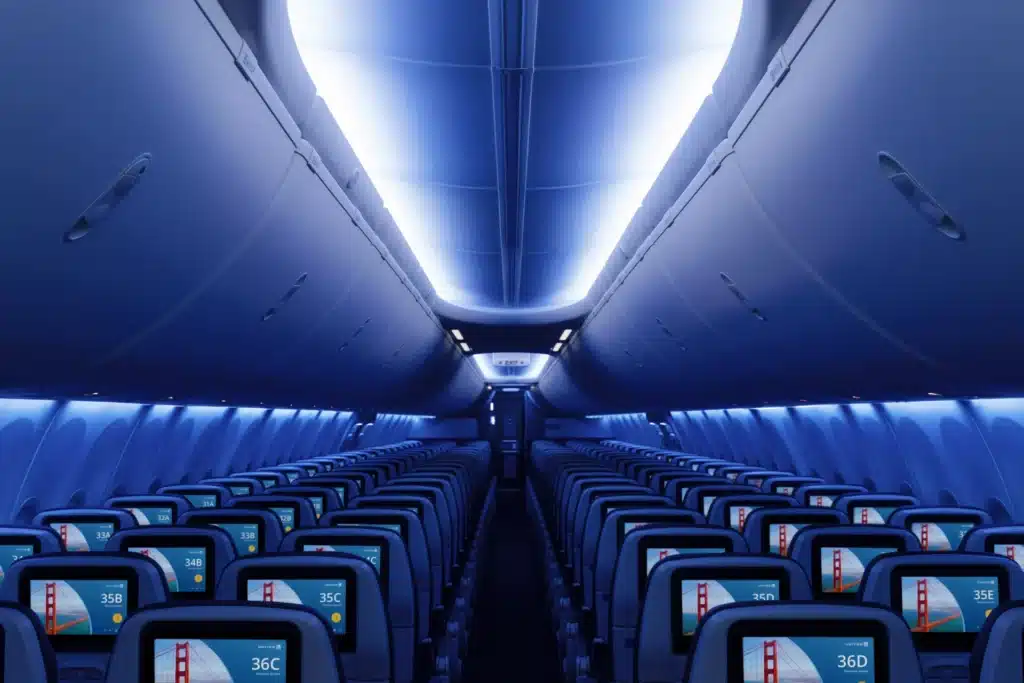
The A321XLR’s Airspace cabin features larger overhead bins, improved LED lighting, and better stowage flexibility. These details matter significantly when passengers spend 8+ hours aboard, though neither aircraft approaches widebody spaciousness.
Passenger Tolerance for Long Narrowbody Flights
Market research suggests passengers accept narrowbody aircraft on flights under 6 hours with minimal resistance. Beyond 6 hours, tolerance depends heavily on ticket price discounts versus widebody alternatives.
Airlines position A321XLR services at lower price points than widebody operations on equivalent routes, using cost advantages to offset comfort compromises. Business class cabins with lie-flat seats help, though narrowbody premium cabins remain inferior to widebody equivalents.
Cabin Pressure and Air Quality
The A321XLR maintains 6,500-foot cabin altitude at cruise, slightly lower than the 737 MAX 10’s 7,000-foot pressure. This 500-foot difference reduces passenger fatigue marginally on ultra-long sectors.
Both aircraft feature advanced air filtration, though neither matches the enhanced humidity control of composite widebodies like the A350 or 787. Passengers flying A321XLR transatlantic services report typical narrowbody dryness.
Fuel Efficiency & Operating Economics
Operating economics determine which aircraft airlines choose for specific route structures, with fuel efficiency varying dramatically by sector length.

Fuel Burn Analysis by Route Length
The A321XLR burns approximately 2,450 liters per hour during cruise on long-range missions, translating to roughly 13.5 liters per passenger per hour with 182 passengers aboard. This represents approximately 30% better efficiency than comparable widebody alternatives on thin routes.
The 737 MAX 10’s fuel consumption varies by range. On shorter sectors (1,000-2,000 nm), the MAX 10 achieves excellent efficiency approaching or exceeding A321XLR performance. The MAX 10’s lighter weight and optimized systems favor short/medium-haul operations.
On 3,000+ nautical mile routes, the A321XLR’s purpose-built design delivers substantial advantages. The aircraft operates closer to optimal cruise weight throughout flight as fuel burns down, while the MAX 10 approaches its operational limits with minimal reserves.
Cost per Available Seat Mile (CASM)
CASM—measuring operating cost per seat per mile—determines route profitability more than any other metric. The A321XLR achieves lower CASM on routes exceeding 3,000 nautical miles due to fuel efficiency and optimal capacity for thin long-haul markets.
The 737 MAX 10 excels on high-density short/medium-haul routes where 230-passenger capacity spreads fixed costs across more seats. Domestic U.S. transcons, intra-European flights, and short Asian routes favor MAX 10 economics.
Airlines must calculate CASM for specific route networks rather than assuming one aircraft dominates universally. An airline operating primarily 2,000-mile sectors might prefer MAX 10 capacity and efficiency, while a carrier targeting 4,000-mile routes needs A321XLR range capability.
Acquisition Costs and Financing
The 737 MAX 10’s lower list price (~$135 million) versus the A321XLR (~$142 million) provides capital cost advantages, though airlines negotiate substantial discounts from list prices.
Operating lease rates for A321XLRs exceed 737 MAX 10 quotes (when available), but lessors recognize the XLR’s unique capabilities command premium pricing. Airlines unable to access specific routes without XLR range pay accordingly.
Airline Network Strategy & Use Cases
Network planning determines aircraft selection, with route structure and competitive positioning driving fleet decisions.
Long-Thin Route Strategy
The A321XLR enables entirely new route categories previously uneconomical. Secondary European cities to U.S. destinations, Asian capitals to secondary Australian cities, and intra-Asia long sectors all become viable with narrowbody economics and appropriate range capability.
Examples of A321XLR-enabled routes:
Dublin to Minneapolis (3,360 nm), Hamburg to Boston (3,320 nm), Copenhagen to Los Angeles (4,670 nm), and Bangalore to London (4,480 nm) represent markets with sufficient demand for 180-200 passengers but insufficient volume to justify widebody deployment.
Airlines launching these routes generate new revenue rather than competing for existing traffic. Passengers previously connecting through hubs fly nonstop, while airlines avoid the complexity and cost of hub operations.
Hub-Bypass Strategy
The A321XLR accelerates hub-bypass strategies allowing airlines to connect secondary cities directly without routing passengers through major hubs. This approach reduces travel time, improves passenger experience, and captures point-to-point demand inefficiently served by connecting itineraries.
Low-cost carriers particularly benefit from A321XLR capabilities. JetBlue operates A321LR variants (shorter-range predecessors) on transatlantic routes from Boston and New York to Europe. The XLR extends this strategy to more city pairs and longer distances.
Widebody Replacement on Thin Routes
Airlines operating widebodies on thin intercontinental routes face challenging economics. A Boeing 777 or A330 carrying 180 passengers burns fuel for 300-350 seats, creating substantial per-seat cost penalties.
The A321XLR replaces widebodies on these routes, matching actual demand with appropriate capacity. Airlines redeploy widebodies to higher-demand routes where larger capacity generates better revenue and profitability.
737 MAX 10 Network Applications
The 737 MAX 10 serves different strategic purposes. Airlines operating dense domestic networks, short international sectors, and high-frequency routes benefit from MAX 10 capacity without requiring extended range capability.
United Airlines ordered 737 MAX 10s primarily for domestic operations where the aircraft’s 230-seat capacity improves slot utilization at congested airports. Southwest Airlines evaluates MAX 10s for high-density routes like Las Vegas to anywhere.
Why Airlines Are Choosing the A321XLR Over 737 MAX 10
Order books reveal airline preferences, with the A321XLR attracting 500+ orders versus approximately 200 for the 737 MAX 10.
Range Capability as Decisive Factor
Airlines prioritizing network expansion through long-thin routes choose A321XLRs almost exclusively. The aircraft’s 4,700-nautical-mile range opens markets the MAX 10 cannot serve, providing competitive advantages that justify higher acquisition costs.
Iberia, Aer Lingus, JetBlue, and other carriers specifically order A321XLRs to launch transatlantic routes from secondary cities. These airlines recognize the MAX 10’s 3,300 nm range eliminates most target routes from consideration.
Certification Delays Impact MAX 10 Appeal
The 737 MAX 10’s certification delays create uncertainty for airline planning. Aircraft ordered years ago remain undelivered, forcing carriers to adjust network strategies or substitute alternative aircraft temporarily.
Airlines facing immediate narrowbody needs for long-haul expansion order A321XLRs because the aircraft entered service in 2024. The MAX 10’s delayed timeline pushes deliveries into late 2025 or beyond, creating competitive disadvantages.
Fleet Commonality Considerations
Existing fleet composition influences aircraft selection significantly. Airlines operating A320neo family aircraft benefit from pilot type rating commonality, maintenance synergies, and parts inventory efficiencies when adding A321XLRs.
Similarly, 737 operators naturally favor MAX 10s for fleet commonality benefits. However, the range limitation forces some 737 operators to consider A321XLRs when route networks require long-range narrowbody capability.
Limitations & Trade-Offs of Each Aircraft
Neither aircraft perfectly suits all missions, with design compromises creating operational limitations.
A321XLR Limitations
The Rear Center Tank reducing cargo capacity represents the A321XLR’s primary trade-off. Airlines must restrict checked baggage on ultra-long routes or reduce passenger capacity to accommodate realistic luggage volumes.
Passenger fatigue on 9-hour narrowbody flights generates complaints regardless of cabin quality. Some travelers refuse to book A321XLR services on principle, preferring widebody comfort even at higher ticket prices.
The A321XLR’s higher purchase price and operating costs on short/medium-haul routes make it uneconomical for sub-3,000 nm operations where standard A321neos or 737 MAX 9s deliver better efficiency.
737 MAX 10 Limitations
The range limitation fundamentally constrains MAX 10 applications. Airlines seeking to operate transatlantic routes beyond East Coast-Western Europe corridors cannot use the aircraft regardless of demand or economic attractiveness.
Certification delays create planning uncertainty and potentially push customers toward A321neo family alternatives. Airlines needing capacity expansion immediately cannot wait for MAX 10 deliveries of unknown timing.
The 737 MAX brand challenges following the MAX 8 crashes persist, with some passengers and airlines remaining wary of the program. While technically resolved through certification changes, reputational damage lingers in certain markets.
Future of Long-Range Narrowbody Aviation
Long-range narrowbody operations represent aviation’s future, with technological advances and changing passenger preferences driving continued evolution.
The A321XLR establishes capabilities that future designs will improve upon. Airlines and manufacturers gain operational data about passenger acceptance of 9+ hour narrowbody flights, informing next-generation aircraft development.
Boeing may develop a long-range 737 MAX variant if market demand justifies investment. Alternatively, an all-new narrowbody design could address range limitations while incorporating advanced technology beyond MAX capabilities.
Environmental pressures favor narrowbodies over widebodies on thin routes. A single-aisle aircraft burning 30% less fuel per passenger than widebody alternatives helps airlines meet carbon reduction targets while serving emerging markets.
Frequently Asked Questions
Is the Airbus A321XLR better than the Boeing 737 MAX 10?
The Airbus A321XLR is better for long-range operations, offering 4,700 nautical miles range versus the 737 MAX 10’s 3,300 nm. The A321XLR enables transatlantic routes from secondary cities and widebody replacement on thin intercontinental sectors. The 737 MAX 10 excels at high-capacity short/medium-haul operations where its 230-seat capacity and lower costs outweigh range limitations.
Can the Boeing 737 MAX 10 fly transatlantic?
The 737 MAX 10 can operate limited transatlantic routes from U.S. East Coast to Western Europe—New York to London (3,000 nm) or Boston to Paris (3,050 nm)—at maximum range limits. It cannot serve most transatlantic city pairs including West Coast to Europe, Central U.S. to Europe, or longer European routes. Headwinds or diversions could push these flights beyond safe fuel reserves.
Why do airlines prefer the A321XLR over the 737 MAX 10?
Airlines prefer the A321XLR when targeting long-thin route expansion requiring 4,000+ nautical mile capability. The aircraft’s purpose-built design with Rear Center Tank enables markets impossible for 737 MAX 10 operations. The A321XLR’s 500+ order book versus MAX 10’s 200 orders reflects airline priorities for network flexibility and ultra-long narrowbody capability.
Is the Boeing 737 MAX 10 delayed?
Yes, the 737 MAX 10 faces significant certification delays. Originally expected in 2023, deliveries now target late 2025 or potentially 2026. Delays stem from FAA certification requirements following 737 MAX 8 crashes and ongoing scrutiny of Boeing manufacturing and safety processes. Airlines with MAX 10 orders await regulatory approval before receiving aircraft.
Which aircraft replaces widebodies on thin long-haul routes?
The Airbus A321XLR specifically targets widebody replacement on thin intercontinental routes where passenger demand supports 180-200 passengers but insufficient traffic justifies widebody economics. Routes like secondary European cities to U.S. destinations previously operated with 250-300 seat widebodies now utilize A321XLR’s appropriate capacity at substantially lower operating costs.
What is the range difference between A321XLR and 737 MAX 10?
The Airbus A321XLR range of 4,700 nautical miles exceeds the Boeing 737 MAX 10’s 3,300 nautical miles by 1,400 nm. This 42% range advantage enables entire route categories impossible for MAX 10 operations including most transatlantic city pairs beyond East Coast-Western Europe and transpac routes requiring extended overwater capability.
Which aircraft is more fuel efficient, A321XLR or 737 MAX 10?
Fuel efficiency depends on route length. The 737 MAX 10 achieves better efficiency on short/medium routes (500-2,500 nm) where lighter weight and optimized systems favor Boeing’s design. The A321XLR delivers 30% better per-seat efficiency on routes exceeding 3,000 nm where purpose-built long-range design and optimal cruise performance overcome MAX 10 advantages.
Can the A321XLR operate profitable transatlantic routes?
Yes, the A321XLR enables profitable transatlantic operations on long-thin routes with sufficient demand for 180-200 passengers but insufficient traffic for widebody aircraft. The narrowbody’s lower operating costs and appropriate capacity make routes like secondary European cities to U.S. destinations economically viable where widebodies would lose money due to excess capacity.
What are the main limitations of the 737 MAX 10?
The 737 MAX 10’s primary limitation is insufficient range for true long-haul operations, restricting the aircraft to routes under 3,300 nautical miles. Certification delays create delivery uncertainty for airlines requiring near-term capacity. The MAX 10 also faces brand perception challenges in certain markets following earlier MAX 8 safety issues, though technical problems are resolved.
Which airlines operate the Airbus A321XLR?
Iberia became the first A321XLR operator in November 2024, deploying the aircraft on transatlantic routes from Madrid to Boston and other U.S. destinations. Aer Lingus, JetBlue, Qantas, Wizz Air, and numerous other carriers have A321XLR orders with deliveries ramping throughout 2025-2028. Airlines prioritize long-thin route expansion and widebody replacement as primary XLR applications.