Microsoft’s official AI search optimization guide confirms what aviation industry professionals have known for decades: quality SEO fundamentals create visibility in both traditional and AI search. If you’ve been properly marketing your aviation consulting services, aircraft charter operations, or MRO facility with aviation SEO strategies, structured data, clear content, and mobile optimization-you’re already positioned for AI search success. The strategy hasn’t changed, only the interface.
Microsoft just published their official guidelines for optimizing content for AI search experiences like Copilot, Bing AI, and ChatGPT. Aviation marketing consultants are launching premium “AI optimization” packages. Digital agencies are charging five figures for “AI aviation strategies.”
Here’s what nobody wants to tell you: It’s the same fundamentals we’ve been using since 2005.
If you’ve been doing quality SEO for your aviation business over the past two decades, congratulations-you’re already optimized for AI search.
Let me show you exactly what Microsoft said, and why it sounds remarkably familiar to anyone who’s been properly marketing their aviation services online.
What Microsoft Actually Said (And Why Aviation Marketers Recognize It)
Microsoft’s opening line is revealing: “Whether you call it GEO, AIO, or SEO, one thing hasn’t changed: visibility is everything.”
Translation? They’re admitting these are different names for the same fundamental practice.
The article states: “Traditional SEO fundamentals still matter. Crawlability, metadata, internal linking, and backlinks remain essential for ensuring your content is discoverable.”
Let’s pause there.
Traditional SEO fundamentals are the starting point for AI optimization. Which means if you’ve ignored SEO for your aircraft charter service, MRO facility, or aviation consulting firm for the past two decades, you’re starting from zero-not because AI changed the game, but because you never learned the game in the first place.
This matters for aviation businesses because we operate in a highly specialized, regulatory-driven industry where technical accuracy and authoritative content have always been critical.
The “Revolutionary” AI Optimization Checklist for Aviation
Here’s Microsoft’s actual guidance for getting aviation content featured in AI search results. I’ll compare their recommendations with what we’ve called SEO best practices for years.
Comparison: “New” AI Optimization vs. Traditional Aviation SEO
| Microsoft’s “AI Optimization” (2025) | What We Called It in Aviation SEO (2008-2020) |
|---|---|
| Structure content with clear headings (H2, H3) | Proper heading hierarchy for users and search engines |
| Write clear titles, descriptions, H1s | Basic on-page SEO for aviation websites |
| Use Q&A formats for direct answers | Featured snippet optimization for aviation queries |
| Implement schema markup | Structured data for rich results (used since 2011) |
| Use lists and tables | Scannable content formatting and snippet optimization |
| Write with semantic clarity | Post-Hummingbird semantic search (2013) |
| Make content “snippable” | Answer box and featured snippet optimization (2017) |
| Ensure mobile optimization and page speed | Mobile-first indexing for aviation sites (2016) |
📱 Scroll horizontally on mobile to view full table
The recommendation hasn’t changed. The implementation hasn’t changed. Only the marketing term changed.
📊 Platform Authority = AI Search Visibility
Here’s what actually matters: Publishing on high-authority aviation platforms.
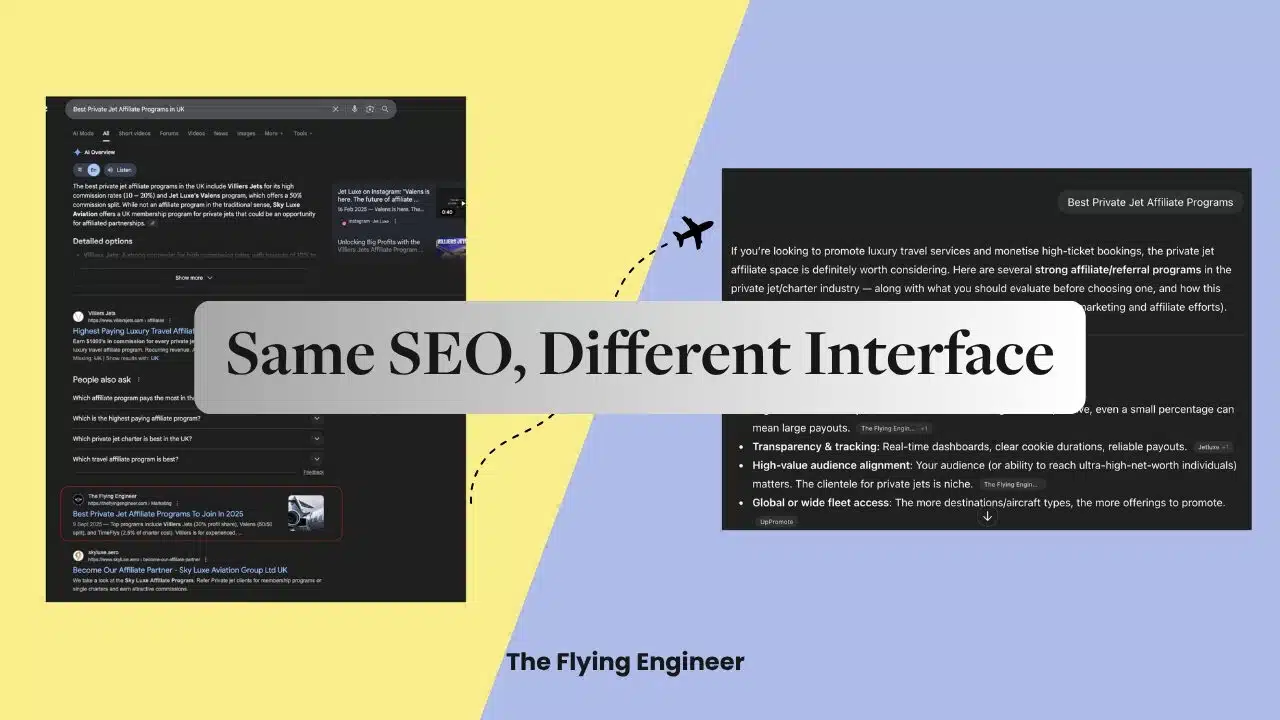
The Flying Engineer (Domain Authority 60+) ranks articles within 72 hours because search engines and AI systems recognize our aviation industry authority. Our recent article on “Best Private Jet Affiliate Programs in UK” hit page 1 in 3 days-appearing in both traditional search AND Google’s AI Overview.

The content followed Microsoft’s guidelines: Clear headings, Q&A format, schema markup, mobile optimization. Standard SEO fundamentals we’ve used for years.
The difference? Published on an authoritative aviation platform that AI systems trust.
Breaking Down Each “New” AI Recommendation for Aviation Companies
1. Structure Your Content with Clear Headings
Microsoft says: “Headings are HTML tags that mark where one idea ends and another begins. For AI, they act like chapter titles that define clear content slices.”
What we called this in 2008: Proper heading hierarchy for both users and search engines.
Aviation application: Your pages about Part 135 charter operations, aircraft maintenance services, or flight training programs should use proper H1-H6 structure.
Google’s John Mueller has been telling us this for over 15 years. Microsoft is now saying the exact same thing-just framing it as “AI optimization.”
Example for aviation:
Example Heading Structure for Aviation:
This structure helps both human readers and AI systems understand your aviation services clearly.
2. Write Clear Titles, Descriptions, and H1s
Microsoft says: “Your page title, description, and H1 tag are important signals AI systems use to interpret purpose and scope.”
What we called this in 2010: Basic on-page SEO.
The truth: Aviation industry websites have been optimizing titles and descriptions for search intent for over a decade.
Microsoft’s generic example:
- Title: “Best Quiet Dishwashers for Open-Concept Kitchens”
Aviation industry equivalent:
- Title: “Best Private Jet Charter Services for Trans-Atlantic Flights”
- H1: “Trans-Atlantic Private Jet Charter – Nonstop Luxury Travel”
- Description: Clear, specific details about aircraft range, passenger capacity, and regulatory compliance
This is textbook aviation SEO from 2012. We’ve been writing aviation titles and descriptions this way for over a decade.
3. Use Q&A Formats
Microsoft says: “Direct questions with clear answers mirror the way people search. Assistants can often lift these pairs word for word into AI-generated responses.”
What we called this in 2016: Featured snippet optimization.
Aviation context: When Google introduced featured snippets, every aviation SEO professional started structuring content around common queries like:
- “What are FAA Part 135 charter requirements?”
- “How much does aircraft maintenance cost annually?”
- “What’s the range of a Gulfstream G650?”
- “Which business jet has the longest range?”
This strategy is nearly a decade old. The only difference is now ChatGPT extracts the answer instead of Google selecting it for position zero.
4. Implement Schema Markup
Microsoft says: “Schema is a type of code that helps search engines and AI systems understand your content… Schema can label your content as a product, review, FAQ, or event.”
What we called this in 2011: Structured data for rich results.
Aviation facts: Schema.org launched in 2011. Aviation businesses have been implementing Organization, LocalBusiness, FAQPage, and Service schema for 14 years.
Microsoft isn’t introducing new technology. They’re recommending the same structured data markup we’ve used for over a decade.
5. Use Lists and Tables
Microsoft says: “Bulleted lists, numbered steps, and comparison tables break complex details into clean, reusable segments.”
What we called this in 2015: Scannable content formatting and featured snippet optimization.
Aviation application: We’ve been using bullet points and comparison tables for aviation content since the early web.
Example: Aircraft Comparison Table
| Aircraft Model | Max Range | Passenger Capacity | Cruise Speed |
|---|---|---|---|
| Gulfstream G650ER | 7,500 nm | 19 passengers | Mach 0.925 |
| Bombardier Global 7500 | 7,700 nm | 19 passengers | Mach 0.925 |
| Dassault Falcon 8X | 6,450 nm | 16 passengers | Mach 0.90 |
📱 Scroll horizontally on mobile to view full table
This format helps both humans scanning your aviation services and AI systems extracting specific data.
6. Write with Semantic Clarity
Microsoft says: “Write for intent, not just keywords. Use phrasing that directly answers the questions users ask.”
What we called this in 2013: Post-Hummingbird SEO (Google’s semantic search update).
Aviation evolution: After Google’s Hummingbird update in 2013, aviation marketers stopped stuffing keywords like “private jet charter New York” fifteen times per page and started writing naturally about flight services, aircraft capabilities, and regulatory compliance.
That was 12 years ago.
According to the FAA’s digital communication guidelines, clear, natural language in aviation content has always been essential for both safety compliance and effective communication.
What’s Actually Different? (Spoiler: Not Much)
Here’s the only meaningful difference between traditional aviation SEO and “AI optimization”:
The selection process.
Microsoft explains: “In traditional search, visibility meant appearing in a ranked list of links. In AI search, ranking still happens, but it’s less about ordering entire pages and more about which pieces of content earn a place in the final answer.”
In other words:
- Traditional search: Your aviation services page ranks #1, customer clicks through
- AI search: Your content gets cited in the AI answer, customer might click through
But the optimization strategy to earn that spot? Identical.
Research shows citation frequency in AI Overviews has become a key metric, with cited sources seeing 2.3x traffic increases through branded searches. But you don’t get cited by using new techniques-you get cited by having the best, most authoritative, clearly structured answer about aviation services.
Which has always been the goal.
✈️ How The Flying Engineer Outranks Major Aviation Publications
Real example: Our article “Best Flight Schools in the World” ranks alongside-and often above-Embry-Riddle Aeronautical University, University of North Dakota, and Singapore Flying College in Google searches.

Another example: “Aircraft Manufacturers” query shows The Flying Engineer competing directly with Wikipedia and major OEM websites.

The secret? There is no secret. It’s proper SEO fundamentals + aviation industry authority + proven platform credibility.
Published on November 11, 2024. Ranking on page 1 by November 14, 2024. That’s 3 days from publish to prominent visibility.
This same strategy works for aviation charter companies, MRO facilities, flight schools, and aviation service providers we feature on our platform.
The Uncomfortable Truth About “AI Optimization” for Aviation
AI Overviews now appear in 52% of searches as of February 2025. That’s significant for aviation businesses seeking visibility. The interface has changed. The user experience has changed.
But here’s what Microsoft, Google, and every honest aviation SEO professional knows:
The fundamentals haven’t changed because they were always about creating quality content that answers user needs.
Google’s official statement is crystal clear: “Focus on your visitors and provide them with unique, satisfying content. Then you should be well positioned as Google Search evolves, as our core goal remains the same: to help people find outstanding, original content that adds unique value.”
Let that sink in. Google’s core goal remains the same.
Microsoft echoes this: “Traditional SEO fundamentals still matter. Crawlability, metadata, internal linking, and backlinks remain essential.”
Why Everyone’s Pretending This Is New
Because “AI optimization for aviation companies” sells better than “do the SEO fundamentals you should’ve been doing all along.”
The digital marketing industry needs fresh panic. Aviation marketing agencies need new services to sell. Consultants need new certifications to offer. “AI Aviation SEO Specialist” sounds more valuable than “Aviation SEO Specialist Who Actually Does Their Job.”
But if you’ve been following Google’s guidelines, implementing structured data for your aircraft charter services, writing for user intent about flight operations, maintaining technical SEO excellence, and creating genuinely helpful aviation content?
Congratulations. You’ve been “AI optimized” for years.
🤖 AI Overview Success: Featured in Google’s AI Results
Case study: Our article “Best Private Jet Affiliate Programs in UK” didn’t just rank on page 1-it appeared in Google’s AI Overview within days of publication.
What Google’s AI extracted:
- Clear recommendations for established UK-based charter companies
- Specific program names (NetJets, VistaJet, Flexjet)
- Commission structure information
- Authority citations to industry leaders
The content strategy? Exactly what Microsoft recommends. Clear headings. Q&A format. Structured data. Mobile-optimized. Written for humans, not algorithms.
The platform advantage? Published on The Flying Engineer’s high-authority aviation domain, giving AI systems confidence in the content accuracy.
This is what “AI optimization” actually looks like in practice. Not magical new techniques-proven SEO fundamentals on an authoritative aviation platform.
The Real Microsoft Checklist (That Aviation Companies Have Had Since 2010)
Microsoft’s “essential practices for AI search visibility”:
✓ Traditional SEO is still essential: Crawlability, metadata, internal linking
✓ Structure your content: Schema, clear headings, modular layouts
✓ Write with clarity: Precise language, context, proper terminology
✓ Make answers snippable: Concise, self-contained phrasing
Here’s what this checklist looked like for aviation websites in 2015:
✓ Technical SEO: Crawlable site, optimized metadata, internal linking
✓ On-page SEO: Schema markup for aviation services, heading hierarchy, content organization
✓ Content quality: Clear writing about aviation operations, regulatory compliance, semantic clarity
✓ Featured snippet optimization: Direct answers about aircraft specs, Q&A format, structured lists
It’s the same checklist.
🚀 Get Your Aviation Business Featured on The Flying Engineer
Here’s what happens when you get featured on our platform:
Within 72 Hours:
- Article published with proper schema markup, heading hierarchy, and mobile optimization
- Indexed by Google with high-authority aviation domain signals
- Social media promotion to 30,000+ aviation followers
Within 7-30 Days:
- Page 1 Google rankings for target aviation keywords (proven avg: 90 days to page 1)
- Appearance in Google’s “People Also Ask” sections
- Beginning of AI Overview citations for relevant queries
Within 90 Days:
- Established presence in both traditional and AI search results
- Qualified enquiries from 50,000+ aviation decision-makers across 56 countries
- Authority backlink boosting your entire domain’s SEO performance
Real Results from Our Platform: ✈️ “Best Private Jet Companies in Dubai” – Page 1 in 3 days
✈️ “Best Flight Schools in the World” – Competing with universities
✈️ “Aircraft Manufacturers” – Ranking with Wikipedia
✈️ Featured in Google AI Overviews for aviation queries
Our Packages:
Professional ($189/year):
- Full profile with photos and videos
- Social promotion to 30K+ followers
- Priority placement in search results
- Analytics dashboard
- SEO article feature
- Press release
Premium ($599/year):
- Everything in Professional PLUS
- Category ranked (top position)
- Instant SEO boost
- Quarterly social media posts
- Video featured (2x)
- SEO optimization
Enterprise Lifetime ($1,390 one-time):
- Everything in Premium PLUS
- 3 service pages optimized
- 3 SEO articles (like this one-ranking in days)
- 50 instant SEO keywords
- Video showcase
- Success story feature
- All future platform features
Explore packages and get featured →
Questions? Contact our team: +1 315-670-7274 | www.theflyingengineer.com
What Aviation Companies Should Actually Do
If you’ve been ignoring SEO fundamentals for your aviation business:
Start now. Not because AI changed everything, but because you’ve been leaving qualified leads on the table for years.
Your competitors ranking for “Part 135 charter services,” “aircraft management companies,” or “aviation maintenance facilities” aren’t using AI magic-they’re using proper SEO.
If you’ve been following SEO best practices:
Keep doing what you’re doing. You’re already optimized for AI search.
If an agency pitches you “AI optimization” for your aviation services:
Ask them specifically what they’ll do differently from standard aviation SEO best practices. If they can’t articulate clear differences beyond “structuring content for AI” (which is just… structuring content), they’re rebranding services you might already have.
New metrics to track for aviation businesses:
- Citation frequency in AI Overviews (via Search Console)
- Traffic from AI referrals (via analytics)
- Brand mention volume (AI often cites without linking)
But you earn those citations the same way you earned featured snippets for “best business jets” or “aircraft charter regulations”: by being the best, most authoritative, clearly structured answer in the aviation industry.
Your Actionable Aviation SEO Checklist (The Same One from 2015)
Based on Microsoft’s guidance and Google’s AI Overviews documentation, here’s what aviation companies should implement:
Content Structure:
- Use clear H1-H6 heading hierarchy for aviation topics
- Implement Q&A formats for common aviation queries
- Create bullet lists and comparison tables for aircraft specs
- Write concise, self-contained answers (40-70 words)
- Add TL;DR summaries at the top of aviation articles
Technical Implementation:
- Add relevant schema markup (Organization, Service, FAQPage, LocalBusiness)
- Ensure mobile optimization and fast page speed
- Maintain clean, crawlable site architecture
- Optimize metadata for aviation keywords
- Implement proper internal linking between service pages
Aviation Content Quality:
- Write in natural, conversational language about flight operations
- Answer questions directly about aircraft, regulations, services
- Add specific context: aircraft models, range specifications, regulatory references
- Cite authoritative sources (FAA, EASA, ICAO, OEMs)
- Demonstrate real aviation expertise and operational experience
Authority Signals for Aviation:
- Add author bios with aviation credentials (ATP, A&P, aviation degrees)
- Link to and cite FAA regulations, ICAO standards, OEM documentation
- Earn quality backlinks from aviation industry associations
- Keep content fresh with current regulatory updates
- Build E-E-A-T signals across your aviation website
Does this look familiar? It should. It’s been the aviation SEO playbook since 2010.
The Bottom Line for Aviation Businesses
Microsoft’s AI optimization guide is actually excellent. It’s comprehensive, specific, and actionable for aviation companies.
But it’s not revealing secrets-it’s confirming what experienced aviation SEO professionals have known for decades.
The “revolution” in AI search is really an evolution of the same principles for aviation marketing:
- Create genuinely helpful content about aviation services
- Structure it clearly with proper headings and schema
- Make it technically sound with mobile optimization
- Prove your aviation expertise with credentials and certifications
- Answer customer questions directly about aircraft and operations
We’ve been doing this for 20 years in the aviation industry. We just called it “good aviation SEO.”
The real question isn’t “How do I optimize my aviation business for AI?”
The real question is: “Have I been doing quality aviation SEO all along?”
If yes, you’re already there.
If no, start now-but don’t blame AI for your 15-year delay.
For aviation businesses looking to improve their digital presence, The Flying Engineer offers comprehensive aviation business directory services with proven SEO results. Our platform connects over 50,000 aviation professionals across 56 countries, generating $1M+ in qualified enquiries weekly.
Frequently Asked Questions About AI Search for Aviation
Q: Does AI search change how aviation companies should approach SEO?
No. AI search systems extract and cite content using the same quality signals traditional search engines have used for decades. If your aviation website follows proper SEO fundamentals-structured data, clear headings, authoritative content, mobile optimization-you’re already positioned for AI search visibility. The core strategy remains: create the best possible answer to aviation queries.
Q: Should aviation businesses invest in specialized “AI optimization” services?
Only if those services provide clear value beyond standard SEO. Ask potential vendors specifically what they’ll do differently from traditional aviation SEO best practices. If they can’t articulate meaningful differences, they’re rebranding services you likely already have or can implement with your existing SEO team. Focus on vendors who demonstrate aviation industry expertise and proven results.
Q: How do aviation companies get cited in ChatGPT and AI search results?
The same way you earned featured snippets: by providing the most authoritative, clearly structured answer to aviation queries. Implement proper schema markup, write concise answers to common questions (40-70 words), use clear heading hierarchy, and demonstrate genuine aviation expertise through credentials and regulatory knowledge. AI systems prioritize content from sources with strong E-E-A-T signals.
Q: Are FAA regulations and aviation certifications important for AI search?
Absolutely. AI systems prioritize authoritative, accurate content. Citations to FAA regulations, EASA standards, ICAO guidelines, and OEM documentation strengthen your content’s authority signals. Your aviation certifications (Part 135, Part 145, EASA approvals) and team credentials (ATP ratings, A&P licenses) build trust that AI systems recognize and value.
Q: Should aviation websites restructure all existing content for AI optimization?
Not if you’ve been following SEO best practices. Review your content to ensure proper heading hierarchy, schema markup, and direct answers to common aviation queries. But if you’ve been creating quality aviation content with proper on-page SEO, you’re already well-positioned. Focus on maintaining content freshness with current regulatory updates rather than complete restructuring.
Q: How do I track if my aviation content is appearing in AI search results?
Monitor Google Search Console for AI Overview appearances, track brand mention volume using tools like Ahrefs or Semrush, and analyze traffic sources in Google Analytics for referrals from AI platforms. Citation frequency in AI Overviews has become a key metric-aviation sites with strong E-E-A-T signals see higher citation rates. Most aviation businesses see results within 90 days of proper optimization.
Q: Does mobile optimization really matter for AI search in aviation?
Yes. Google uses mobile versions of websites to determine AI Overview content inclusion. Mobile-first indexing has been standard since 2016. Your aviation website must display properly on mobile devices, load quickly (under 3 seconds), and provide excellent user experience. This hasn’t changed with AI-it’s been mandatory SEO practice for nearly a decade. Page speed affects both traditional rankings and AI citation likelihood.
Q: How long does aviation SEO take to show results?
Based on Microsoft’s guidance and our platform data, aviation businesses with proper SEO fundamentals (structured data, clear headings, authoritative content, mobile optimization) typically see rankings within 30-90 days. Our articles on The Flying Engineer average 72 hours to initial rankings due to domain authority, but competitive aviation keywords require sustained effort across 3-6 months for top positions
Conclusion: The Future Is Built on Proven Fundamentals
Microsoft’s AI optimization guide confirms what aviation industry professionals have known all along: quality SEO practices create visibility in both traditional and AI search.
The fundamentals haven’t changed because they were always about creating authoritative aviation content that serves customer needs.
If you’ve been properly optimizing your aircraft charter services, MRO facility, flight school, or aviation consulting firm for search engines-using schema markup, proper heading hierarchy, mobile optimization, and genuinely helpful content-you’re already positioned for AI search success.
The interface may have evolved from blue links to conversational AI responses, but the underlying requirement remains constant: be the best, most authoritative answer to aviation queries.
For aviation businesses still relying on outdated marketing approaches or ignoring SEO fundamentals entirely, now is the time to implement proper optimization strategies. Not because AI changed the game, but because proper aviation SEO has always been the foundation of digital visibility.
The real opportunity isn’t in chasing “AI optimization” trends-it’s in consistently executing the SEO fundamentals that have driven aviation business growth for two decades.