
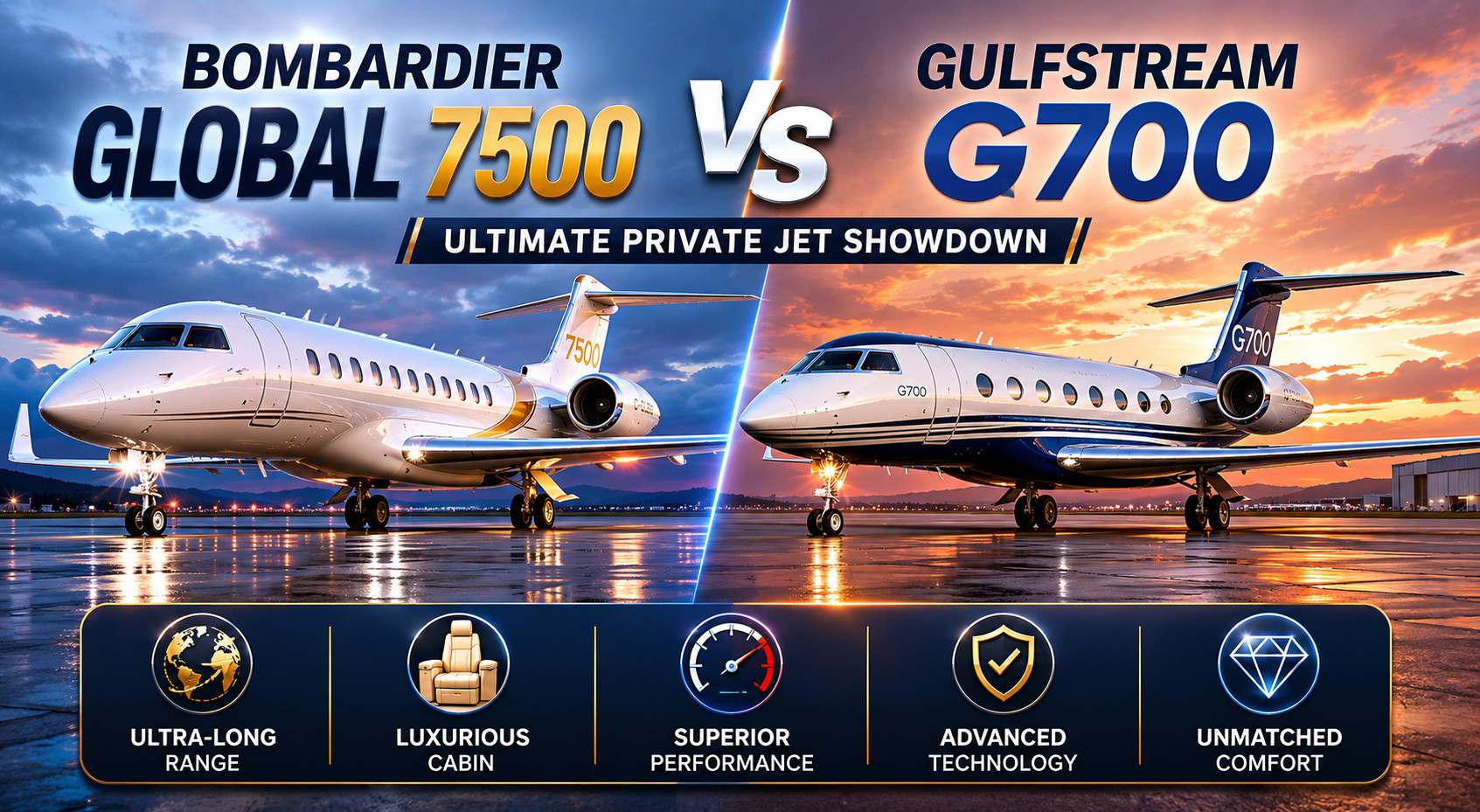
Ultra-long-range private jets have transcended transportation, becoming symbols of power, mobility, and uncompromising luxury for the world’s most influential individuals. At the apex of this elite category stand two titans: the Bombardier Global 7500 and the Gulfstream G700, aircraft that redefine expectations for private aviation.
The Global 7500 vs Gulfstream G700 debate dominates boardrooms, fractional ownership discussions, and aviation conferences where decisions involve eight-figure investments and operational considerations spanning decades. Both manufacturers bring industry-leading expertise to these flagships, creating aircraft that serve similar missions through remarkably different design philosophies.
This comparison examines cabin innovation, engineering excellence, operational capabilities, and the distinct approaches each manufacturer takes toward delivering the ultimate private aviation experience. Understanding which jet better serves specific needs requires looking beyond specification sheets to how these aircraft perform in real-world ultra-long-range missions.
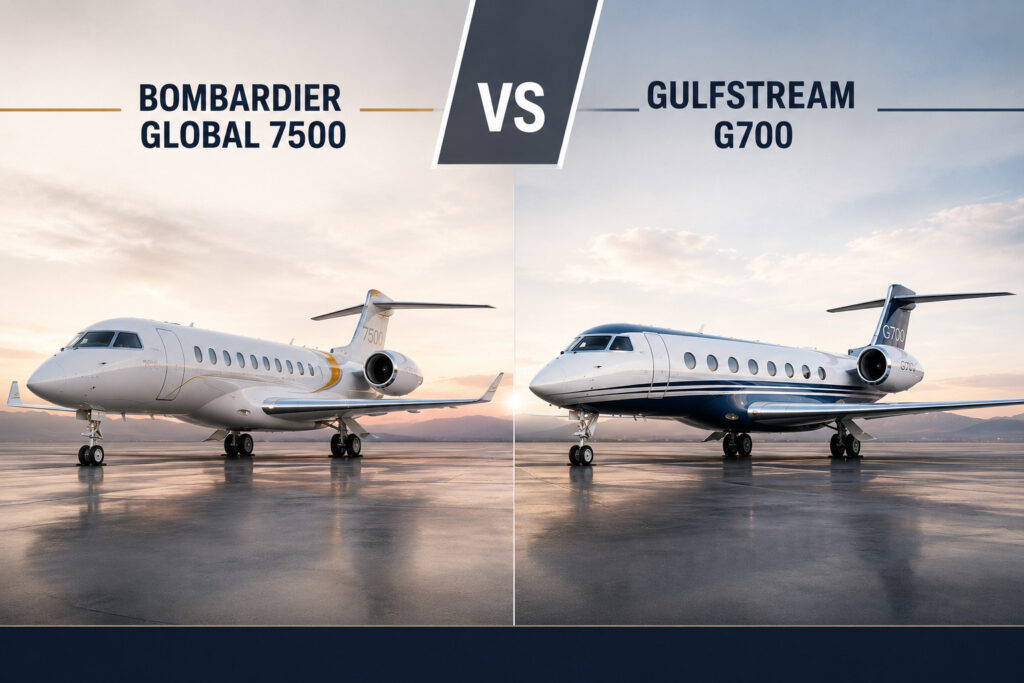
Meet The Two Kings Of Ultra-Long-Range Aviation
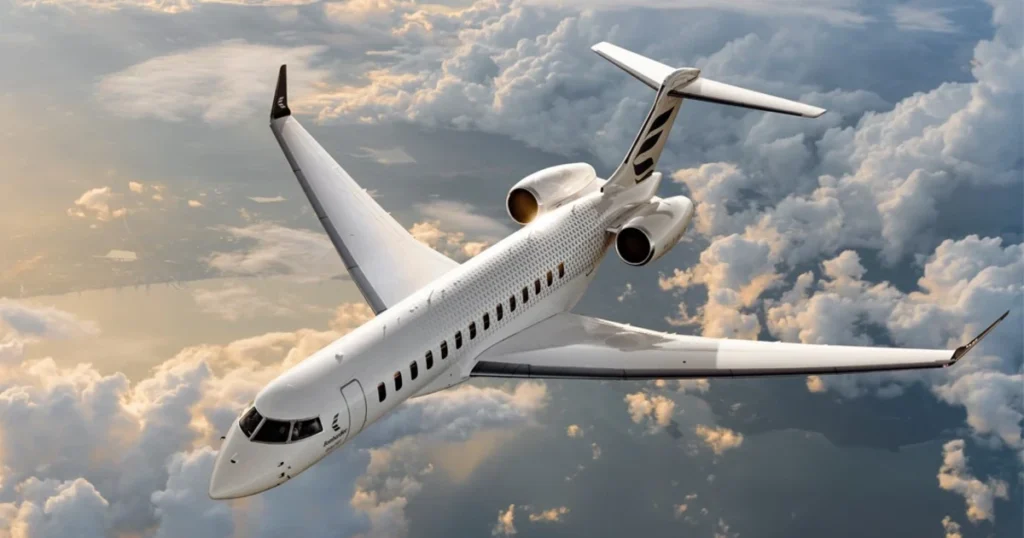
The Bombardier Global 7500 represents Canadian engineering at its finest, holding the current range record for purpose-built business jets at 7,700 nautical miles. Bombardier positions the Global 7500 as the industry’s most capable and innovative business jet, challenging Gulfstream’s decades-long market dominance.
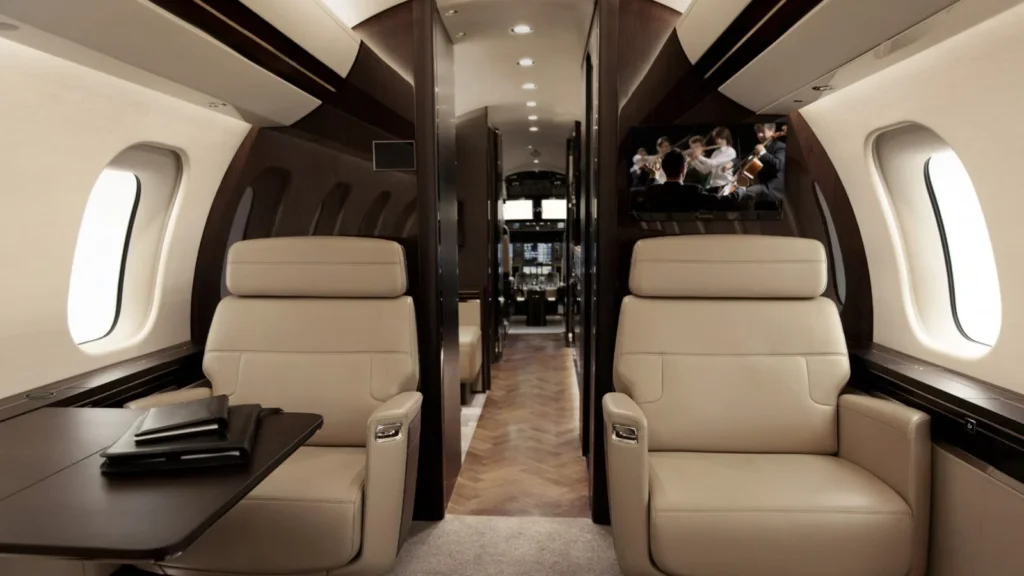
The Global 7500’s revolutionary four-zone cabin layout enables configurations impossible in conventional business jets. A dedicated crew suite, full-sized bedroom, conference room, and lounge create distinct living spaces throughout the flight. This compartmentalization appeals to buyers prioritizing privacy and functional separation during ultra-long missions.
Bombardier targets buyers valuing cutting-edge innovation, maximum range, and cabin layouts that mirror luxury residential spaces rather than simply offering expensive airplane interiors. The Global 7500 represents Bombardier’s statement that private aviation can evolve beyond traditional business jet conventions.
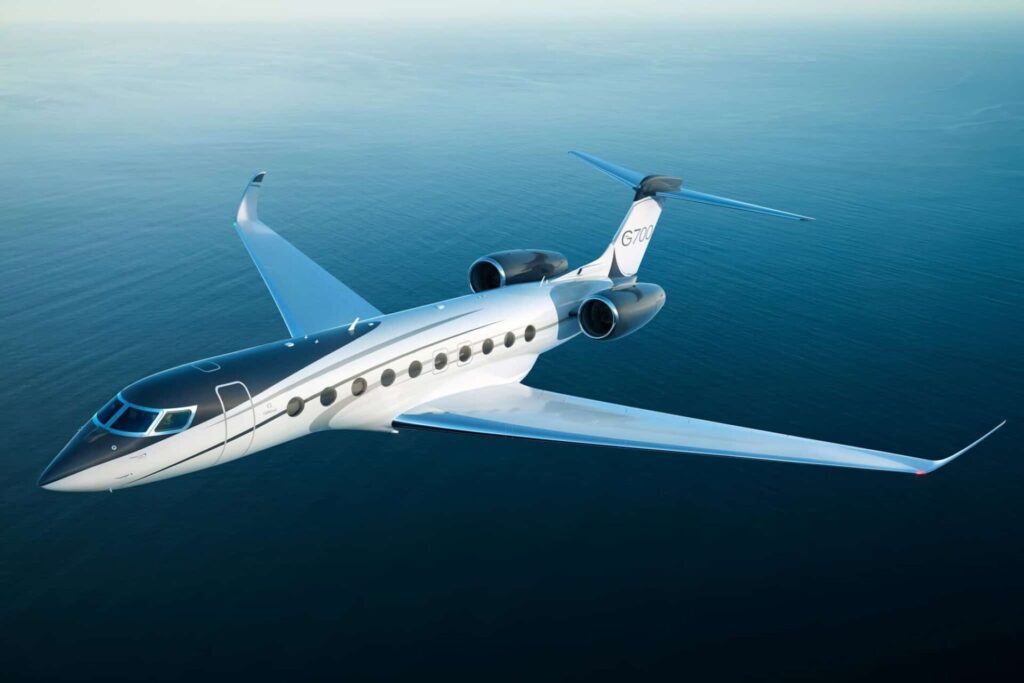
The Gulfstream G700 builds on the American manufacturer’s reputation as the gold standard in business aviation. Gulfstream emphasizes proven reliability, industry-leading cabin altitude, and the prestige associated with owning what Fortune 500 companies and heads of state consistently choose.
The G700 delivers 7,500 nautical miles range, speeds approaching Mach 0.925, and cabin technology that reduces passenger fatigue through lower cabin altitude and advanced environmental systems. Gulfstream focuses on refinement over revolution, perfecting the business jet formula through incremental innovation.
Both aircraft serve ultra-high-net-worth individuals, multinational corporations, and governments requiring nonstop global connectivity. The market remains large enough for both manufacturers to thrive, with buyers selecting based on operational priorities, brand loyalty, and specific mission requirements rather than clear superiority of one over the other.
Cabin Size And Luxury Comparison
Cabin design philosophy separates these competitors as distinctly as their specifications. The Bombardier Global 7500 pioneered the four-zone cabin concept, creating the most compartmentalized business jet interior available.
The Global 7500 cabin spans 54.4 feet length, 8.2 feet width, and 6.2 feet height, providing approximately 2,637 square feet of usable space. However, the revolutionary aspect isn’t dimensions but layout:
- Zone 1: Conference/dining area with full-size table seating six
- Zone 2: Entertainment lounge with theater seating
- Zone 3: Master bedroom suite with permanent bed and ensuite bathroom
- Zone 4: Dedicated crew rest area with separate lavatory
Solid doors separate zones, creating true privacy impossible in open-cabin layouts. The permanent bed in the master suite eliminates awkward divan-to-bed conversions, while the crew suite ensures staff remains fresh during ultra-long flights without intruding on passenger space.
Bombardier’s Nuage seating represents another innovation, featuring a deep recline mechanism that floats on a floating base, providing exceptional comfort during both work and rest. The zero-gravity position rivals first-class airline seats while maintaining the flexibility business jets require.
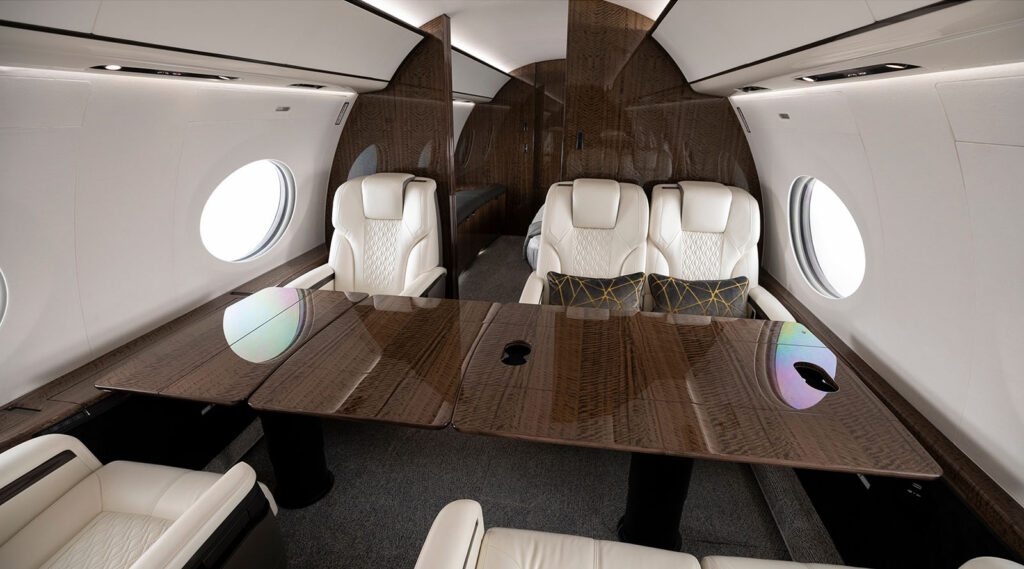
The Gulfstream G700 takes a different approach, maximizing open cabin flexibility while maintaining luxury. The G700 cabin measures 56.7 feet long, 8.2 feet wide, and 6.3 feet tall, offering approximately 2,806 square feet—slightly more total space than the Global 7500.
G700 layouts typically feature:
- Grand suite: Forward master bedroom with permanent bed
- 19 panoramic windows: Largest in business aviation, flooding cabin with natural light
- Five living areas: Flexible configurations adapting to mission needs
- Ultra-galley: Full kitchen capability for gourmet meal preparation
The G700 emphasizes spaciousness and light over compartmentalization. Gulfstream argues that open layouts provide better social interaction and visual connection throughout the cabin, important for family travel or executive teams working collaboratively during flights.
Both aircraft feature cinema-quality entertainment systems, high-speed Ka-band connectivity enabling video conferencing, and environmental controls creating comfortable atmospheres regardless of external conditions. The choice between them depends on whether buyers prioritize privacy through separation (Global 7500) or openness through connectivity (G700).
Which Jet Has Better Range?
Range capability defines ultra-long-range business jets, and here the Bombardier Global 7500 holds a clear, measurable advantage. Maximum range reaches 7,700 nautical miles, currently the longest of any purpose-built business jet in production.
This additional 200 nautical miles over the G700 unlocks specific mission profiles:
- Singapore to Los Angeles: 7,614 nm—the Global 7500 completes nonstop; the G700 requires favorable winds or fuel stops
- New York to Hong Kong: 7,990 nm—both aircraft require favorable winds, though the Global 7500 succeeds more reliably
- Dubai to New York: 6,850 nm—both complete comfortably with reserves
- London to Perth: 9,000 nm—neither aircraft covers this distance, representing current technology limits
The Global 7500 set the business aviation distance record flying from Singapore to Arizona nonstop, covering 8,152 nautical miles. This real-world demonstration proved capabilities exceed published specifications when conditions permit.
The Gulfstream G700 achieves 7,500 nautical miles at Mach 0.85 cruise, or 6,400 nautical miles at faster Mach 0.90. This flexibility allows passengers to choose between maximum range or minimum flight time depending on mission urgency.
For most business aviation missions, the 200-nautical-mile difference proves academic. Both aircraft cover virtually any realistic city pair nonstop, including routes like Los Angeles to London (5,400 nm), Dubai to Los Angeles (8,300 nm with stops), and Sydney to Los Angeles (6,500 nm).
The range advantage matters most at the extremes—trans-Pacific routes where every nautical mile counts, or missions requiring significant fuel reserves for weather diversions. For buyers prioritizing absolute maximum range above all else, the Global 7500 delivers measurable benefits.
Speed And Performance Comparison
The Gulfstream G700 dominates speed performance. Maximum cruise speed reaches Mach 0.925, making it one of the fastest civilian aircraft flying. Typical long-range cruise operates at Mach 0.85-0.90, allowing passengers to select speed versus fuel economy based on mission requirements.
This speed advantage translates to meaningful time savings on ultra-long missions. A New York to Dubai flight covers approximately 6,850 nautical miles. At Mach 0.90, the G700 completes the journey in roughly 13 hours. At Mach 0.85, the Global 7500 requires approximately 13 hours 45 minutes—a difference of 45 minutes.
Over hundreds of flights annually, those minutes compound. For executives managing global operations where time represents money, the cumulative savings justify the G700’s speed capability. However, the fuel penalty at higher Mach numbers reduces range, forcing tradeoffs between speed and distance.
The Bombardier Global 7500 cruises at Mach 0.85 maximum, prioritizing efficiency over absolute speed. Bombardier argues that few missions benefit from speeds exceeding Mach 0.85, especially considering the fuel burn increase and range reduction at higher speeds.
Runway performance slightly favors the Global 7500. Its balanced field length of approximately 5,800 feet enables operations from airports the G700 might find restrictive. The G700 requires roughly 6,250 feet, limiting access to some secondary airports serving private aviation.
Both aircraft operate efficiently at maximum altitude, certified to 51,000 feet. These altitudes enable flying above most weather and commercial traffic, improving ride quality and enabling more direct routing through less congested airspace.
Cockpit Technology And Pilot Experience
Cockpit philosophy reflects each manufacturer’s approach to aviation technology. The Bombardier Global 7500 features the Vision Flight Deck, combining Rockwell Collins Pro Line Fusion avionics with innovative features like synthetic vision, combined vision system (CVS), and extensive automation.
The Vision Flight Deck includes:
- Four large touchscreen displays: Primary flight, navigation, and systems information
- Combined Vision System: Enhanced and synthetic vision on primary displays
- Fly-by-wire flight controls: Reducing pilot workload through automation
- Predictive windshear detection: Enhanced safety during approach and departure
- Head-up display options: Available for enhanced situational awareness
Bombardier emphasizes intuitive interfaces that reduce training time and improve safety through logical system organization. The cockpit accommodates both experienced business jet pilots and those transitioning from smaller aircraft, with automation handling routine tasks while humans focus on decision-making.
The Gulfstream G700 employs the Symmetry Flight Deck, representing Gulfstream’s vision for next-generation cockpit design. This system combines touchscreen technology with traditional controls in what Gulfstream claims is the most advanced business jet cockpit available.
The Symmetry Flight Deck features:
- 10 touchscreens: Controlling all aircraft systems with intuitive interfaces
- Active control sidesticks: Providing tactile feedback between pilot stations
- Enhanced vision system: Synthetic vision with database-driven terrain awareness
- Predictive landing performance: Real-time runway requirement calculations
- Phase-of-flight intelligence: Presenting only relevant information contextually
Gulfstream emphasizes reducing pilot workload through intelligent automation that presents information when needed while hiding complexity during routine operations. The touchscreen interfaces respond faster than previous-generation controls while maintaining redundancy for critical functions.
Both cockpits represent significant advances over earlier business jets. The choice between them often depends on pilot preference rather than objective capability differences, with corporate flight departments typically selecting based on existing fleet commonality and pilot training infrastructure.
Passenger Comfort At High Altitude
High-altitude comfort separates ultra-luxury business jets from their smaller competitors. The Gulfstream G700 maintains industry-leading cabin altitude performance, a core competitive advantage Gulfstream invests heavily to maintain.
At 41,000 feet cruise altitude, the G700 cabin altitude reaches only 2,840 feet equivalent—lower than Denver’s elevation and significantly better than industry standards. At 51,000 feet maximum altitude, cabin altitude remains just 4,850 feet. This technology reduces passenger fatigue dramatically by maintaining higher oxygen partial pressure.
Passengers arrive fresher, think more clearly during flight, and experience reduced jet lag. For executives conducting business while airborne or arriving for critical meetings, this capability provides measurable competitive advantages justifying the aircraft’s substantial acquisition cost.
The G700 also delivers 100% fresh air every two minutes, never recirculating cabin air. Combined with plasma ionization removing airborne contaminants, the system creates one of the healthiest flying environments available. Humidity control maintains comfortable moisture levels rather than the desert-dry conditions affecting many aircraft.
The Bombardier Global 7500 matches typical business jet cabin altitude standards while emphasizing other comfort factors. Cabin altitude reaches approximately 4,850 feet at 41,000 feet cruise, comfortable though not matching Gulfstream’s industry-leading numbers.
Bombardier instead prioritizes cabin layout flexibility, noise reduction, and the Nuage seating system as primary comfort differentiators. The four-zone layout reduces noise transmission between areas, while the Nuage seats provide zero-gravity positioning impossible in conventional business jet seating.
The Global 7500 also features smooth ride technology reducing turbulence effects through active wing control surfaces. Sensors detect atmospheric disturbances and command control surface movements counteracting turbulence before passengers feel it, creating a noticeably smoother experience in rough air.
Both aircraft incorporate advanced climate control systems maintaining consistent temperature throughout cabins. Neither suffers the hot-spots or cold-zones common in older business jets with less sophisticated environmental systems, creating comfortable atmospheres regardless of external conditions or cabin location.
Engine Comparison
Engine selection represents fundamental philosophical differences between manufacturers. The Gulfstream G700 employs Rolls-Royce Pearl 700 engines producing approximately 18,250 pounds of thrust each.
Pearl 700 features include:
- Advanced fan blade design: Reducing noise while improving efficiency
- Low-pressure turbine: Derived from Rolls-Royce Trent commercial engine family
- Optimized for high-speed cruise: Maximum efficiency at Mach 0.85-0.90
- Digital engine control: Maximizing performance across all operating conditions
The Pearl 700 enables the G700’s superior speed performance while maintaining competitive fuel consumption. The engines provide ample thrust reserves for hot-and-high operations, critical for airports like Aspen or Mexico City where altitude and temperature reduce engine performance.
The Bombardier Global 7500 uses GE Passport engines, the first all-new business jet engine in over a decade when introduced. Each Passport produces approximately 18,920 pounds of thrust, providing significant power reserves.
Passport engine advantages include:
- Higher thrust output: Enabling superior climb performance and runway flexibility
- Advanced materials: Reducing weight while improving durability
- Optimized for long-range efficiency: Maximum fuel economy at Mach 0.85
- Quiet operation: Contributing to the Global 7500’s low cabin noise levels
The extra thrust enables the Global 7500’s impressive range despite carrying more fuel and featuring a heavier airframe than competitors. The engines also provide better single-engine climb performance, enhancing safety margins during critical flight phases.
Maintenance costs for both engine types remain comparable, with global service networks ensuring parts availability and technical support worldwide. The choice between engines rarely drives aircraft selection, as both deliver exceptional reliability and performance for their respective airframes.

Which Jet Is More Expensive?
Pricing places both aircraft firmly in the ultra-luxury category where buyers prioritize capability over cost considerations. The Gulfstream G700 lists at approximately $78 million base price before customization. VIP completion adds $8-17 million depending on materials, technology, and design complexity.
Total acquisition typically ranges $85-95 million for fully configured G700 aircraft. Annual operating costs reach $3.5-4.5 million including fuel, crew salaries, maintenance, insurance, and hangar for typical 400-500 hour yearly utilization.
The Bombardier Global 7500 lists at approximately $75 million base price, with completion costs adding $7-15 million for fully customized interiors. Total acquisition ranges $82-92 million depending on specification level and customization complexity.
Operating costs run slightly lower than the G700, approximately $3.2-4.0 million annually for comparable utilization. The difference stems primarily from fuel efficiency at the Global 7500’s typical Mach 0.85 cruise speed versus the G700’s faster operations.
Resale values historically favor Gulfstream aircraft, which maintain stronger residual values in the pre-owned market. The G700’s market position as industry standard typically commands premium pricing when sold, though both aircraft hold value well compared to smaller business jets.
For buyers evaluating ownership structures, both aircraft qualify for various tax advantages depending on business use and domicile. Fractional ownership programs like those offered by NetJets and Flexjet provide alternatives to full ownership, spreading acquisition costs across multiple owners while ensuring guaranteed aircraft availability.
Technical Specifications Compared
| Specification | Global 7500 | Gulfstream G700 |
|---|---|---|
| Maximum Range | 7,700 nautical miles | 7,500 nautical miles |
| Max Cruise Speed | Mach 0.925 | Mach 0.925 |
| Typical Cruise | Mach 0.85 | Mach 0.85-0.90 |
| Cabin Length | 54.4 feet | 56.7 feet |
| Cabin Width | 8.2 feet | 8.2 feet |
| Cabin Height | 6.2 feet | 6.3 feet |
| Cabin Area | ~2,637 sq ft | ~2,806 sq ft |
| Engines | GE Passport (2x) | Rolls-Royce Pearl 700 (2x) |
| Cabin Altitude (at 41,000 ft) | ~4,850 feet | 2,840 feet |
| Passenger Capacity | Up to 19 | Up to 19 |
| Base Price | ~$75M | ~$78M |
Category Winners Analysis
| Category | Winner | Why |
|---|---|---|
| Maximum Range | Global 7500 | 7,700 nm vs 7,500 nm—measurable advantage |
| Speed | Tie | Both reach Mach 0.925 maximum |
| Cabin Altitude | G700 | Industry-leading 2,840 ft reduces fatigue |
| Cabin Innovation | Global 7500 | Revolutionary four-zone layout with solid doors |
| Cabin Space | G700 | 169 sq ft more total area, longer cabin |
| Proven Track Record | G700 | Gulfstream's decades of business jet leadership |
| Operating Costs | Global 7500 | Slightly lower fuel consumption and maintenance |
| Resale Value | G700 | Gulfstream historically maintains stronger residuals |
Why Billionaires And Governments Love These Jets
Ultra-long-range business jets transcend mere transportation, serving as mobile command centers, secure meeting spaces, and symbols of achievement for those who've reached the apex of professional or political power.
Privacy and Security: High-profile individuals face increasing security concerns traveling commercially. These aircraft eliminate public exposure, enable security detail integration, and remove vulnerabilities associated with commercial aviation's accessibility. Heads of state, Fortune 500 CEOs, and ultra-wealthy families require transportation that protects both physical safety and confidential information.
Global Mobility Without Compromise: Both aircraft enable point-to-point global travel without refueling stops, customs delays, or schedule constraints. Executives managing operations across continents require guaranteed access to distant locations regardless of commercial airline schedules or geopolitical disruptions affecting regional carriers.
Productivity in Transit: High-bandwidth connectivity, secure communications, and comfortable work environments enable executives to maintain full operational control while airborne. The hours spent in flight become productive work time rather than lost time, justifying acquisition costs through improved business efficiency.
Status and Prestige: At the highest wealth levels, aircraft become status symbols broadcasting success and capability. Arriving at international meetings aboard a Global 7500 or G700 communicates a level of achievement and influence that transcends verbal introduction, opening doors and commanding respect.
Governments worldwide operate aircraft in this class for presidential and prime ministerial transport, viewing them as flying embassies projecting national prestige while enabling diplomacy. The security features, communication systems, and global range make them ideal for heads of state requiring reliable transportation regardless of destination or political conditions.
Global 7500 vs G700 — Which One Wins?
No universal winner emerges from the Global 7500 vs Gulfstream G700 comparison because these aircraft target the same market with different operational philosophies and design priorities.
Choose the Bombardier Global 7500 if maximum range, cabin layout innovation, and operating cost efficiency matter most. The extra 200 nautical miles enables specific trans-Pacific missions impossible for competitors, while the four-zone layout creates privacy unmatched in business aviation.
The Global 7500 appeals to:
- Buyers requiring absolute maximum range for specific mission profiles
- Families valuing privacy through physical separation of cabin zones
- Operators prioritizing lower operating costs over speed
- Those attracted to revolutionary cabin innovation over traditional layouts
- Buyers wanting the Nuage seating system's unique comfort characteristics
Choose the Gulfstream G700 if cabin altitude, proven reliability, and industry prestige drive your decision. The G700's 2,840-foot cabin altitude represents a measurable passenger comfort advantage, while Gulfstream's established reputation provides confidence in long-term support and resale value.
The G700 appeals to:
- Buyers prioritizing lowest possible cabin altitude for passenger wellbeing
- Those valuing Gulfstream's decades of business jet leadership
- Operators requiring maximum speed flexibility for time-sensitive missions
- Buyers attracted to panoramic windows and open cabin aesthetics
- Those seeking the prestige of owning what many consider the industry standard
Both aircraft cost similarly, operate comparably, and deliver exceptional luxury. The choice depends on which specific advantages align with operational priorities, cabin layout preferences, and whether maximum range or lowest cabin altitude represents the more important capability.
This comparison resembles choosing between competing ultra-luxury business jets—both manufacturers produce outstanding aircraft, with buyers selecting based on specific needs rather than clear superiority. The aviation industry benefits from intense competition forcing continuous innovation.
The Future Of Ultra-Luxury Aviation
The Global 7500 and G700 represent current technology peaks, though both manufacturers continue advancing their platforms and developing next-generation capabilities for future models.
Sustainable aviation fuel compatibility becomes increasingly critical as corporate buyers face environmental pressures from stakeholders and regulators. Both aircraft operate on SAF blends today, with manufacturers working toward 100% SAF operation as production scales and fuel availability improves globally.
Advanced connectivity continues evolving, with future aircraft potentially offering bandwidth rivaling ground-based connections. Real-time video conferencing, cloud computing access, and secure data transmission will enable productivity levels currently impossible during flight, further justifying ultra-luxury aircraft acquisition.
Wellness features grow in importance as buyers recognize that arriving rested provides competitive advantages. Future developments may include circadian lighting systems, advanced air purification, and even biometric monitoring adjusting cabin environment automatically to optimize passenger health during ultra-long flights.
The market for aircraft like the Global 7500 and G700 continues expanding despite economic uncertainties. Ultra-high-net-worth populations grow globally, particularly in Asia and the Middle East, creating new buyers seeking capabilities these flagships deliver. The COVID-19 pandemic permanently shifted how the wealthy view commercial aviation, accelerating trends toward private ownership unlikely to reverse.
Neither manufacturer plans models significantly exceeding these aircraft in capability soon, focusing instead on refining current platforms. These jets represent practical limits of current business jet technology short of transitioning to VIP airliners like the BBJ 777X, which serve different market segments entirely.
Frequently Asked Questions
What Is The Range Difference Between Global 7500 And Gulfstream G700?
The Bombardier Global 7500 achieves maximum range of 7,700 nautical miles, while the Gulfstream G700 reaches 7,500 nautical miles—a difference of 200 nautical miles favoring the Global 7500. This advantage proves most significant on extreme trans-Pacific routes like Singapore to Los Angeles (7,614 nm) where the Global 7500 completes the journey nonstop while the G700 requires favorable winds. For most business aviation missions including Dubai to New York (6,850 nm) or Los Angeles to London (5,400 nm), both aircraft complete routes comfortably with reserves. The Global 7500 currently holds the business aviation distance record after flying Singapore to Arizona nonstop covering 8,152 nautical miles under optimal conditions.
Which Private Jet Is Faster, Global 7500 Or G700?
Both the Global 7500 and G700 achieve identical maximum cruise speeds of Mach 0.925, making them equally fast at top speed. However, operational differences emerge in typical cruise profiles. The G700 commonly operates at Mach 0.85-0.90 depending on range requirements, while the Global 7500 typically cruises at Mach 0.85 for maximum efficiency. On a New York to Dubai flight (6,850 nm), the G700 at Mach 0.90 saves approximately 45 minutes compared to the Global 7500 at Mach 0.85, though this comes at the cost of increased fuel consumption and reduced range. For time-sensitive missions, the G700's willingness to trade fuel for speed provides operational flexibility the Global 7500 matches less frequently.
How Much Does A Bombardier Global 7500 Cost?
The Bombardier Global 7500 base price starts around $75 million for green aircraft before interior completion. VIP customization adds $7-15 million depending on materials selection, technology integration, and design complexity. Total acquisition costs for fully configured Global 7500 aircraft range from $82-92 million. Annual operating expenses including fuel, crew salaries, maintenance, insurance, and hangar run approximately $3.2-4.0 million assuming 400-500 flight hours yearly. The Global 7500's operating costs run slightly lower than the G700 primarily due to fuel efficiency at typical Mach 0.85 cruise speeds. Buyers should also consider fractional ownership alternatives before full acquisition.
How Much Does A Gulfstream G700 Cost?
The Gulfstream G700 lists at approximately $78 million base price before customization. Interior completion adds $8-17 million depending on owner specifications, materials quality, and technology systems. Total acquisition typically ranges $85-95 million for fully configured aircraft ready for operation. Annual operating costs reach $3.5-4.5 million including all fixed and variable expenses for typical 400-500 hour yearly utilization. The G700 represents Gulfstream's flagship model and commands premium pricing reflecting decades of business jet leadership. Despite high costs, G700 ownership remains attractive for ultra-high-net-worth individuals and corporations requiring maximum capability. Gulfstream aircraft historically maintain strong resale values, offsetting higher initial acquisition costs through better residual values in the pre-owned market.
Two Paths To The Same Destination
The Bombardier Global 7500 vs Gulfstream G700 comparison reveals two exceptional aircraft approaching ultra-long-range business aviation through distinctly different philosophies. The Global 7500 innovates through revolutionary cabin layout and maximum range capability, while the G700 perfects the traditional business jet formula through refinement and proven technology.
Both aircraft deliver uncompromising luxury, global range, and engineering excellence that separate them from smaller competitors. The Global 7500's four-zone cabin creates privacy impossible in conventional layouts, while the G700's industry-leading cabin altitude reduces passenger fatigue through measurable physiological advantages.
Neither aircraft represents a universally superior choice because buyers prioritize different capabilities. Maximum range versus lowest cabin altitude. Revolutionary layout versus proven configuration. Bombardier innovation versus Gulfstream prestige. These tradeoffs ensure both manufacturers maintain strong market positions serving buyers with different operational requirements.
For those fortunate enough to consider aircraft in this category, the decision ultimately reflects personal priorities rather than objective superiority. Both the Global 7500 and G700 represent the pinnacle of what private aviation can achieve, delivering experiences that justify their extraordinary acquisition and operating costs.
The aviation industry and its customers benefit from this competition. Both manufacturers push boundaries, forcing continuous innovation that elevates the entire ultra-long-range category. Whether choosing Bombardier or Gulfstream, buyers access the finest business jets ever created, aircraft that redefine global mobility and deliver luxury previously confined to imagination.